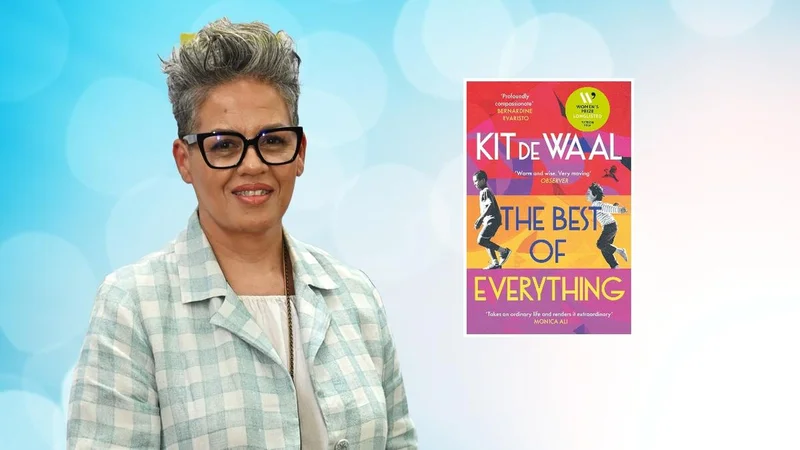
Last year, author Kit de Waal, 65, was the jury chair of the Women’s Prize for Fiction. This year, she was on the longlist of the same prize with her novel The Best of Everything (published by Tinder Press).
Beginning in 1972, The Best of Everything traces the life of Paulette, a 29-year-old Caribbean woman working as an auxiliary nurse in Birmingham. Deeply in love with a man named Denton, she begins to imagine a future with him—until his life is cut short in a tragic accident. In the aftermath of her loss, Paulette forms an unexpected bond with one of Denton’s friends. But just as she begins to rebuild her life, she comes face to face with the man responsible for Denton’s death. What might have unfolded as a story of revenge instead becomes a moving exploration of friendship, motherhood, forgiveness and kindness.
In this interview, the England-based author discusses how she found the distinct voices of the novel’s many characters. Edited excerpts:
Would you say that the ‘best’ in the title of your novel is meant to signal its subjectivity?
Yes, definitely. For my immigrant parents, ‘the best of everything’ was food. To many people, that would look like poverty, but it was modest for them. Paulette’s version too is modest — it’s a nicer house, though a rented one. Good food. Nike trainers. So, I wanted to show how all this is a moveable feast, and how ‘the best of everything’ comes down to the reality of life.
Paulette is a caregiver both in her personal and professional life. How did you shape this character?
Paulette is an amalgam of many people I know. My mother was an auxiliary nurse, who would come home from work and tell us stories of people that needed her. My sister is a foster carer, and I have friends who have been affected by bad relationships, poverty, and domestic abuse. I chose different aspects of all these people to create Paulette. Her fault is that she has too much love to give, which must go somewhere. It’s good for her job but not so great in her private life.
How did you find the distinct voices of your characters?
It’s really hard to stay true to a character’s voice. Paulette has a limited vocabulary, while ‘shirt & tie’ can speak in complicated sentences, especially when talking about his wife. Paulette has a specific West Indian diction — cutting her eye, kissing her teeth, or the way she talks about Denton having 32 perfect teeth. But her palette is limited, so the most you can do as a writer is play within those limitations.
Could you elaborate on the complexities of care in this sisterhood between Paulette and Maggie, a white woman?
Maggie is also an immigrant and both have experienced racism, though as a black immigrant, there is an additional layer for Paulette.
Given that Maggie and Paulette have nobody, they have each other in sisterhood. That’s the unspoken thing between them: they are outsiders but they have to be good to one another, as they’re united in otherness and poverty.
Nellie, the child Paulette comes to care for, was born to a mother with a brain injury. How did you approach writing this character?
Nellie really represents ‘the best of everything’ for Paulette. He has a gaping absence of love in his life, which is exactly what Paulette has too much of. They have a perfect bond, which Nellie can see but Paulette tries to put the blinkers on.
In developing Nellie, I wanted to amplify his yearning. I had to have him more aware than Paulette, of the potential in their relationship. I wanted him to be overwhelmingly real beyond everything because the plot serves the character. The character always comes first.
While writing him, I was thinking, ‘Oh, Paulette, can’t you just love him?’ But Paulette wouldn’t. She’s going to love her child. I couldn’t make things nice for Nellie because I have to make it true for him in order to show how the ‘saved boy’ becomes the ‘saviour’.
What are you working on next?
I just finished the sequel to *My Name Is Leon,* my first book. Leon was 10 in that book and now he is 37. The book will be out in May 2027.
The interviewer is a non-binary queer writer, essayist, and culture critic.
Published - August 04, 2026 04:03 pm IST