The US Treasury has taken the unusual step of coordinating with the Bank of Japan to buy yen, with the US selling euros rather than dollars to fund the purchases. Even though there has been a lot of commentary on this action, which is largely on target, some clarification is warranted, particularly over why the US intervened solo, as in why it perceived it was exposed.
The short version is that Japan is going green at the gills due to the (remarkably) continuing hangover from its monster real estate-stock market bubbles of the late 1980s, combined with an aging population and a general propensity to save rather than spend.1 It has used super loose monetary policy to fight borderline deflation with not much success until the Covid supply shock. That meant the yen was kept low in the post crisis era, which was beneficial to exports even if it failed to goose the domestic economy much.2 Japan is badly exposed to the Iran war-induced energy and supply shock, which have put more pressure on the currency and make buying critical supplies even more costly.
Most commentators deems the Treasury action to be intended to prevent large-scale sales of Treasuries to generate dollars so at to buy yen and increase its level. Analysts have been alarmed at the rise in longer-dated yields as the Iran war has progressed. While that may indeed be Treasury Secretary Bessant’s motive, it begs the question as to why the US does not tell Japan to suck it up and raise interest rates to defend the yen instead. It suggests the officialdom is at least as worried about a possible yen carry trade unwind.3
First to the operation proper. From CNBC:
- Japan’s Finance Ministry said it conducted a coordinated yen-buying intervention with the U.S. Treasury on Friday.
- Japan said it “will not hesitate to conduct further coordinated interventions in the future” and remains in close communication with the U.S. Treasury.
- U.S. Treasury Secretary Scott Bessent also confirmed the action in a statement, saying, “Friday’s coordinated foreign exchange actions countered disorderly yen movements.”
Japan’s Finance Ministry said Monday it had conducted a coordinated yen-buying operation with the U.S. Treasury on Friday, marking a rare joint move by the two allies to stem sharp swings in the Japanese currency.
Tokyo signaled it was prepared to act again if needed, saying it “will not hesitate to conduct further coordinated interventions in the future” and remains in close communication with the U.S. Treasury. Finance Minister Satsuki Katayama also stressed that Japan “remains attentive and in close communication with counterparts at U.S. Treasury.”
The Japanese yen had hit 163.73 against the greenback on Thursday last week, and strengthened to 157.57 on Friday. It was trading at 157.70 per dollar on Monday. The yen’s weakness has become an increasing concern for Tokyo, with the currency recently falling to its lowest level in roughly four decades against the dollar.
The ministry also announced plans to utilize the Federal Reserve’s foreign and international monetary authorities repo facility in the future. The FIMA repo facility allows approved foreign central banks and monetary authorities to obtain short-term dollars by temporarily exchanging U.S. Treasury securities
U.S. Treasury Secretary Scott Bessent similarly confirmed the action in a statement, saying, “Friday’s coordinated foreign exchange actions countered disorderly yen movements.”
Keep in mind that when a county is having an external debt crisis (whether private or public) and that then kicks off a currency criss (think the 1997 Asian crisis or the seemingly unending Argentina rescues), the IMF is the go-to party. In addition to being the lead actor in the infamous 1980s G-5 Plaza and later Louvre Accord yen interventions, the US and Japan acted in 2011 to halt sudden yen appreciation and in 1998, to halt a downdraft.4 The IMF comes up in some reporting on the current rescue-of-sorts, in that some traders wonder if US-Japan operations will be constrained by IMF rules on what is required to be considered a free-floating currency, a status Japan would presumably seek to keep if it can. 5
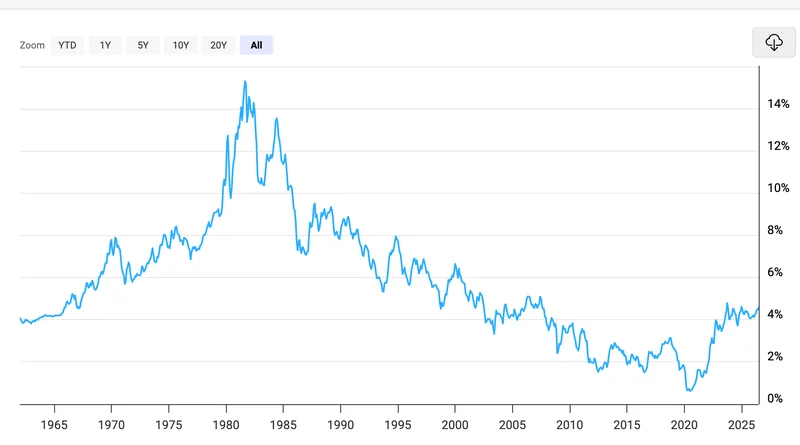
Let us remind readers that the hysteria over Treasuries breaching 5% ought to be unwarranted. This is hardly a high rate in historical terms. From Macrotrends:
The wee problem is that the US and many other countries went on a super-low interest rate experiment during and after the 2008 crisis. I remember when the Fed dropped its policy rates below 2% and thought it was a mistake. The central bank quietly later reached the same conclusion, that the ZIRP (in actual or real interest rate terms) did not spur the real economy, but instead goosed asset prices6 and most of all leveraged speculation. Bernanke did try to back the Fed out of these economy-distorting policies but lost his nerve in the 2014 Taper Tantrum.
But now we have a whole generation of investors that grew up under a bad new normal. And we also have finance pros as well as way too many who lack expertise (as in YouTubers who are sound on geopolitics) hand wringing about the US deficits as if they will case a crisis. Earth to base: a currency issuer like the US will never default involuntarily. It can generate too much inflation. What causes financial crises is excessive private debt. Both the US and even more so China are in that category. This is why we think it is quite possible that Treasury is worried about a carry trade unwind, which would hit wobbly tech stocks even harder.
The issue with US deficits is not their level per se but how badly they are done. To start with, the US does not even have proper accounting. We do simple in-out cash flows and do not parse out current spending (which in business would be on an income statement) versus investing (which would create a capital asset on a balance sheet).
Second, Michal Kalecki in his seminal essay, Political Obstacles to Achieving Full Employment, explained why governments would need to run deficits on an ongoing basis: the private sector would never invest enough to produce full employment. They want a pool of hungry labor to preserve their social distance from laborers and wield more authority over them.
But the US has been running highly unproductive deficits, in particular to fund stoopid wars but also for a bloated health care system and other forms of rentierism. So the concerns about the magnitude of the Biden and Trump budget deficits are warranted, even if the critiques are often not well founded.
With those caveats, now to some of the overviews. See the short image of the Bessant note at the top of the video segment, clearly intended to encourage investors to front run the US and Japan and so reduce how much they’d need to do:
🇺🇸🇯🇵 The Note in Bessent's Hand: Why America Just Bet Billions on Japan
A single sheet of paper, caught by a Reuters lens behind Treasury Secretary Scott Bessent at the July 31 cabinet meeting, said everything Tokyo needed to hear. "To Do: Buy Japanese Yen (JPY), $5–10 bil." It… pic.twitter.com/KDsms37wH6
— Aric Chen (@aricchen) August 2, 2026
Next to Wolf Richter, who is particularly caustic about the fix the Japanese economy is in:
According to a leaked comment published by the Financial Times, the New York Fed sold euros in its reserves – not dollars – and bought yen with the proceeds on Friday. The use of euros instead of USD has not been confirmed yet…
The rumor effect before the intervention, the theatrics, the intervention itself, and the announcement and confirmation effect resulted in a jump of the yen against the USD, from about ¥164 to the USD on Wednesday to ¥156.9 currently. This joint intervention was the big kahuna.
And both sides said that they would be ready to do it again, if needed.
Sure, but the prior interventions by Japan failed to turn around the downward spiral of the yen; they just provided temporary reprieve before the yet started spiraling down again.
Much tighter monetary policies by the BOJ – including lots of QT and much higher rates much faster – need to happen to permanently end the plunge of the yen. The yen is getting crushed by the BOJ’s crazed monetary policies from 2012 to 2022. That’s the root cause. What’s amazing is that they got away with it for so long…
1 No major economy has ever made the transition from an investment-export led economic model to a consumer-driven one without suffering an economic crisis. In Japan, it has taken the form of lost decades of growth. One impediment in Japan is the famously small apartment sizes in Tokyo and environs. There’s not a lot of room for stuff.
2 The yen was very strong in the runup to the crisis as the carry trade unwound, which fed into the crisis by forcing the sale of investments that had been funded by yen borrowings. I recall economists saying in the post 2010 era that Japan was exaggerating how bad its domestic economy so that no one would bust its chops over how weak the yen was then.
3 “Carry trade” = borrowing in a currency with lower interest rates to fund leveraged positions in a higher interest rate currency. This is about as smart as picking up pennies in front of a steam roller.
4 The US has a proud history of currency operations to defend domestic miscreants and speculators. From ECONNED:
This is 1994. You are a portfolio manager at a mutual fund. A salesman from Morgan Stanley calls and offers something that
sounds really appealing, an AA-rated instrument that makes payments that are markedly higher than typical AA-rated paper. He tells you that there is one hitch: if the value of the Mexican peso falls more than 20%, then the payments you receive from the bond (the instrument) will start falling in proportion to further decreases in the price of the peso. You know Mexico is a little rocky, but 20% is a very big cushion, so you take the plunge….The ratings agencies clearly thought that the peso was likely to fall. The grade they gave to Mexican government debt, denominated in dollars, was BB, a junk bond rating, while its peso debt was rated AA-….
The deals continue as doubts about Mexico were intensifying. Dollar-based investors are withdrawing from the country, putting even more pressure on the peso, which is at the bottom of its managed band. Salesmen at Morgan Stanley are placing bets on whether the currency will collapse. The firm, worried that it will go bust if Mexico suspends convertibility of the peso into dollars, creates some peso convertibility bonds that pay a mere extra 50 basis points (0.50%) to get customers to absorb that risk. It targets the most clueless, who cheerfully buy the paper….
Did Morgan Stanley and its cohort knowingly push the Mexican banks to ward the brink? Ex-Morgan Stanley derivatives salesman Frank Partnoy, who helped to peddle the Mexican deals, suggests as much…
Ironically, the popularity of peso gambles was probably Morgan Stanley’s salvation. So many investors held peso-linked dollar paper that no one looked particularly stupid for having gotten on the bandwagon. Moreover, the dam age was so widespread that Uncle Sam rode in to the rescue. The United States provided a bailout in the form of a $50 billion emergency loan. Congress had voted down the rescue, but Treasury Secretary and friend of Wall Street Robert Rubin broke open a Treasury piggy bank (the Exchange Stabilization Fund, a Depression-era creation to support the dollar) for an unintended purpose, namely, assisting U.S. banks and investors by propping up the peso. Some ar gued at the time that it would have been better to structure a bailout of the Mexican economy rather than of U.S. investment banks and investors, but to little avail.
5 From Bloomberg in Yen Strategists Parse IMF Rules for Clues to Japan’s Next Move:
Tokyo’s intervention on Thursday sent the yen surging more than 3% against the dollar, marking its latest attempt since around April-May to haul the currency back from a 40-year low. The question now is how quickly it can step in again.
Japanese officials have previously mentioned the IMF framework, under which a currency can be designated as free-floating if intervention is limited to at most three instances over six months, with each episode lasting no more than three business days. Exceeding that threshold could prompt the IMF to reclassify the currency as simply floating, carrying potential reputational costs.
In practice, this means Japan could return on Friday and again on Monday and still have the whole episode counted as a single market operation.“The IMF rule allows for intervention to be more effective, meaning that once you have done one, then you can go for your life over three days,” said Rodrigo Catril, a strategist at National Australia Bank Ltd. in Sydney. “Usually interventions are followed by aftershocks or mini interventions.”
6 That was initially a feature, not a bug, since the Fed and other central banks very much wanted to boost housing prices. But QE did that. It was designed to lower the interest rates of longer-dated Treasuries and mortgage spreads over Treasuries. There wa no reason to keep short rates super low on top of that.