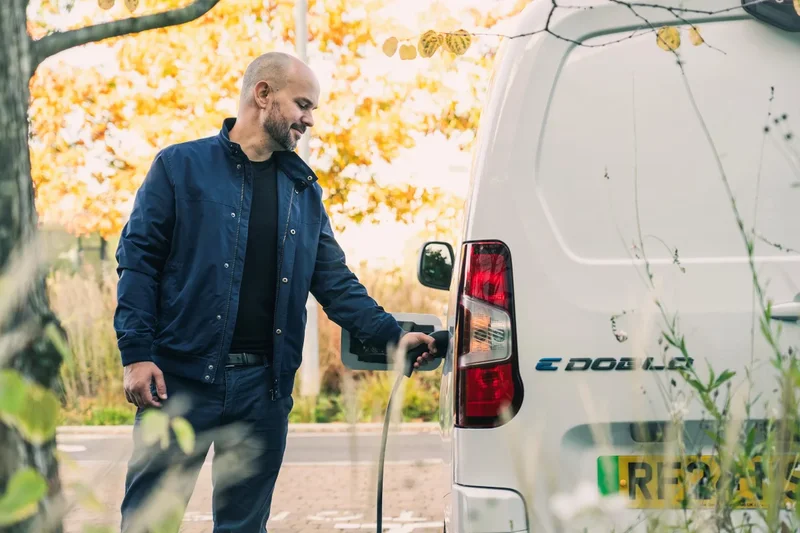
More than 70 per cent of the world’s leading corporate fleets didn’t add a single new petrol or diesel vehicle last year, according to a new report that suggests electric cars are quickly becoming the default choice for big businesses.
The latest Ev100 Progress and Insights Report, published by Climate Group, found that companies are moving beyond small electric-car trials and are now making EVs part of their everyday operations.
The study looked at corporate fleets working across 140 markets and found that one in five Ev100 members have already electrified more than half of their entire fleet.
Some businesses have gone much further. Global pharmaceutical company AstraZeneca has switched more than 80 per cent of its fleet of over 22,000 vehicles to electric power, and now operates fully electric fleets in 37 markets.
Stuart Poore, Executive Director Climate and Nature Strategy at AstraZeneca, said: "Driving change through collective action is essential – we recognise that no single company can achieve this global transition alone. Our fleet electrification is part of a broader transformation that's already underway."
The new figures suggest companies are increasingly choosing electric vehicles not simply to meet environmental targets, but also to shield themselves from changing fuel prices and prepare their fleets for future rules on emissions and combustion-engined vehicles. Climate Group says electric cars are cheaper to drive, require less maintenance and produce no exhaust emissions when they’re being used. For businesses operating hundreds or even thousands of vehicles, those differences can add up quickly.
Dominic Phinn, Head of Transport at Climate Group, said: "Corporate fleets are showing that the transition to electric vehicles is no longer a future ambition; it is happening now, at scale. They know EVs are cheaper to drive, they’re cleaner, and need less maintenance. Across markets, companies are moving from testing EVs to embedding them into core business operations. Their experience provides real-world evidence that electrification can deliver across diverse geographies, business models and operational requirements."
The report also claims that Ev100 members have avoided nearly three million tonnes of carbon dioxide equivalent emissions since joining the scheme.
However, replacing petrol and diesel cars is only part of the job. Companies also need somewhere to charge their new electric fleets, particularly when vehicles are spread across offices, depots and other business locations.
Ev100 members have now installed more than 48,500 charging units across 6,000 locations around the world, according to the report. That charging network is likely to be particularly important for vehicles that return to the same workplace or depot each day, allowing them to be plugged in when they’re parked rather than relying entirely on public charging points.
The latest findings also show that company EV use is spreading beyond the better-established electric-car markets in Europe, North America and parts of Asia. During the past year alone, Ev100 members put almost 24,000 electric vehicles on the road in emerging EV markets. That takes the total number deployed by members in those countries to 70,000 since they joined the initiative.
The Ev100 network was founded by Climate Group in 2017 and brings together businesses that have committed to speeding up the move to electric transport. Its work is now increasingly focused on fleet electrification in Latin America, Africa and Asia, where the electric car market and charging networks are generally at an earlier stage of development.
Climate Group says corporate fleets can play an important role in those regions by creating guaranteed demand for electric vehicles and charging points. Large company orders can give car makers, leasing companies and charging operators greater confidence to invest in markets where EV sales are still relatively low. It also means the move to electric fleets isn’t restricted to businesses operating in countries, with the most mature charging networks or the widest choice of electric cars.
The progress reported by AstraZeneca is being held up as evidence that a large and varied international fleet can be electrified across dozens of different markets.
There are still practical challenges for companies making the switch, including charging availability and finding suitable electric replacements for every type of vehicle. But the latest figures suggest many of the world’s biggest businesses are no longer waiting for those issues to disappear before getting started.