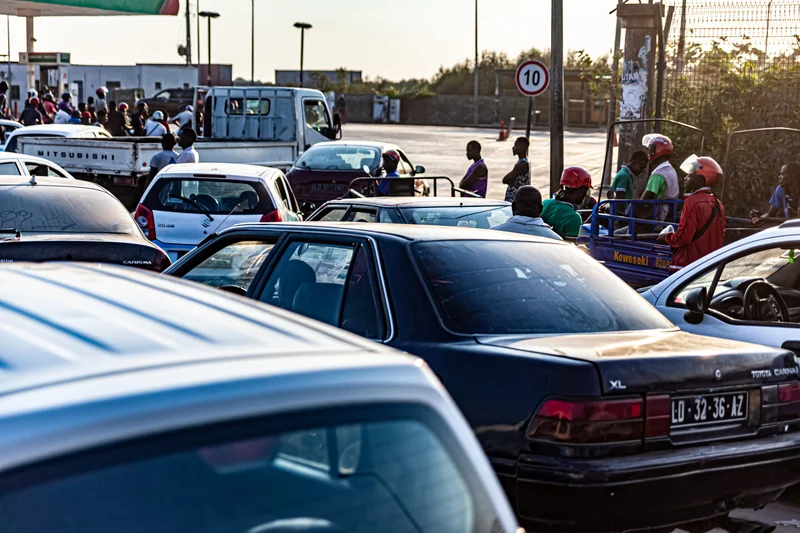
Angola’s Fuel Import Bill Hits US$1.7 Billion, Up 48%
ANGOLA · ENERGY ECONOMICS
What the Angola fuel import bill actually shows
In the first half of 2026 Angola spent Kz 1.544 trillion on imports of oil, fuels and gas. That is Kz 499 billion more than the same period of 2025, an increase of 47.8%.
No other import category rose as much. Fuel’s share of total national imports climbed from 14.6% to 23.2% in a single year.
Nearly a quarter of everything Angola buys abroad is now oil, fuel and gas. For one of Africa’s largest crude producers, that is the central fact of its economy.
Why higher oil prices did not rescue the budget
Exports did rise, and by more. Oil, fuel and gas exports went from Kz 12.307 trillion to Kz 12.915 trillion, an increase of about Kz 609 billion or 4.9%.
In headline terms that is a comfortable margin over the Kz 499 billion import increase. The problem is who receives each side.
Expansão’s point is that the import bill is paid by the state in full, while export revenue mostly accrues to the operating oil companies. The state captures taxes, fees and its production-sharing entitlement.
Assuming roughly one third of the export gain becomes effective state revenue, the paper puts that at Kz 203 billion against Kz 499 billion of extra import cost. On that modelling assumption, the net effect on these two trade lines is negative by some Kz 296 billion.
The refining gap behind the numbers
Angola’s refining capacity covers only a fraction of its own fuel demand. The Luanda refinery runs 65,000 barrels a day, and Cabinda’s first phase, which began commercial deliveries in May 2026, adds 30,000.
That is against crude output of roughly 1.03 million barrels a day. The regulator IRDP put Angola’s external dependence for fuel at 82.7% in the first quarter of 2026.
When crude prices rise, refined product prices rise with them, usually by more. A producer without sufficient refining is therefore long the cheap end of the barrel and short the expensive end.
This is the trap Nigeria has been in for roughly three decades and is only now escaping. Imported petrol was about 64% of supply over the 13 months to November 2025, on a THISDAY analysis of regulator data.
With the 650,000 barrel-a-day Dangote refinery finally at full rate, domestic output covered 78.6% of Nigerian petrol in the first half of 2026. Refining capacity shortens the queue; it does not end the dependence overnight.
Why this travels beyond Angola
The assumption that an oil producer benefits from an oil rally is one of the most durable simplifications in market commentary. Angola’s first-half accounts are a clean counter-example.
Ecuador is the closest parallel in Latin America. It imported about 65% of the fuel it consumed in the first quarter of 2026, and after a fire on 1 March the Esmeraldas refinery fell to 39% of capacity, pushing the March import bill to about US$810 million on Primicias’ reading of central bank data.
Bolivia’s import exposure is larger still, at more than half its gasoline and over 90% of its diesel. Its problem compounds a collapse in gas export revenue, and as a net fuel importer it is on the wrong side of the price too.
The variable that decides the outcome is not reserves but refineries. Where a country sits in the value chain determines whether a price shock is income or expense.
What to watch next
The first marker is the second half. If crude prices ease while refined product margins stay wide, the squeeze continues rather than resolves.
The second is domestic refining. Cabinda’s first phase started up inside this very half-year and the import bill still rose 47.8%.
A second Cabinda phase would take it to 60,000 barrels a day, with construction due to begin in the first half of 2027 and far larger plants planned at Soyo and Lobito. Each one that starts up removes a slice of the import bill.
The third is subsidy policy. Luanda has been cutting subsidies since June 2023, taking diesel from 135 to 300 kwanzas a litre in stages through March 2025, to 400 that July and to 420 in June 2026.
Mass protests followed the July 2025 round, in which at least 22 people were killed. That is the real limit on how much more of this bill the state can hand to consumers.
Frequently asked questions
How much did Angola spend importing fuel in the first half of 2026?
Kz 1.544 trillion, about US$1.7 billion, on oil, fuels and gas — Kz 499 billion more than the first half of 2025. That is an increase of 47.8%.
How much of Angola’s imports are fuel?
23.2% of all national imports in the first half of 2026, up from 14.6% a year earlier.
Did higher oil prices help Angola?
Exports of oil, fuels and gas rose about Kz 609 billion, more in absolute terms than imports, but the state pays the import bill in full while collecting only taxes, fees and its production-sharing entitlement. Assuming about a third of the export gain reaches the treasury, Expansão puts the net effect on these two trade lines at roughly Kz 296 billion negative.
Why does Angola import fuel at all?
Its refining capacity covers only a fraction of domestic demand: 65,000 barrels a day at Luanda plus 30,000 at Cabinda’s first phase, against crude output near 1.03 million. The regulator IRDP put external dependence for fuel at 82.7% in the first quarter of 2026.
Is the pass-through figure official?
No. The roughly one-third estimate is Expansão’s own modelling assumption, explicitly stated as such in its reporting.
This article was produced by The Rio Times’ automated newsroom system. How we use AI · Report an error