“Spider-Man: Brand New Day” turns organic web production into a superpower. In the 2026 film, Tom Holland’s character, Peter Parker, begins producing webbing inside his body and shooting it from his wrists, rather than firing synthetic web fluid from the wrist-mounted mechanical web-shooters he used in earlier films. The switch transforms a familiar superhero technology into a biological ability and highlights the spectacular properties of real spider silk.
Humans cannot shoot spider silk from their bodies, but scientists have studied this amazing material for decades, working to adapt it for a range of technological applications.
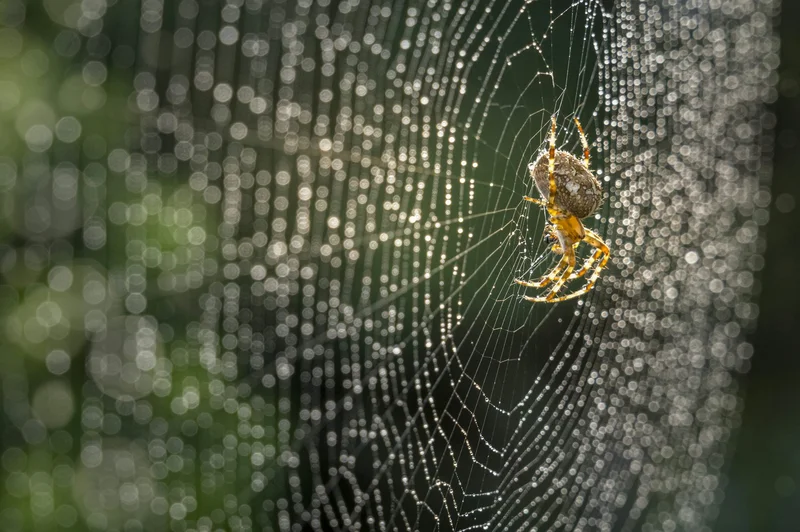
A web may look like one kind of thread, but in reality, it is a carefully engineered structure assembled from several materials. As a scientist with biomaterials expertise, I’m fascinated by how biology controls silk, from its protein building blocks to the architecture of a finished web, and by how scientists may adapt it for medical applications.
A web is a structure, not a substance
Spider silk refers to the material that spiders produce to make webs. The web is the architecture built from it, much as steel is a material and a bridge is a structure.
All spiders make silk, although many spiders do not build webs to catch food. They also use silk for safety lines, shelters, egg cases and wrapping prey. A safety line is a strand of silk that trails behind a spider and can catch it if the spider slips or falls, much like a climber’s safety rope. Orb weavers are especially useful examples because their familiar wheel-shaped webs combine several types of silk, each with a distinct function. Female orb-weaver spiders can possess multiple types of silk-producing or silk-associated glands, each linked to a different task.
To build a web, orb-weaver spiders use strong silk that forms the frame and radial “spokes” of the web. The capture spiral is the looping thread that circles the web and holds insects after they strike it. A highly stretchable silk forms the capture spiral.
The frame of an orb web is not sticky, as the glue lies mainly on the capture spiral. Its droplets contain proteins, water, salts and small molecules that help the adhesive remain soft and tacky. Other silks protect eggs or fasten threads to a surface. Another type of silk provides temporary scaffolding.
How a spider builds a web
A typical orb-weaver spider starts by bridging a gap, sometimes releasing a fine strand that drifts on the breeze until it catches another surface. The spider reinforces that line, creates a frame and adds radial threads that meet at a central hub.
Next, it lays down a temporary spiral that acts like construction scaffolding. It places the sticky capture spiral down on that scaffolding, often removing the temporary thread as it works. Researchers found that spiders follow distinct patterns of movement produced at each construction stage.
The completed web also carries information. When an insect hits the web, vibrations from the force travel along the threads and help the spider locate the prey.
Turning liquid protein into fiber
Spider silk consists mainly of very large proteins called spidroins. Their long chains contain stiff sections that pack together, and flexible sections that stretch. When you zoom in, they resemble tiny hard blocks connected by molecular springs.
This type of protein gives some silks both strength and toughness – two related but distinct mechanical properties. Strong fibers can be pulled with a large amount of force before breaking, while tough fibers absorb lots of energy as they stretch.
Spider silk can have extraordinary toughness, and the silk woven by a type of spider called Darwin’s bark spider is one example. It builds large webs across rivers, supported by bridge lines that can span 80 feet (25 meters). In one study, its dragline silk – the strong, nonsticky silk used for structural parts of a web – absorbed more than 10 times as much energy before breaking as Kevlar, when compared by volume.
That does not mean an entire web is difficult for a person to break. Strength and toughness describe a material’s performance after accounting for a strand’s tiny cross-sectional area or volume. Each thread is extremely thin, and a web contains very little silk overall, so the absolute force needed to rupture several strands remains small.
A spider does not store finished thread inside its body. It stores concentrated silk proteins in a water-based liquid inside glands in its abdomen. As the liquid moves through a narrowing duct, water is removed, the pH falls and the balance of ions changes. Flow through the duct also exerts mechanical forces that align the proteins, which then assemble into a solid fiber.
The spider performs this conversion at ordinary room temperatures in a water-based system, without the high heat or harsh solvents often used to manufacture synthetic fibers. For a biomaterials scientist, that manufacturing process may be as impressive as the fiber.
From webs to medicines and tissue repair
As a researcher in drug delivery and tissue engineering, I see a central lesson in spider silk: A material’s performance depends not only on its ingredients, but also on how scientists process and organize them.
Rather than harvesting silk from spiders, researchers study silk by placing silk genes into bacteria or other cells. These cells manufacture engineered silk proteins that scientists can shape into particles, films, gels, fibers and porous scaffolds.
For drug delivery, silk can act as a reservoir that holds a medicine and releases it gradually inside your body. In one laboratory study, engineered spider-silk particles released small molecules at a nearly constant rate for about two weeks. Researchers have also explored silk particles and gels for drugs made from proteins, like insulin and antibody treatments. These systems remain experimental, but they show how a biodegradable material might protect a medicine and control its release.
Silk can also form a scaffold: a temporary three-dimensional framework that gives cells space to attach, grow and organize during tissue repair. Scientists add cell-binding signals or other biological cues to engineered silk. These signals tell cells to attach to the silk scaffold.
Depending on the injury, a scaffold can cover a wound on the skin or be implanted inside the body to bridge or fill an area of damaged tissue.
Animal studies have tested recombinant spider silk as a covering for burn wounds, while laboratory studies have explored silk-based structures designed to support cell growth and guide nerve repair.
My research team and I have applied the same principle in 3D-printed synthetic scaffolds for bone regeneration. The scaffold provides the same type of physical support as silk scaffolds while delivering DNA instructions intended to encourage nearby cells to produce signals that support blood vessel growth and tissue repair.
The real wonder behind the webs
Scientists still cannot fully reproduce spiders’ ultimate control over silk formation or the complex architecture of their webs. But spider silk has already inspired experimental approaches to drug delivery, wound care and tissue engineering. Spider-Man supplies the spectacle, and real-life spiders supply the sensational materials science.