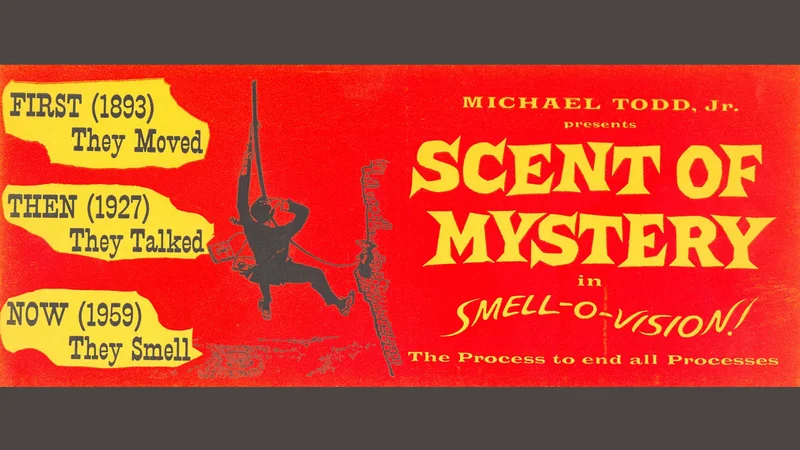
A mere six days into the 1960s, American moviegoers queued up for a cinematic leap. They’d watched as silent films transformed into talkies. And today, another cinematic breakthrough was surely due to delight the senses—or at least deliver novelty in compelling doses.
Yet when Smell-O-Vision debuted on January 6, 1960, there was something exceedingly phony about it. Teased ad nauseam in the press, this space-age tech wound up gassing moviegoers with brandy and gunpowder odors before flopping so hard its lone user called it “a complete disaster.”
Such was the verdict of famed cinematographer Jack Cardiff after his first and only smellie debuted in 1960 Smell-O-Vision. He’d made his mark with Hitchcock’s Under Capricorn (1949) and The African Queen (1951). Settling into the director’s chair, Cardiff boldly synced his third feature film with a Swiss inventor’s “scent brain.” It sequentially spewed 15 smells into auditoriums in Chicago, New York, and Los Angeles to tease plot points and amplify scenes.
Cardiff hoped viewers of his 1960 dramedy, Scent of Mystery, would associate its villain with the aroma of pipe tobacco, and a busted wine barrel with sweet grapes. Yet, inconsistent odor delivery and cost-cutting doomed Smell-O-Vision to mediocrity and a brief theatrical run.
Talkies filled seats; smellies cleared rooms. But the ideas underpinning Smell-O-Vision, which piped scents to seats—and rival format AromaRama, which pumped perfumes through air-conditioning ports—just won’t die. They’ve materialized as scratch-and-sniff gags and 4D films that feel like theme park sideshows, rattling viewers’ seats and blasting them with gusts of wind, mist, and yes, scents.
If you could go back to 1960 and experience Smell-O-Vision in all its unrealized glory, would you turn up your nose? Or would you take a whiff?
Theatrical stinkers: a brief history
Theaters have long used odors to immerse audiences, exploiting the express route smells take to the emotional and memory centers of our brains.
Take, for example, “Macbeth.”
Seventeenth century performances of the Shakespearean tragedy called for stagehands to detonate mini explosives, or squibs, to evoke thunder. Such effects also “would have filled the theater with the smell of gunpowder,” Oxford experimental psychology professor Charles Spence wrote in 2021, in the journal i-Perception.
This created “an olfactory reference for the ‘three witches’ bizarre incantation: ‘Hover through the fog and filthy air.’”
The olfactory system, to which Spence refers, powers the sense of smell in humans, witches(?), and other vertebrates. It includes the nostrils, odor-sensing neurons, and the olfactory bulb, which beams smell info around the brain.
This wasn’t just a Shakespeare or stage-play thing. For example, London’s Alhambra Theatre sprayed its auditorium “with scent by Rimmel’s Vaporizers” during an 1868 performance of a ballet called “The Fairy Acorn Tree.” And that’s far from the only scent-invoking performances: There are numerous accounts of theaters employing scent design, all the way through the dawn of cinema.
The slow march to smellies
To contextualize Smell-O-Vision and Scent Of Mystery’s debut, Variety rustled up early cinematic experiments in many-sensory media. In one issue, the trade magazine featured a letter to the editor from a former manager of Boston’s Fenway Theater.
(This movie palace would eventually become Berklee’s Performance Center, in time for the band Aerosmith to christen it as a rehearsal space—surely an aromatic experience unto itself since the band’s leader, Steven Tyler, was known for his “distinctive scent” of “a citrus-berry-macho-musk fragrance.”)
During Fenway Theater’s heyday in 1929, the former manager recalled “carefully” spilling a pint of lilac perfume into the theater’s ventilation system. He timed it so the scent reached moviegoers as the film’s title, Lilac Time, appeared, to much applause. (In hindsight, he added, it was possible to expand on this idea for other films by frying bacon or “gathering together a group of marijuana smokers to lend their atmosphere.” Coulda, woulda, shoulda!
Just shy of a decade later, while planning the 1940 animated feature Fantasia, Walt Disney considered “floral perfumes for the Nutcracker Suite” and “gunpowder to stoke the devilishness of the Sorcerer’s Apprentice sequence.” That’s according to What the Nose Knows, a 2008 book on smells in pop culture by psychologist Avery Gilbert.
But the House of Mouse apparently saw dollar signs add up and bailed: “Disney, while reluctant to give up on such a ‘great publicity angle,’ eventually decided to steer away for cost reasons,” Gilbert wrote.
The same year Fantasia debuted, utterly odorless in 1940, Smell-O-Vision entered the picture.
Swiss inventor Hans Laube previewed an early version of Smell-O-Vision at the New York World’s Fair. “Movies stink now,” his subordinates joked in a September 1940 Variety interview. From the Fair’s Swiss Pavilion, Laube reportedly showcased scented short films. One sharp-smelling demo featured a chef chopping onions. Another smelled of “apple blossom as a happy couple strolls through the orchard in springtime,” per Variety.
The initial tech required a projectionist to trigger smells manually; it apparently fooled the New York Times. The paper said Laube’s machine produced “odors as quickly and easily as the soundtrack of a film produces sound.” Still, Laube left New York without a deal to commercialize the tech. A decade passed before the inventor could truly put Smell-O-Vision to the test.
A smelly “battle” is born
As Laube refined his tech ahead of its 1960 debut, competing innovations kept the scented-media dream in the zeitgeist. General Electric showcased Smell-O-Rama in 1953, combining an image of a 3D rose with an atomizer.
Another Smell-O-Vision rival AromaRama, which clearly a public relations pro devised, also barreled towards release.
“Smells are surer than sounds or sights to make the heartstrings crack,” AromaRama developer Charles Weiss said in a 1959 CBS appearance.
Noting the budding rivalry, Variety dubbed the approaching showdown between AromaRama and Smell-O-Vision the “Battle of the Smellies.” But when AromaRama debuted in December 1959 with the documentary film Behind the Great Wall, critics pretty much eviscerated it.
The New York Times dismissed AromaRama as a “stunt” with an “artistic benefit” of “nil.” Crucially, the review noted that Behind the Great Wall was not directed with scents in mind. Weiss had added them after the fact.
In contrast, Smell-O-Vision’s debut less than a month later stood out because it incorporated odor tech into the architecture of a film. Earlier experiments, and many subsequent ones, used smells as an afterthought or gimmick to fill seats. In this light, Smell-O-Vision was the real deal. Did critics buy it?
Related 'That Time When' Stories
Smell-O-Vision reeks its way into history books
Hot on AromaRama’s heels, Cardiff’s Scent of Mystery funked up theaters in January 1960 with transformed Smell-O-Vision tech. Eschewing manual buttons, Laube linked notches on a film reel to a belt of pierceable perfume containers and piped odors to each seat, per a contemporaneous issue of Popular Science. This innovation, which Laube called a “scent brain,” enabled automatic scent release from bottle to nose.
But even a considered approach to scented cinema by Cardiff fell flat. Upon Scent Of Mystery’s debut, the New York Times remarked that moviegoers sat “there sniffling and snuffling like a lot of bird dogs, trying hard to catch the scent.”
Thus the battle of the smellies screeched to a halt. Reviewers in 1960 panned both AromaRama and Smell-O-Vision, criticizing scented cinema as altogether distracting, mistimed, and ineffective. Smells lingered and merged together. They didn’t reach all moviegoers on cue. And hissing sounds reportedly tugged the robes off the skeletal tech of the era, undercutting the illusion of smelling stuff on screen.
Cardiff later called Smell-O-Vision the “one film I want to erase from my memory.” Ironic, considering how scents often help cement memories into place.
Though cruel, the Smell-O-Vision beef outlasts those who whiffed it contemporaneously. Time magazine has repeatedly ranked it among the worst ideas of all time. This is particularly unfair to Laube: The father of Smell-O-Vision had sketched out more advanced tech than budgets ultimately allowed.
For example, the inventor foresaw that spewing back-to-back scents would add up to a muddled mess. He devised a solution to reverse the machine and suck up a scent before dispensing another, so theaters wouldn’t reek like the bowels of Sephora. But critics barely got a whiff of Laube’s actual vision.
Smell-O-Vision’s abrupt turn from hype to nothingburger, and its silly name, helps explain how it lingers in pop culture. It would take a radical leap forward for scented media to outgrow its hokey origin story. So far, nobody’s done it.
Smell-O-Vision’s closest successor today is the theme park-like offshoot 4DX. But like 3D, 4DX remains a detour from the enduring 2D nature of cinema.
Save for the buttered popcorn, movies are largely still odorless, and Smell-O-Vision remains utterly teasable for how poorly it emulated a widely accessible thing. All told, we have Smell-O-Vision in our real life. A mere look around offers plenty of things to see and smell. Sometimes, life yields aromatic, evocative, beautiful things—and sometimes, it stinks!
In That Time When, Popular Science tells the weirdest, surprising, and little-known stories that shaped science, engineering, and innovation.