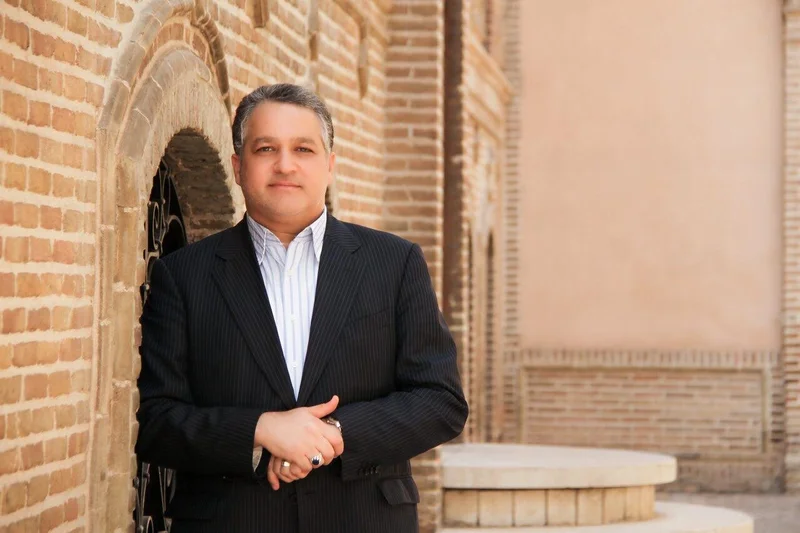
HEGTA chief highlights Ardabil’s potential as a storytelling destination
TEHRAN – Alireza Tabesh, chief executive of the Tourism Group of the Social Security Organization (HEGTA), has described Ardabil as a destination that needs to be introduced through storytelling, saying the province’s rich historical, cultural, natural and spiritual capacities have yet to be presented to visitors as a coherent tourism experience.
In a note, Tabesh wrote that the holding of a national literary and mystical tourism conference at the UNESCO-registered Sheikh Safi al-Din Khanegah and Shrine Ensemble provided an opportunity to revisit a fundamental question: why has a province with such extensive resources not yet secured its deserved place in the minds of Iranian and international tourists?
He said the answer should not be sought in a lack of attractions, noting that Ardabil is among the few Iranian provinces that simultaneously encompasses nature, history, mysticism, literature, art, handicrafts, music, health tourism and local culture.
“From Sabalan and its hot springs to the Sheikh Safi complex, from Ashiq music and charming handicrafts to vibrant villages, local cuisine and ancient rituals, each can independently become a reason for travel,” Tabesh wrote. “The issue is that these capacities have not yet been offered to tourists in the form of a destination and a coherent narrative.”
He said that for years tourism discussions in Iran had focused mainly on attractions, while competition among destinations in today’s world is based not on the number of historical sites but on the quality of experiences created for travelers.
“Today’s tourist does not travel only to see a monument or a landscape; they seek an experience that creates meaning, remains in their memory and can be narrated after the journey ends,” he added.
Tabesh stressed the importance of “destination management,” describing it as connecting all the assets of a region through a shared narrative that links nature, history, literature, art, food, handicrafts, architecture, music and local lifestyles.
“A successful destination is not a list of attractions; it is an experience that takes shape in the mind and heart of the traveler,” he wrote.
He described the Sheikh Safi al-Din Ardabili World Heritage complex as more than a valuable architectural monument, saying it represents mysticism, art, calligraphy, thought, the formation of the Safavid state and part of Iran’s historical memory.
According to Tabesh, if the complex is accompanied by professional interpretation and storytelling, it can transform a simple visit into a profound experience of Iranian culture. However, reducing the visit to a few minutes of sightseeing and souvenir photographs would result in losing a significant part of its value.
He made a similar idea about Mount Sabalan, saying the mountain is not merely a high peak but a narrative of mythology, nature, nomadic migration, music, cuisine, night skies and the region’s ecosystem.
“The true value of these assets becomes clear when they are brought together to create an integrated, narrative-based experience for tourists,” he wrote.
Tabesh also pointed to recent developments in Ardabil, including the publication of books introducing the region’s history and cultural identity to younger generations, children’s and teenagers’ publications focused on provincial heritage, as well as conducting research projects.
He said these initiatives show that a narrative-based approach to Ardabil’s identity is gaining strength.
“These efforts, when viewed together, are not merely scattered cultural activities; they are components of a broader strategy for ‘destination narrative management,’” Tabesh wrote.
He added that every novel, children’s story, documentary, play, travelogue and book portraying Ardabil represents part of the province’s intangible tourism capital, arguing that destinations are created in the minds of audiences before they are chosen on maps.
Tabesh also emphasized that destination management requires cooperation beyond institutional boundaries, saying universities, urban authorities, cultural heritage officials, private businesses, media organizations, cultural associations and local communities must work within a shared framework.
“No organization alone can create the narrative of a destination,” he said.
He added that organizations such as HEGTA can play a facilitating role by connecting cultural heritage, investment, experience design and tourism markets, but said Ardabil’s future depends above all on establishing an integrated destination management system.
“Ardabil will become a city where every traveler, after leaving, becomes a storyteller of Ardabil,” he said, describing this as perhaps the most important measure of successful destination management in the 21st century.
AM