Afghanistan hunger crisis intensifies as millions left without food aid
By
Nathalie Minard, Geneva
Afghanistan’s dire hunger crisis now affects 14 million people including babies fed on little more than weak tea and bread by their despairing and dirt-poor parents.
Key points
- 14 million Afghans face acute hunger, with only one in nine receiving WFP food assistance.
- Child malnutrition has reached record levels in 12 provinces, with children under two hardest hit.
- Funding shortages have forced WFP to scale back lifesaving nutrition programmes nationwide.
- The agency needs $500 million before winter to avert a worsening humanitarian crisis.
In a new alert on Tuesday, the UN World Food Programme (WFP) said that one in three Afghans is now in the grip of acute food insecurity and that it lacks the resources to contain the deepening crisis
Today, 12 provinces have now reached critical levels of acute child malnutrition, the highest number ever recorded.
Conflict, widespread unemployment, soaring food prices, shrinking humanitarian funding and disruption to supply routes are fuelling the crisis, WFP said.
Forced returns
The return of six million Afghans pushed back mainly from Pakistan and Iran since September 2023, has increased the strain on the country’s already fragile economy.
“In the past three years, close to six million Afghans have been forcibly expelled from neighbouring countries,” said John Aylieff, WFP Country Director for Afghanistan. Briefing journalists in Geneva from Kabul, he explained that **there are “simply not enough jobs to sustain” the returnees. **
**“Conflict with Pakistan and the Middle East crisis have created trade disruptions, which have pushed up the price of staple foods by 20 to 30 per cent...The poor are being priced out of the market,” he explained. **
Because of crippling funding cuts, WFP has been able to feed only one in nine of the 14 million people now acutely hungry in Afghanistan.
And as funding shortfalls deepen, lifesaving nutrition programs are being scaled back, just as needs are peaking.
Most vulnerable infants
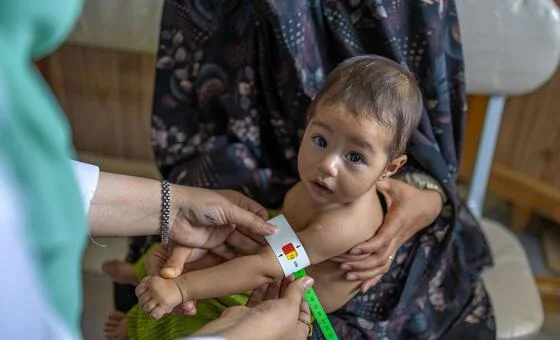
Child wasting - the deadliest form of malnutrition - has reached critical levels in one-third of the country's provinces. “The number of children being rushed to health centres is soaring and we're seeing this visibly. Eighty per cent of the worst cases are children under two years of age and NGOs report that too many of them are arriving too late to be saved,” warned Mr. Aylieff.
Shrinking humanitarian funding means that “millions of acutely malnourished Afghan children are being turned away without assistance at the very moment when their lives are at risk,” leading to “deaths, which of course are fully preventable”, he added.
During a recent visit to the province of Kandahar, in southern Afghanistan, WFP staff met Farida, a mother of three whose story reflects the plight of many of the country's poorest families. Her husband, an elderly street vendor, earns less than a dollar a day, leaving the family with no chance of affording nutritious food, healthcare, or other basic necessities.
Mother's plight
Two of Farida's children suffer from anaemia, and her six-year-old son has been too weak to attend school for months, because of acute malnutrition.“When we spoke to Farida, her baby started crying from hunger,” the WFP Country Director for Afghanistan said. “She reached into her bag and pulled out a child's bottle. Normally, you expect the child's bottle to be full of milk. This one only had weak tea in it. There was simply no money in the household for milk.”
Farida told WFP that she repeatedly has to tell her children that there is nothing more to eat. The family is barely surviving on tea and bread. Without the food assistance they receive through a WFP-supported clinic, she said her children would “undoubtedly die”.
“That's a hard message to hear,” said Mr. Aylieff. “But harder still when you realize that WFP is only funded this year to feed one in seven acutely malnourished women and children. Yes, we are turning away six out of seven and we're turning them away empty-handed with absolutely nothing,” he stressed.
WFP treats malnourished children aged under five and pregnant and breastfeeding mothers in clinics across the country, in partnership with UNICEF. But a sharp decline in humanitarian funding has forced the agency to prioritize food assistance to only a fraction of the most vulnerable. The distribution of specialized nutritious foods to prevent malnutrition and stunting halted completely in May 2025.
The UN food agency warned that Afghanistan’s nutrition crisis is spinning out of control. WFP’s operations for emergency food assistance and nutrition programmes are costed at about $900 million for 2026. “We have not met needs in the first six months because we didn't have money. And when you look at the next six-month window, this critical window, not just because of the current crisis, but also in the run up to winter, which is the real flashpoint of hunger, WFP still needs $500 million to address the acute food needs in the country,” said Mr. Aylieff.
Humanitarians continue to highlight that deepening hunger fuels migration, radicalization and ultimately instability, with consequences that extend beyond Afghanistan's borders.