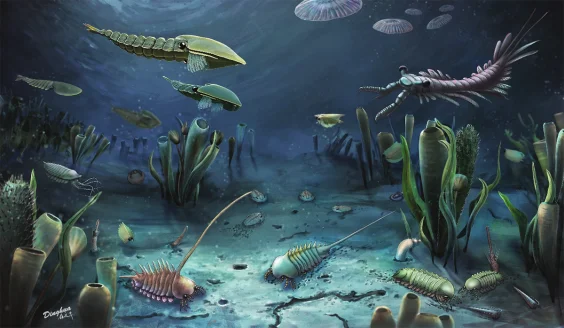
Something magnificent happened during the Cambrian Period, 539 to 486 million years ago: complex life emerged. Almost all major animal groups arrived, with the evolution of shells, skeletons, and other features that supported larger organisms.
Scientists have hypothesized that the “Cambrian explosion” resulted from a gradual increase in atmospheric oxygen levels that provided a metabolic boost. But now, a review study published today in Trends in Ecology & Evolution hypothesizes that the ecosystem overhaul was also fueled by an explosion of poop.
In a modern ocean, animal excrement is a key part of the nutrient cycle that infuses the water column with carbon, nitrogen, phosphorus, and iron, nutrifying deep waters. The earliest evidence of ocean animals is from the Ediacaran Period, about 600 million years ago, but to date, no fossilized poop has been found. Beginning in the Cambrian, however, such “coprolites”—that is, evidence of gut contents—have been discovered in 36 fossil deposits, the oldest dating to about 538.8 million years ago.
Read more: “In Search of the First Animals”
Paleobiologists Julien Kimmig, from Germany’s Staatliches Museum für Naturkunde Karlsruhe, and Russell Bicknell, from Flinders University in Australia, searched the primary literature for all known instances of Cambrian coprolites. They found a variety of them, from microscopic “carpets” of feces to inch-long cylindrical or circular versions. By analyzing the array in relation to diets of Cambrian animals, they gained insights into food webs and nutrient cycling from hundreds of millions of years ago.
“We’ve considered these ancient diets, increasingly sophisticated digestive systems, and trophic interactions as part of a much bigger picture,” explained Bicknell in a press release, “to help explain how more organic matter and nutrients poured into the ancient oceans to accelerate ecosystem development at the end of the Ediacaran and early Cambrian periods.”
The researchers hypothesize that as more complex digestive systems evolved, wider varieties of food were processed. A larger boost of poop made nutrients available to other organisms, creating the conditions necessary to sustain complex life. “The importance of feces in ancient ecosystems is often overlooked,” added Bicknell.
Viva la fecal revolucion!
Lead image: Zhixin Sun, Fangchen Zhao, Han Zeng, Cui Luo, Heyo Van Iten, Maoyan Zhu / Wikimedia Commons