It’s 11pm, the temperature’s a still-balmy 23C. Towards the end of my 25-minute taxi ride from Yerevan’s international airport into the city, we come to a vast, largely pedestrianised square where a series of illuminated fountains gush to the soundtrack of classical music (and, at one point, the theme tune to Star Wars). Throngs of people, young and old, are milling around, enjoying the spectacle alongside persistent balloon and flower sellers. Some kind of special event or celebration? Turns out it’s just your average Monday – the Dancing Fountains show, as it’s known, takes place every afternoon and evening during summer, here at Republic Square.
By daylight it transpires that the square is actually oval-shaped, ringed by imposing, curved buildings and an important part of Armenian architect and urban planner Alexander Tamanian’s vision for the city. He designed it all practically from scratch in the 1920s, just after the country fell under Soviet rule. A grand affair, the square is home to various government ministries, the Central Post Office, the National Gallery and the History Museum, all constructed from the rose-coloured tuff (a volcanic stone) which has caused Yerevan to be dubbed, poetically, the Pink City.
Landlocked within the South Caucasus region, and bordered by Georgia, Turkey, and trickier neighbours Iran and Azerbaijan, Armenia hasn’t generally been at the top of most people’s wishlists. So why visit? I’ve come from London via the first direct route with Wizz Air, which launched on 12 June. While it might seem an unlikely destination for the average budget traveller, Wizz Air’s MD, Yvonne Moynihan, explained: “We want to help our customers explore beyond the obvious.” Yerevan, rich in history, culture and character, definitely fits the bill.
It’s one of the world’s most ancient cities, in existence since 782BC – predating Rome – but has had to weather squabbles over its control by the Byzantines, Ottomans, Persians and the Russian Empire. Not much of the old city remains; instead I find a modern and sophisticated metropolis of just 1.1 million people, with battered, Russian-made Ladas dominating the traffic just as much as slick Teslas do.
As I explore its wide, leafy avenues with my delightful local guide Marie, who uncannily resembles the actress Rachel Zegler, there is indeed something different at almost every turn. Culture is revered here, and plaques, busts and statues celebrating some of the country’s most famous poets, artists, musicians and composers adorn the streets. A recent addition is a sculpture of French-Armenian crooner Charles Aznavour. Born Shahnur Vaghinak Aznavourian, he is honoured thanks to his fundraising efforts after a devastating earthquake in the country in 1988.
On our way to the stately grey, circular, Tamanian-designed National Opera and Ballet Theatre, Marie reveals a link to another Armenian descendant. We walk past the small, pretty Swan Lake, and she tells me that in 2015, a particular musical artist was here with his then-wife, and gave an impromptu performance before running into the lake fully-clothed, causing hundreds of fans to, chaotically, copy him.
It may not surprise you to hear that the artist was Kanye West, with his then-wife Kim Kardashian. (Another A-list Armenian is Cher, born Cheryl Sarkisian in California. She visited Yerevan in 1993, and was pictured posing on the toppled and decapitated statue of Lenin which, pre-independence, once dominated Republic Square).
A short walk away is one of the most striking urban sights I've ever encountered: the Cascade Complex, a tiered structure of 572 steps climbing past terraces of fountains, carvings, and contemporary artworks donated by collector Gerard Cafesjian. More pieces line the staircases and escalators inside.
Read more: Turkey’s best budget train ride is an 800-mile journey east
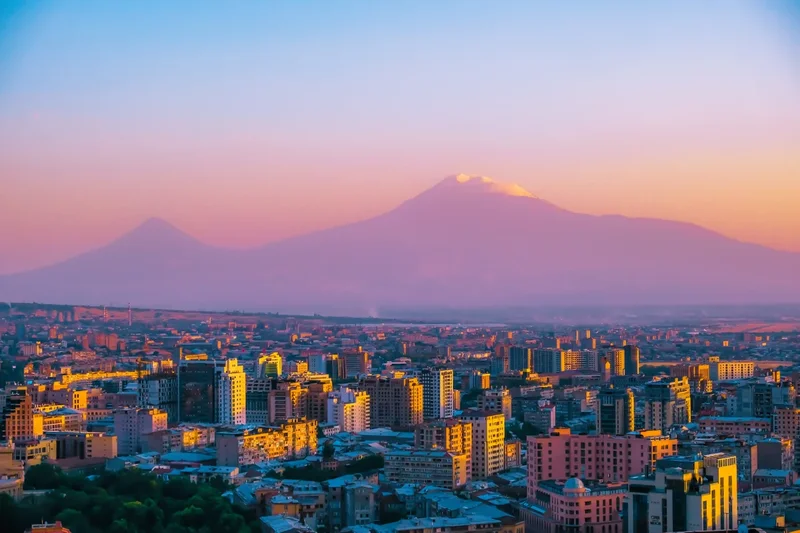
From the top, the view stretches across to Mount Ararat, the biblical resting place of Noah's Ark, and a sacred site to the many Armenians who believe it ties them directly to Noah's lineage. Tamanian deliberately designed the city so every resident could see the mountain, even though the Soviets ceded the land it stands on to Turkey in 1921. Its twin peaks, one far smaller and shaped rather like Mount Fuji, are both perpetually snow-capped.
Armenia’s history has had far darker chapters, too; never more so than when the Ottoman Empire carried out a horrific genocide between 1915 and 1916, targeting the country's Christian population. The sad and sobering facts are ably recounted at the Tsitsernakaberd Armenian Genocide Memorial complex, which sits on a hill overlooking the Hrazdan Gorge. It makes for uncomfortable visiting, but I’d say it’s necessary to understand some of the turmoil this beautiful country has suffered and its subsequent resilience.
I’ll end on a much more positive note: the food. At every juncture, this was fresh, homemade and utterly delicious. Even Armenia’s bread is Unesco-recognised: the ubiquitous lavash, a thin, chewy sheet of blistered flatbread, is prepared by women who joyfully slap and turn the dough until it’s transparent enough to be slammed against the interior of a special undergound oven, called a *tonir. *
Read more: I’ve been to more than 120 cities – these are the six best in Europe for a solo summer break
Elsewhere, fire-grilled meats (khorovats) and fish are common. I had a delicious plate of red trout at Sherep, one of the city’s best restaurants, alongside dolma (minced meat and rice wrapped in vine leaves), harissa, a thick, comforting wheat porridge made with chicken or lamb, and more salads than you can shake a bottle of olive oil at: locally-grown tomatoes, cucumbers, peppers, olives and more are mixed with herbs, local cheeses, and, sometimes, beef or chicken.
If you have a sweet tooth, pick up a slab of gata at a food market, a round, brioche-like cake with a sugary filling. One of my favourite meals was at Zepyur, a hip hangout with 70s-style decor just off Aboyvan Street, one of the main thoroughfares.
After devouring a delicious dinner, Marie ordered me a surprise dessert, which turned out to be in the form of the bust of Lenin. Red icing concealed chocolate mousse, and honestly, I had as much fun taking his head off as I’d imagine the Armenians did with his statue in the aftermath of their independence from the Soviet Union in 1991. That year marked the start of a hopeful, positive and vibrant new chapter for Armenia, and from what I’ve seen in Yerevan, I’d say that still remains the case.
The best things to see in Armenia outside of Yerevan
These fascinating sights are all within an hour’s drive:
- Garni Temple: The only surviving Greco-Roman colonnaded building in the former Soviet Union, this elegant, first-century structure is often compared to Athens’ Parthenon.
- Symphony of Stones: Armenia’s answer to the Giant’s Causeway, this natural phenomenon consists of thousands of hexagonal basalt columns located within the dramatic Garni Gorge.
- Geghard Monastery: A medieval, Unesco-listed cave monastery carved into the cliffs of the Azat Valley. If you’re lucky, you might catch a choir singing in one of its rock-cut chapels.
- Zvartnots Cathedral: Dating from the seventh century, but destroyed by an earthquake in the 10th, the impressive ruins of this circular cathedral are built on the location where Gregory the Illuminator, the founder of Christianity in Armenia, met with the then-King Tiridates to persuade him to adopt the religion.
- Etchmiadzin: The home of the oldest cathedral in Armenia, and possibly the world, built in 301, shortly after Christianity was adopted. Today it’s also the administrative headquarters of the Armenian Apostolic Church.
How to do it
Flights departing on Mondays and Fridays from London Luton to Yerevan start from £46 one way with Wizz Air.
Where to stay
Spacious double rooms at the Ramada Hotel start from £129 per night.
Laura was a guest of Wizz Air