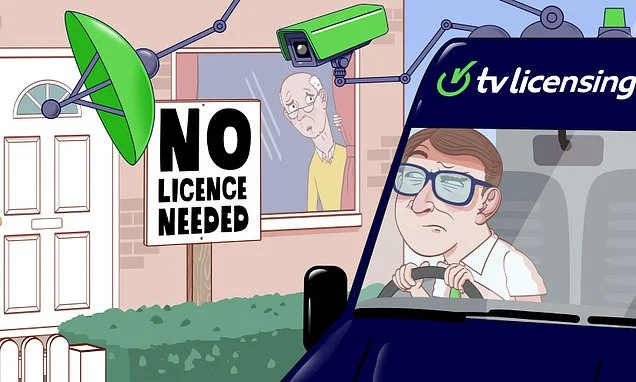
TV licensing sent me a letter saying I watched BBC iPlayer without a licence. I don’t know what iPlayer looks like, never mind how to use it. I don’t watch live TV either, and only use my set to watch DVDs and videos. It is not connected to an aerial. Why is the BBC harassing me?
D.O., West Yorkshire.
Sally Hamilton replies: On speaking to you, I discovered you had made a ‘no licence needed’ declaration to TV Licensing within the last couple of years. You are one of the 3.7 million premises, both residential and business, to state they do not require a TV licence.
It is illegal to watch live or record TV programmes on any channel or use BBC iPlayer in any form without a licence, which costs £180 a year or £60.50 for black and white.
The exception is if a viewer only accesses on-demand programmes on streaming services such as Netflix and never watches any live broadcasts. On-demand services from iPlayer do require a licence.
Householders aren’t compelled to declare that a licence is not required, though the ‘no licence needed’ (NLN) declaration, which can be made online, is helpful in fending off constant reminders from TV Licensing. It typically lasts 24 months and then the reminders kick in again until another declaration is made.
As you are 89 and anxious about technology, your family organised the declaration for you. They wanted to help end the torment of your regular licence reminder letters. Reminders go out to properties that haven’t registered as NLN as often as once a month, with the message becoming increasingly threatening.
They include warnings of potential visits from enforcement officers and fines of up to £1,000 (£2,000 if you live in Guernsey) for non-payment.
Regular licence reminder letters go out to to properties that haven’t registered as ‘no licence needed’ (NLN) as often as once a month, with the message becoming increasingly threatening
You were relieved to switch off the postal barrage but recently, when the organisation wrote to say it suspected you were watching iPlayer, you nearly flipped.
When we spoke, you were adamant you never watch live or catch-up TV. You use your old set only to view your large collection of DVDs and video cassettes, of old series like Bonanza and comedies Cheers and Sgt. Bilko. You get news from two radios, one tuned to BBC Radio 4 and the other to the World Service. A licence is not required to listen to the radio.
You could not fathom how the BBC concluded someone had accessed iPlayer in your house. I asked about visitors and you said your daughter visits. I wondered if she had logged into iPlayer on her phone? You had no idea.
But even if she had, I imagine she has her own licence, so why would it be an issue if she happened to log on under your roof?
The rules say it is fine for a licence holder to watch TV in someone’s unlicensed property, so long as the device runs off its battery. Once connected to the property’s mains, it becomes potentially illegal. This rule does not apply when plugging in on public transport.
On my request TV Licensing investigated. A few days later, after customer service spoke to you, it was able to confirm that the issue came about because a relative manages your NLN declaration, and the email used to do this was the same as the one they use to sign into iPlayer.
There was no suggestion your relation accessed iPlayer at your home. You were off the hook.
TV Licensing said: ‘We have spoken with your reader and clarified the circumstances surrounding the NLN declaration.
‘A review was prompted after activity suggested that licensable content may have been accessed from the property. Having established the relevant facts, we can confirm that the NLN declaration remains in place.’
You can now go back to watching your favourite series without fear of pestering post. Perhaps an episode of Cheers is appropriate.
I wanted to put a £10 bet on the World Cup for Spain to win, and my husband placed it for me at the local Coral betting shop. The slip said, ‘Spain to win World Cup final’ and when they did my husband went to claim the winnings. The bookmaker refused to pay as Spain didn’t win in the first 90 minutes. This wasn’t pointed out to my husband when he made the bet and was not mentioned on the slip. We lost only a small amount but what if he’d bet £1,000? Readers need to be aware.
P.S., Warlingham, Surrey.
I am not a sports better and have only had the occasional flutter long ago on the Grand National. Like you, I’d have imagined that a bet on Spain to win the World Cup offered no room for interpretation. But no.
It seems that Spain would have had to have won before the 90-minute whistle blew. Because the Spaniards scored to win 1-0 in the second half of extra time, your bet was null and void.
A reader placed a bet on ‘Spain to win the World Cup final’ but the bookmaker refused to pay them, because the team didn’t win in the first 90 minutes – a common wager in sports betting
You were most unhappy and contacted Coral’s customer complaints. Staff asserted that Coral had played by rules apparently displayed on the wall of the shop.
Even when you argued that at no time did the cashier explain that the market was 90 minutes only and that the betting slip also had no mention of any such restrictions, it cut no ice. I put your gripe to Coral, reminding it that you and your husband are not regular punters.
It confirmed your bet was accepted on the match result market, which related to the outcome after 90 minutes of play.
This is apparently a standard wager when betting on sports such as football and rugby where games can go to extra time.
It says your bet was priced at 23/20, meaning it would have landed you a windfall of £21.70, including your stake, had this scenario come to pass.
You didn’t realise there was a separate market for ‘Spain to lift the trophy’, covering extra time and penalties. The odds were 4/7, which would have provided winnings of £15.71, stake included.
Having reviewed the case with the shop, Coral has agreed as a goodwill gesture to honour the bet on the basis of ‘Spain to lift the trophy’ and said you can pick up the £15.71. The shop has been reminded to make such differences clearer to customers unaccustomed to betting.
A spokesman said: ‘While the bet was settled correctly under the applicable market rules, we recognise why the customer feels the distinction between the two markets may not have been sufficiently clear from the wording on the slip, particularly for someone who only places occasional bets on major sporting events.’
You were pleased with the outcome and hoped other novices will learn from your experience.