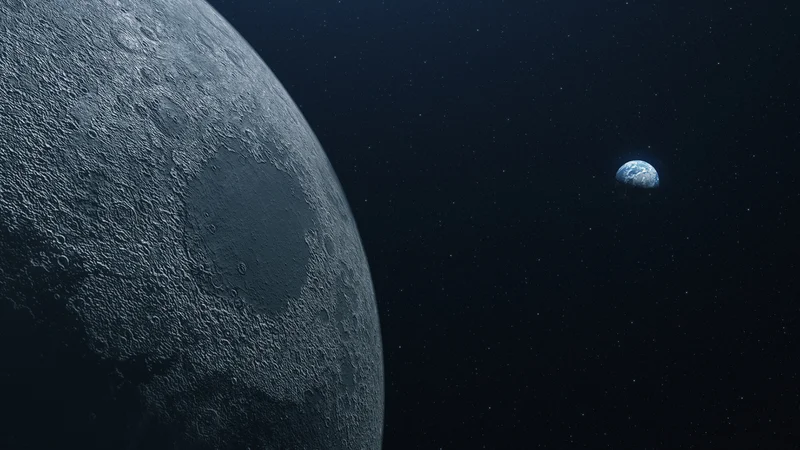
An abandoned part of a SpaceX Falcon 9 rocket is projected to crash into the moon at 2:35 a.m. EDT on Aug. 5 — and two new studies suggest the event may be visible in telescopes from parts of North and South America, providing both amateur and professional astronomers with a rare, real-time viewing opportunity. Both studies are available as preprints on the arXiv server.
The impending Aug. 5 impactor is the truck-sized spent upper stage of a Falcon 9 rocket. In 2005, the rocket boosted two privately owned landers into orbit around the moon, before leaving its upper stage in an elliptical orbit around Earth, according to OrbitalRadar.com.
A report earlier this year estimated that the collision would occur near the moon's Einstein crater, with the rocket grinding into the lunar surface at a speed of 5,436 mph (8,748 km/h). Although that sounds fast, it's about six times slower than a natural impactor, like an asteroid, would hit.
What can you see with a telescope?
The initial impact flash of the collision — which will last less than a second and be hidden on the sunlit side of the moon — will likely be invisible to casual skywatchers, according to one of the new studies. The brightest estimates for the impact put it at 20 times dimmer than Saturn. The resulting crater likely won't be visible from Earth, as the study estimates that the hole is relatively small and shallow — about 90 feet (27 meters) wide and up to 16 feet (5 m) deep.
More promising for Earthbound skywatchers is the plume of regolith (and potentially water vapor) the impact will loft. The plume will likely reach several miles in height, with computer-based simulations from the second study showing it may tower up to 31 miles (50 km) high. This will make it visible over the moon's limb as a cloud, with the debris spreading up to 112 miles (180 km) from the impact site.
The plume will hang above the lunar surface much longer than the flash — for up to 400 seconds, or close to seven minutes; during this time, it will scatter sunlight toward Earth. Even then, the plume will be too faint to be observed with the naked eye, William Jo, a graduate research assistant at the University of Texas at Austin and co-author of the second study, told Live Science in an email. Viewers will need a good backyard telescope to see it.
"Where the science is"
Although the event will be dim and occur on the sunlit portion of the moon, skywatchers are gearing up to watch it. Benjamin Fernando, a postdoctoral researcher at Los Alamos National Laboratory and co-author of the first study, told Live Science in an email that there "will be an observing campaign involving professional and amateur astronomers from around the world."
Get the world’s most fascinating discoveries delivered straight to your inbox.
In particular, he said, folks in South America and continental North America — where it will be night, with the moon high above the horizon — will have the best chance of seeing it, although you will need at least a 4-inch (10 centimeters) telescope.
Related stories
However, Jo was less optimistic. "I don't think it would be an easy task for an amateur astronomer," he said, but if they know exactly where to point their telescope and tackle atmospheric refraction, they might see the plume. Nonetheless, he urged well-equipped observers to try observing the plume, as that is "where the science is."
This science, Jo said, would help researchers understand how everything delivered to or disposed of on the moon will ultimately affect the lunar surface. "This would be useful for studying disposal methods for upper stages, maybe how far ejecta will travel, and whether or not the ejecta will hit sensitive instruments, or in the far future lunar bases," he added.
Previous collisions of human-made objects on the moon have likewise led to some major scientific insights. For example, the 2009 crash of a Centaur rocket's upper stage was analyzed by NASA's Lunar Crater Observation and Sensing Satellite mission, which revealed subsurface ice near the lunar south pole. As a result, the lunar south pole is now considered the most coveted location for moon missions that aim to establish a permanent human presence on Earth's satellite.
Deepa Jain is a freelance science writer from Bengaluru, India. Her educational background consists of a master's degree in biology from the Indian Institute of Science, Bengaluru, and an almost-completed bachelor's degree in archaeology from the University of Leicester, UK. She enjoys writing about astronomy, the natural world and archaeology.