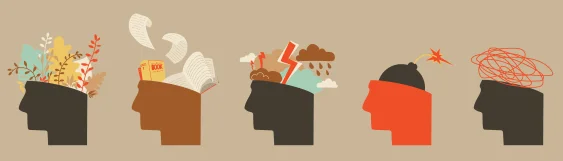
I think, therefore I am,” said René Descartes. “We become what we think,” said the Buddha. Across the crush of time, some of our most recognized philosophers have come to believe that who we are is, in large measure, determined by our thoughts. They guide our actions and experience of the world. They express our fears and desires. They weave the fabric of our personalities.
But many people have only a glancing handle on where their minds go on any given day. And if our own thoughts are mysterious, the preoccupations of the people around us are still more obscure. Even when you know another person well enough to guess when they’re upset or about to tell a joke, it’s impossible to know what is actually going through their heads.
Given the general inscrutability of thought, I was fascinated to read a new study that identifies patterns in the subjects people turn to most frequently and sorts human thinking styles into four buckets. The authors, economists from Claremont Graduate University in California and Wuhan University in Hubei, China, note in their study that despite the central place of thoughts in consciousness and the human experience, and the impact thoughts have on self-reported happiness, the contents of our thoughts are surprisingly understudied.
“So much of what it means to be human is about what’s going on in our head,” economics professor Joshua Tasoff, a senior author on the study, told The Guardian. “The fact that we haven’t really looked at that as economists is really quite extraordinary.”
Read more: “I Didn’t Know My Mind Was So Strange Until I Started Listening to It”
To help correct the record, the scientists asked 258 Americans between the ages of 19 and 71 to respond to periodic surveys about their thoughts. Over a two-week period, they buzzed them 6 to 8 times a day on their phones. What they collected amounted to a total of more than 23,000 snapshots of peoples’ inner monologues. When alerted, the participants were asked to record the thought most dominant in their awareness, slot it into one of 12 categories, determine whether it was an intrusive thought or a welcome one, describe the activity they were engaged in when they had the thought, and rate their happiness. Then the researchers analyzed the text they collected.
It turns out that on a daily basis, a lot of what people think about is, “I’m tired, I need to work, I want food.” Sensory impressions related to the body accounted for about 20 percent of all the thoughts recorded over the period. Work accounted for 17 percent and food about 14 percent. When it came to thoughts related to desire, half of people taking the survey identified food or drink as the object, especially coffee. There was little to no mention of sex, and in fact, relationships accounted for just 10 percent of thoughts, as did thoughts about art and hobbies, even though these were among the most closely associated with feeling happy. About half of peoples’ thoughts were intentional, as opposed to accidental or intrusive.
When it comes to relationships, friendships and pets may exert greater pull on the mind than romance, children, or coworkers, according to the results. Friends were the most common subject of thought in the relationship category, occurring at a frequency equal to that of the four romantic relationship terms combined: husband, wife, girlfriend, and boyfriend. Some 46 percent of participants mentioned thinking about a friend at least once.
Pets, meanwhile, seem to live rent free in our minds, outranking children in people’s thoughts. Dogs and cats combined occurred slightly more often than son and daughter combined. While thoughts about dogs were associated with walks, thoughts about cats were related to needs and wonder. Apparently we’re all wondering, “Does Fido need to go to the park?” Or: “Is Coco the cat hungry?”
The dearth of reports about sexual thoughts aroused the skepticism of the researchers. “There may be things people don’t want to share with us. You know: TMI [too much information],” Tasoff told The Guardian. Sex thoughts only cropped up 11 times, and “no thoughts” or “empty mind” was only slightly more common.
Read more: “How to Quiet Your Mind Chatter”
Thinking styles may also cluster into one of four buckets, Tasoff and his team found. There are those who worry about the world, including politics, social issues, and wars; those who are preoccupied with household chores and finances; those who focus on the mind and the body—a largely female group, whose thoughts were more intrusive than the average; and those who tend to primarily mull career and leisure in equal measure. The authors nicknamed this last group the work-hard play-hard group. It skewed slightly male and had the highest average income and levels of happiness. Aside from the work-hard play-hard group’s higher average incomes, however, the demographics were widely variable across thinking styles.
The study, which is a preprint and hasn’t yet been published in a peer-reviewed journal, is just a first step toward a more comprehensive view of the contents of human thought, Tasoff and his colleagues note. The study sample was diverse, but not necessarily representative of the U.S., and data that relies on self-report can be biased in favor of responses that are socially desirable and difficult to independently verify.
One hypothesis the researchers wanted to test relates to an old saying from Roman emperor and philosopher Marcus Aurelius: “The happiness of your life depends on the quality of your thoughts.” He may have been on to something. Thoughts better explained happiness than a person’s income, age, education, or even what they were literally doing at the moment. Intentional, chosen thoughts made people happier than mind-wandering or unwanted intrusive thoughts. And, thinking about music, hobbies, and food gave people a happiness boost roughly equal to the happiness provided by being employed or married.
Taken as a whole, the results suggest that our thoughts and those of the people around us may not be as exotic as we might think—and that it’s not the life you lead that determines your happiness, but rather the voice narrating it.
Lead image: Irina Popova / Adobe Stock