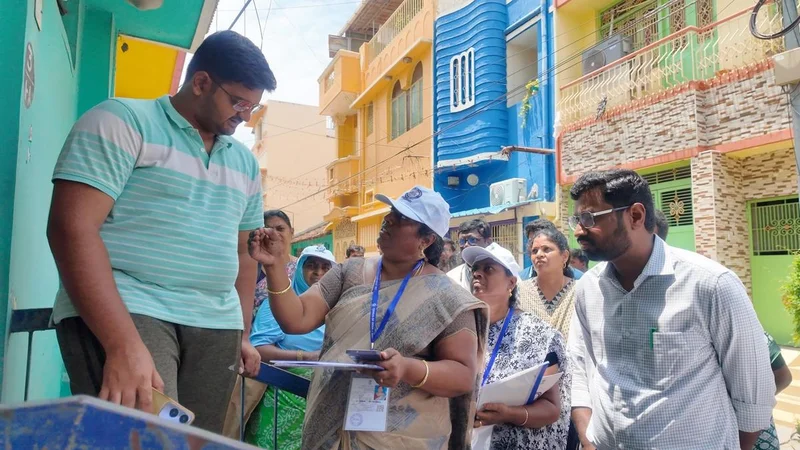
The questions for the second phase of the Population Census 2027 are likely to be notified next week, days before the exercise, which will reveal how caste is to be enumerated in independent India, begins on August 17 in Ladakh and snow-bound areas of Jammu and Kashmir, Himachal Pradesh and Uttarakhand, ahead of the rest of the country where the exercise is to be held in February 2027.
As reported by The Hindu, the rehearsal for the Population Enumeration (PE) phase was conducted from July 1-20 in 16 States and Union Territories where respondents, other than Scheduled Caste and Scheduled Tribes, recorded their castes in an “open column” or the enumerator noted a resident’s caste as declared by them. The final questionnaire is likely to include 28 questions. Among the questions that are likely to be asked first time are whether respondents consume “packaged or bottled water” and likely include “natural calamities” among the reasons for migration, alongside more conventional categories such as education, marriage, work and business. It is also likely to provide a detailed code directory on educational qualification rather than the earlier practice of self declaration.
The caste of all residents is to be recorded during the PE phase. The Population Census 2027 is the first digital Census and the first to enumerate caste in independent India. Until now, only the Scheduled Caste (SC) and Scheduled Tribe (ST) were being enumerated during the Census exercise.
Unreliable data
The open column methodology had resulted in the 2011 Socio Economic Caste Census (SECC) returning over 46 lakh different “caste names”, largely owing to the difference in what people understand by caste. Significantly, the Prime Minister Narendra Modi-led government has consistently maintained over the last decade that the 2011 SECC’s caste data was unreliable because of “errors” in data collection. The total number of castes during the 1931 Census was 4,147. The SECC was conducted as a survey and was out of the purview of Census At, 1948 and had no statutory backing. The data were never released by the government.
On August 3, the Registrar General and Census Commissioner of India notified in the gazette of India that “the conduct of Census of the population shall be undertaken in the Union territory of Ladakh and the snow-bound non-synchronous areas of the Union Territory of Jammu and Kashmir and the snow-bound non-synchronous areas of the States of Himachal Pradesh and Uttarakhand, from September 1, 2026 to September 30, 2026 with a revisional round from October 1, 2026 to October 5, 2026.”
An option for self-enumeration will be available from August 17-31, before the start of house-to-house population enumeration, the notification said. It added that the reference date for population count for these areas would be 12 a.m., October 1. The reference date for the rest of the country is 12 a.m., March 1, 2027.
The Population Census exercise is done in two phases — the Housing and House Listing Operations (HLO) and Population Enumeration, spanning over 11 months. The HLO phase is to be concluded by September 30 across the country. Barring few States such as West Bengal, Assam, Manipur, the HLO phase has been concluded elsewhere.
Published - August 04, 2026 10:00 pm IST