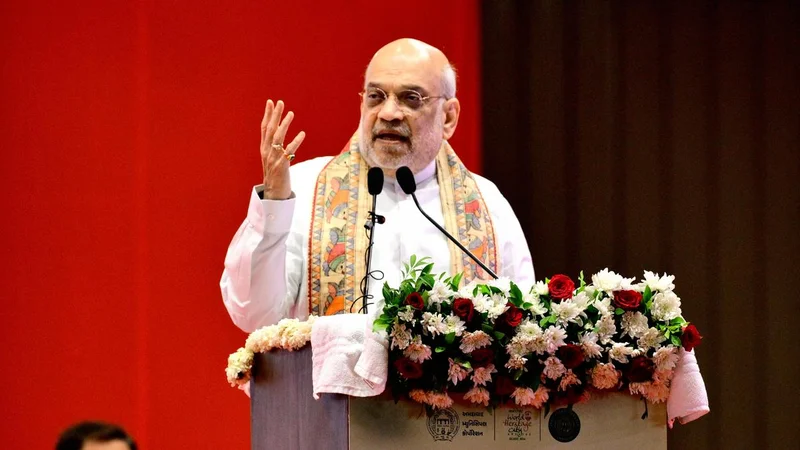
India has brought back 274 fugitive criminals from 36 countries over the past seven years, the Ministry of Home Affairs (MHA) said in a statement on Tuesday (August 4, 2026).
The Ministry said that “previous governments lacked the political will to bring back fugitives” and that the Narendra Modi government had made the extradition of fugitives a "national priority".
Three-pronged strategy
It added that Home Minister Amit Shah has emphasised a three-pronged strategy against fugitives: global outreach, strong coordination, and smart diplomacy. Mr. Shah has described the issue of fugitive offenders as one that is intrinsically linked to the country’s sovereignty, economic stability, law and order, and national security.
In a post on X, Mr. Shah said, “Under the vision of a robust and secure India, the Modi govt has pulled in the net, nabbing fugitives hiding abroad. Regardless of which country they absconded to, India’s new approach to national security has ensured the return of 274 criminals since 2019, compared with a mere four per year during the UPA regime. Gone are the days when criminals were allowed to sneak through the gaps in the system. New India has addressed every gap in the old system through new laws, institutions, and global partnerships, weaving an unbreachable security net.”
He added that the government has launched integrated, intelligence-led, and technology-driven operations to trace fugitives abroad.
“The provision for trial in absentia under the three new laws has empowered the justice system to initiate proceedings against absconding criminals. Stringent application of the PMLA led to the confiscation of assets worth ₹17,874 crore and restitution of ₹18,762 crore,” the Minister said.
The BHARATPOL effect
Mr. Shah said new frameworks like the BHARATPOL have ensured a seamless coordination grid across the world, turning “every corner of the world into a hunting ground for fugitives”.
The largest category of fugitives brought back comprised those wanted for murder, robbery and other violent crimes (62), followed by sexual offences, including rape and POCSO cases (53), other offences (45) and organised crime, gangsterism and extortion-related cases (42). India also secured the return of 18 fugitives in human trafficking and kidnapping cases, 17 linked to terrorist, anti-national or narco-terror activities, 16 involved in narcotics and drug trafficking, 12 in smuggling, fake currency, cybercrime and contraband cases, and nine wanted for fraud and financial crimes.
The MHA said that before 2014, India had extradition treaties with only 37 countries.
The campaign to bring fugitives back to India covers cases involving terrorism, pro-Khalistan extremism, the gangster-terror nexus, narcotics trafficking, cyber fraud, and fake currency, the Ministry said.
The extradition of 26/11 Mumbai terror attack accused Tahawwur Hussain Rana from the United States stands as a significant example of India’s resolve and its sustained legal and diplomatic efforts in pursuing complex terror cases, it said. The MHA said in matters related to Jammu and Kashmir, fugitives operating from abroad had been used to sustain terrorism, narco-terrorism, and cross-border support networks.
The number of Interpol Red Corner Notices issued has increased in recent years, the Ministry said, adding that 40 notices were issued in 2022, 100 in 2023, 107 in 2024 and 112 in 2025, while 182 have already been issued in 2026 so far. The MHA said that to strengthen efforts to trace fugitive offenders, Operation Trishul was launched to geo-locate absconding criminals.
“Under this initiative, with the support of Interpol, the locations of fugitives in hiding were established using satellite inputs, surveillance, and digital footprint analysis. Many fugitives had changed their names or identities while residing abroad. However, through the use of advanced technology and profile mapping, Indian agencies were able to identify and trace them,” the Ministry said.
Published - August 04, 2026 10:30 pm IST