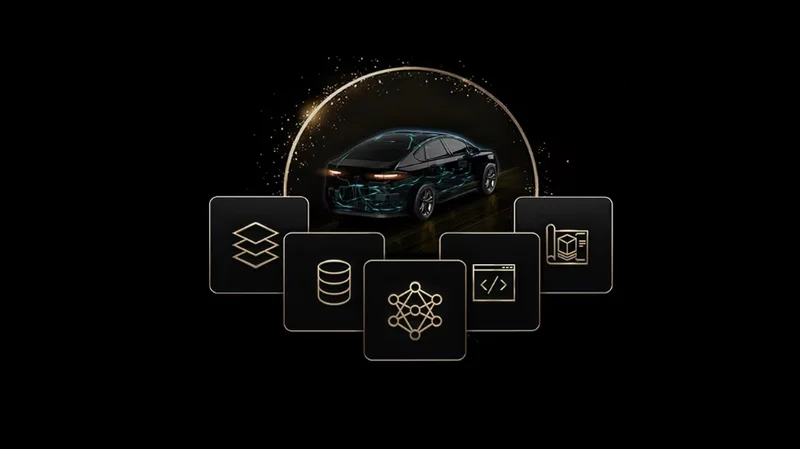
Nvidia wants self-driving cars to explain themselves. The company has released Alpamayo 2 Super, an open AI model for robotaxis that does not just plan a route but reasons about why, and it is now available for commercial use.
The model is Nvidia’s pitch for a more interpretable kind of autonomy. Rather than a black box that spits out a steering angle, Alpamayo produces a chain of reasoning, a trajectory, and a plain-language account of the decision behind it.
Under the hood it is a vision-language-action model of about 34 billion parameters, built on Nvidia’s open world models, the Cosmos family it has been pushing as a foundation for robotics and physical AI. It pairs a large reasoner with a smaller action expert that turns thought into a driving path.
The model takes in video from up to seven cameras for a full 360-degree view, and it is aimed squarely at Level 4 driving, the tier where a car handles everything within a defined area without anyone at the wheel.
The headline feature is what Nvidia calls a chain of causation. The model can show the reasoning behind a decision, whether to yield, change lane, or stop, which matters enormously in a domain where regulators and courts will want to know why a car did what it did.
The bet behind it is that reasoning fixes autonomy’s trust problem. A car that can justify a swerve is easier to certify, audit, and defend than one that simply acts, which is as much a regulatory strategy as a technical one.
It is genuinely open, at least by the industry’s standards. The weights sit on Hugging Face under a permissive Linux Foundation licence, the inference code is on GitHub, and the auto-labelling pipeline has been open-sourced too.
The full model is not meant to ride in the car. Alpamayo 2 Super is a teacher, designed to be distilled into smaller versions that run on Nvidia’s in-vehicle DRIVE chips, which is where the business quietly reasserts itself.
That is the tell. Nvidia gives the model away and sells the silicon, the Thor and Hyperion hardware the distilled versions are tuned to run on, a familiar move for a company that would rather own the platform than any single app.
The approach has found an audience. Nvidia says the Alpamayo models have been downloaded around 400,000 times since the family launched in January, and its self-driving stack already sits behind efforts like Uber’s robotaxi push in Munich.
Nvidia has been at this a long time. Its cars have learned to drive by watching humans for years, and Alpamayo is the reasoning-first evolution of that work, arriving just as robotaxis move from pilots to paying services.
‘Alpamayo is the moment cars begin to safely reason, not just drive,’ said Nvidia chief executive Jensen Huang, framing the release as a step-change rather than an increment.
The claims deserve some caution. Benchmarks are not roads, rivals are circling, and Nvidia has already been beaten on at least one robotics benchmark, a reminder that owning the tools is not the same as winning the race.
There is a hardware catch, too. The full model is memory-hungry, needing tens of gigabytes of GPU memory to run, which keeps the frontier version firmly in the hands of well-resourced developers rather than hobbyists.
The openness is not entirely selfless, either. An industry that standardises on Nvidia’s model, tools, and data tends to standardise on its chips, which is the outcome the free download is really designed to produce.
Open models are becoming the norm at the driving frontier. Sharing weights and data lets a whole industry improve the same base rather than each firm starting from scratch, and Nvidia would rather set that base than watch a rival do it.
Still, an open, reasoning-capable driving model is a notable thing to hand the industry. If autonomous cars are ever to be trusted, being able to ask them why may come to matter as much as how well they drive.
Get the TNW newsletter
Get the most important tech news in your inbox each week.