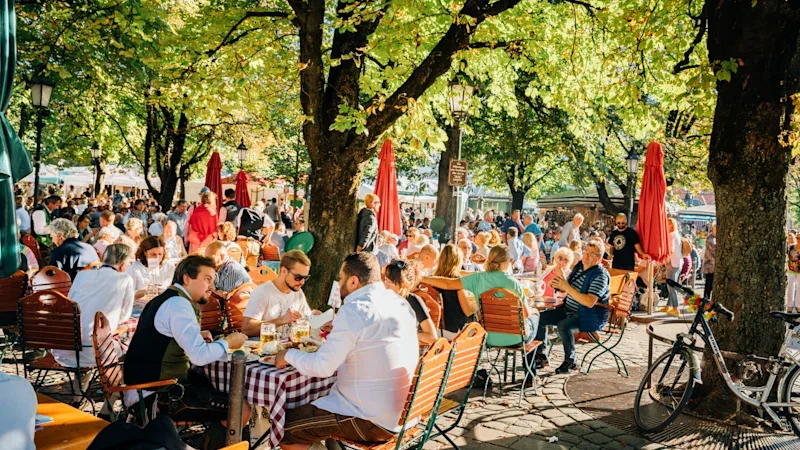
Bavaria is often stereotyped as Germany at its most traditional, a region where dirndl and lederhosen are worn at celebrations, beer is the local “water” and schnitzel is on every menu. While the first two are accurate (and Bavarians do drink more beer per person than the rest of the country), when it comes to gastronomy, there’s a lot more to it than crumbed meat.
Munich’s innovative young chefs and food creators have been adding some interesting touches to traditional dishes, driving its unique cuisine scene in new directions.
And, as I discover, you can learn a lot about Bavaria’s past and present while touring some of the city’s eateries. It also helps if you win the jackpot on your foodie exploration, as I did, to be accompanied by Wolfgang (call me “Wolfi”) Hingerl, an award-winning Bavarian sommelier and chef who owns and runs several high-profile establishments including Marie Therese Gasthaus and Mural (a 2020 Michelin star recipient).
Our first stop is the Viktualienmarkt, Munich’s oldest and most famous food market where over 100 stalls sell everything from traditional wurste (sausages) to organic juices. We steer clear of the tempting beer garden where, having bought food from a stall, you can take it to a table and wash it down with a mass (a litre) of beer. Instead, we head to Gürmet, a small Turkish-focused, vegan-vegetarian mezze eatery run by a German-Turkish couple, Sarah Lange and Mete Gür. The fare blends local vegetables with organic Turkish spices. The results are superb. My favourite? Gozleme that’s filled with pear, mushrooms and cheese.
Get exclusive travel deals delivered straight to your inbox. Sign up now.
Our next stop, the fast-casual Melrose by Fairfax Express, comes as a surprise – this tiny US-style deli serves stuffed rolls. The selection of fillings is limited to five and that’s intentional: all are prepared in-house. These include lobster, turkey and pastrami. As someone who steers clear of “subs”, our vegetarian option, eggplant parmigiana, is a game changer for me.
A five-minute trip on the number 19 tram takes us from the centre, across the River Iser and to the heart of Haidhausen. Traditionally known as the French Quarter, this pretty neighbourhood has historic houses with dormer windows, tree-lined streets and a French flair. At its core is Wiener Platz where the pretty Fischerbuberl fountain burbles.
Here, we join the queue at Fisch Hausl, a local “institution” that’s renowned for its preserved fish. Wolfi orders matjes, pickled herring and pickled onions. I relish the brine flavour, though I am at bursting point.
That is until I spot a specialty coffee hub, Suuapinga, where I order a flat white (it’s made with Bavarian-roasted Arabica beans and is superb) and for Wolfi, an espresso tonic, an espresso shot in sparkling water (he swears by it on a hot day). Rejuvenated by the caffeine, we wander past the Hofbräukeller, a massive beer garden off the Weiner Platz. Huge chestnut trees create a green canopy over the tables.
We return to the centre, and make a beeline for Cafe Frischhut (a must visit). For around 50 years this bustling spot has been preparing smaltznudel, a round disc of yeast dough that’s deep fried in clarified butter and sprinkled with sugar. My order is slipped swiftly into a paper bag. I chomp into this steaming wonder; it’s the sweet taste of Bavaria.
Wolfi agrees that he wouldn’t change a thing about it. I’m surprised. For along the way I’ve urged Wolfi to define the younger generation’s approach to gastronomy. He says that it’s not “modern Bavarian or Bavarian with a twist” (as many people push him to say). Instead, it’s about using the best local produce, knowing the producers, and preparing dishes using methods – including from other cultures – that enhance flavours.
Simply put, in his words, “It’s about evolution, not revolution”.
But, Wolfi agrees, when it comes to foods like the basic Bavarian smaltznudel, sometimes nothing beats unadulterated tradition.
THE DETAILS
TOUR + EAT
This is a simple tour to follow yourself. First up at the Viktualienmarket (viktualienmarkt-muenchen.de) is Gürmet (gümet.de); then Marie Therese Gasthaus (marie-therese.restaurant); followed by Mural (muralrestaurant.de); and finally Melrose by Fairfax Express (fairfax-express.de/melrose).
In the French Quarter (or Haidhausen, see munich.travel/en), you’ll find Fisch Hausl (fischdelikatessen.eatbu.com); Suuapinga (suuapinga.com); and Hofbräukeller (hofbraeukeller.de). Look for Cafe Frischhut on Instagram.
STAY
Hotel Vier Jahreszeiten Kempinski has 296 rooms (over 16 categories) and three presidential suites. Prices for a double start at around €400 ($650) a night excluding breakfast. See kempinski.com
The writer was a guest of Hotel Vier Jahreszeiten Kempinski.