Jantar Mantar and Bankipur, taken together, may make the prospect of an early delimitation exercise far less attractive for the Bharatiya Janata Party (BJP) than it once appeared. For much of the last decade, the BJP had reasons to believe that it had assembled a durable social majority, with Hindus acting as a voting bloc across large parts of north and west India. If groups displayed stable voting preferences over long periods, then redrawing constituency boundaries could amplify existing advantages.
Engineering constituency boundaries to advance a particular political outcome, commonly called gerrymandering, rests precisely on this premise: that electoral loyalties of social groups are predictable. It is reasonable to assume, for instance, that Muslims are less likely to vote for the BJP, just as African Americans have historically been less likely to vote Republican than Democratic in the U.S. Gerrymandering works by stacking and cracking electorates according to such group identities and their assumed preferences.
The BJP has had reason to assume that it built a threshold Hindu voting bloc that could provide it with a permanent majority, albeit with regional variations. The party’s continuing electoral triumphs in Gujarat is an example. One reason for its enthusiasm for an early delimitation exercise, which under the existing constitutional scheme can take place only after the data from the Census is published, has been to explore the possibility of redrawing Lok Sabha and Assembly constituencies to maximise its demographic advantage. This is not merely an assumption or an allegation. Assam Chief Minister Himanta Biswa Sarma has publicly stated that the delimitation of Assembly constituencies in the State was intended to reduce the number of seats in which Muslims could influence the outcome. The subsequent electoral outcome suggests that the exercise worked in the party’s favour.
Yet politics has a habit of unsettling certainties.
An unforseen twist
Bankipur’s demographic composition is almost a dream scenario for the BJP. Out of roughly 3.8 lakh voters, around 1.6 lakh are upper-caste Hindus, the party’s strongest social base. Muslims number about 40,000 and Yadavs roughly the same. In effect, the constituency has just enough communities considered adversarial to the BJP, namely the Muslims and Yadavs, to generate counter-polarisation on religious and caste lines, while still allowing the party to build a larger coalition of upper castes, Other Backward Classes (OBCs) and Dalits.
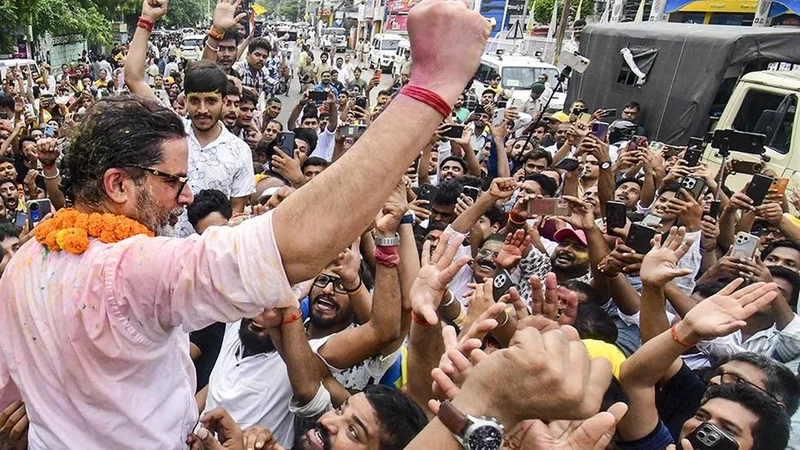
For years, Bankipur represented an ideal laboratory for the BJP’s twin strategy of caste and religious consolidation. Yet the party’s defeat at the hands of Jan Suraaj founder Prashant Kishore suggests that these assumptions may no longer hold automatically. Mr. Kishore’s victory appears to have rested on a social coalition that cut across caste and religious boundaries.
Something similar happened in Datia, though in a very different setting. Datia’s electorate of about 2.2 lakh is overwhelmingly Hindu. It has around 35,000 Brahmins, more than 30,000 Scheduled Caste voters, over 80,000 OBC voters spread across several communities, and another 25,000 to 30,000 Thakur and Vaishya voters. Muslims account for only a small proportion of the electorate. While the relatively new Jan Suraaj could sweep aside the BJP in Bankipur, the Congress could only secure a narrow victory in Datia. The dynamism within the Hindu electorate makes any permanent assumptions about its political preferences risky for the BJP.
Emergence of a new category
What links Jantar Mantar and Bankipur is the emergence of a political variable that neither the BJP nor its opponents had adequately anticipated: Gen Z as a distinct political community. The protests and mobilisations around issues of recruitment, examinations, unemployment and representation have revealed a generation that does not fit neatly into traditional electoral boxes. It is not that Gen Z voters are caste-agnostic. In fact, they appear to be deeply caste-conscious, expressed in sharply different ways, ranging from anti-reservation arguments to assertive Ambedkarite politics. Yet these divergent strands often converge in their scepticism towards the BJP and, in many cases, towards established political parties in general.
This horizontal social category complicates the older vertical structures of caste and religious mobilisation. A young Brahmin, a young Dalit and a young OBC voter may occupy very different positions in the social hierarchy, yet they can share common anxieties about jobs, mobility, and examinations. Their political choices are therefore not always determined by inherited community loyalties.
The disintegration of the BJP’s seemingly perfect constituency in Bankipur and the emergence of Gen Z politics suggest that politics in the Hindi heartland is not a prisoner of constituency boundaries. Electoral behaviour is increasingly shaped by cross-cutting identities that intersect with caste and religion but do not fully submit to them.
This challenges the logic of an early delimitation exercise for the BJP. Constituency engineering can magnify an advantage only when the social coalitions remain stable. If the party’s traditional bloc is showing signs of strain, redrawing boundaries can only do so much. The more urgent task for the BJP may be to mend its own camp and restore its social base than redrawing the boundaries of constituencies.
Published - August 05, 2026 01:02 am IST