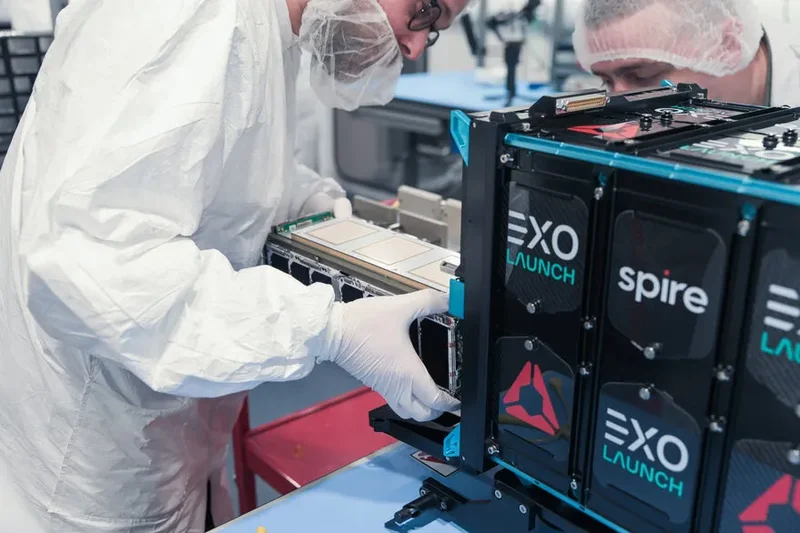
SAN FRANCISCO – The National Oceanic and Atmospheric Administration will continue to evaluate data from Spire Global’s Hyperspectral Microwave Sounder (HyMS) under a $3 million contract extension announced Aug. 4.
Under the six-month extension, NOAA will “further evaluate how hyperspectral microwave sounding data can improve numerical weather prediction,” according to the news release. “The work will assess sensor performance across a broader range of atmospheric conditions and seasonal weather patterns, while evaluating the impact of the data on forecast accuracy and atmospheric profiling.”
Traditionally, passive microwave sensors have provided critical data for numerical weather prediction (NWP). “However, the legacy broadband instruments lack the vertical resolution needed to capture fine atmospheric structures,” according to a NOAA news release. “Hyperspectral microwave sensor technology uses high-spectral resolution in sounding microwave bands, allowing data users improved observations in all-weather conditions, and potentially improving NWP.”
HyMS captures atmospheric observations across more than 2,000 sensing channels, enabling “high-vertical-resolution atmospheric profiling while offering resilience to radio frequency interference,” the Spire news release said. “These capabilities have the potential to provide weather agencies with more detailed, reliable atmospheric observations to improve forecasting, particularly in regions where traditional observations are limited.”
Hyperspectral microwave sounding provided by “a scalable commercial constellation” promises to unlock “a new tier of global weather data,” Spire CEO Theresa Condor said in a statement. “We’re proud to expand our work with NOAA as we demonstrate how commercial innovation and resilient atmospheric data can power the next era of global weather forecasting.”
Since its launch in January, the HyMS demonstrator mission has proven “that HyMS can successfully collect high-quality hyperspectral microwave observations from orbit,” Mohammad Belal, Spire microwave technologies program director, said in a statement. “This extension allows us to evaluate those observations across a much broader range of atmospheric conditions and seasons, helping us better understand how the data can improve numerical weather prediction and complement existing weather observation systems.”
The NOAA contract includes an unfunded option to supply three months of additional data valued at $2 million.
In 2022, Spire won a $4 million NOAA contract to develop the HyMS in-orbit demonstrator.