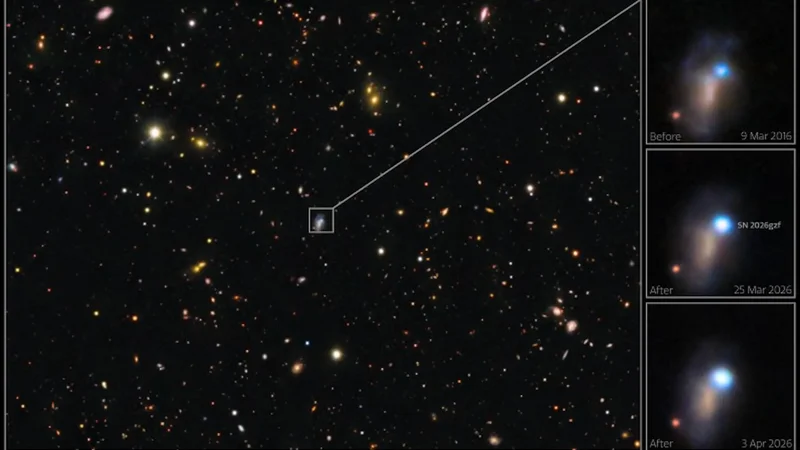
A supernova’s death throes can echo across space for millions of years, but its fiery ignition is over in a matter of minutes. As soon as a dying star’s core collapses, the energy waves begin traveling outward until they rip through the surface in an X-ray burst known as a “shock breakout.” This burst produces the first detectable light from a supernova, but it doesn’t last long. Within hours or even seconds, the shock breakout is overtaken by the ensuing stellar explosion.
Predictably, it’s incredibly rare for astronomers to observe the brief cosmic kickstarter. It’s so difficult that only one definitive example has been confirmed in the last 20 years. But thanks to quick coordination efforts around the world, an international research team recently spotted a star’s shock breakout about 500 million light-years from Earth. Their resultant study published in The Astrophysical Journal Letters documents one of the rarest cosmic occurrences on record, while also raising new questions about what’s possible during a supernova explosion.
Spying on SN2026gzf
The event was first detected on March 21 by the Einstein Probe, an X-ray space telescope overseen by the European Space Agency (ESA), Chinese Academy of Sciences, and the Max Planck Institute for Extraterrestrial Physics in Germany. Suspecting to see a rare shock breakout, astronomers at multiple observatories quickly pinpointed their target to gather as much data as possible. Teams soon confirmed the burst originated from a broad-lined Type Ic supernova (Ic-BL) designated SN 2026gzf. Supernovae like SN 2026gzf usually send out power jets of material at nearly the speed of light. They are also often associated with gamma-ray bursts—some of the most powerful and luminous events in the known universe.
However, astronomers quickly noticed odd behavior from SN 2026gzf compared to related supernovae. The X-ray shock breakout was the faintest ever detected, and follow-up observations didn’t identify any relativistic jet bursting forth. This led researchers to suspect the supernova’s jet was essentially being strangled.
“One possibility is that the jet was ‘choked,’ either by the surface of the star or by circumstellar material surrounding the star,” Brendon O’Connor, a Carnegie Mellon University astronomer and study co-author, said in a statement.
Over the ensuing weeks, O’Connor and his colleagues orchestrated an international forensic examination of SN 2026gzy, using resources from institutions like NASA’s Chandra X-ray Observatory, the National Radio Astronomy Observatory, the Caltech’s Palomar Observatory, and the Hobby-Eberly Telescope.
According to NASA Einstein Fellow and University of Maryland, College Park, astronomer Jillian Rastinejad, this level of teamwork allowed scientists to detail three critical aspects of the event—the initial X-ray shock breakout, the subsequent supernova, and the supernova’s interactions with previously ejected stellar debris.
“With this information we were able to map out the structure of the material surrounding the star and understand the star’s violent lifestyle before it collapsed,” she said.
Many types of stellar death
The mountains of collaborative data allowed Rastinejad and others to confirm that SN 2026gzf’s origin point is a Wolf-Rayet star. These stellar objects are about 20 times the sun’s mass, but burn through their hydrogen while they’re still young. Before the shock breakout, the star experienced irregular periods of mass loss, where it emitted all of its helium and hydrogen to leave behind a depleted star mostly composed of oxygen and carbon. These chaotic phases generated numerous material layers around the star, with one of the nearest being the low-mass debris that created the first X-ray signal.
Taken altogether this means SN 2026gzf isn’t just a rare supernova. Its strange and unexpected behavior suggests that huge stars may frequently die in ways astronomers never considered.
“This is the first time we’ve mapped out the pre-explosion environment of a star that has been stripped of hydrogen and helium,” added University of Maryland astronomer and study co-author Gokul Srinivasaragavan. “Going forward, I’m excited to observe more shock breakout events in similar detail to test if all stripped stars have a similar ‘lifestyle’ prior to collapse and what, if any, differences we see.”