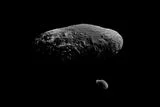
New images of (44) Nysa, an asteroid in the belt between Mars and Jupiter, may be unlike any previously observed asteroid, according to a new arXiv study.
Using data collected from advanced telescopes, including the Large Binocular Telescope on Mount Graham in Arizona, an international research team found that (44) Nysa has found evidence of a unique three-lobed structure and a small moon.
These findings help give researchers a better view of the complex history of this large and bright asteroid.
"In this paper, we're finally unmasking the asteroid's true nature, long after it was discovered," Al Conrad, an associate staff scientist at the Large Binocular Telescope Observatory (LBT) and a co-author on the paper, said in a press release.
Read More: Basic Building Blocks of Life Found on Asteroid Bennu
What Is (44) Nysa?
Researchers first spotted (44) Nysa in 1857, as it is one of the brightest visible asteroids. From what they have observed, the asteroid is enstatite-like (E-type), which means its surface composition makes the asteroid appear brighter. Though it has been a continuous subject of study, its true shape has remained somewhat of a mystery.
According to the study, some of the first observations suggested the asteroid may have been elongated or possibly bilobate in shape — meaning it was divided into two lobes. The recent images, brought to light by LBT, the SHARK-VIS, and the SPHERE/ZIMPOL instrument on the European Southern Observatory's Very Large Telescope located in Chile, show detailed features of the asteroid’s surface. These include two large valleys across the asteroid’s circumference, according to the press release.
The research team refers to the valley features as “colli” — neck-like connections that form between separate lobes.
"The images reveal a remarkably unusual object," said lead author Kate Minker of Lowell Observatory in Flagstaff, Arizona, in the press release. "The most likely explanation is that Nysa is either a contact trinary, consisting of three connected components, or an extremely irregular coherent body unlike anything we've previously observed."
Understanding How (44) Nysa Formed
By combining the SHARK-VIS images with observations collected from observatories around the world, the research team compiled a highly detailed 3D model of (44) Nysa. The model suggested that the asteroid may have three lobes, all connected by the colli.
These findings help give researchers a better understanding of how (44) Nysa formed. The leading theory is that the asteroid formed through low-velocity re-accumulation of fragments from a past collision, perhaps before (44) Nysa reached this point in the asteroid belt. Another theory suggests that (44) Nysa is the remains of a large “hit-and-run” collision.
"These new images appear consistent with several earlier clues that Nysa is not a conventional asteroid," Conrad said. "For the first time, we can directly investigate whether those clues point to a deeply indented body or to a true multi-lobed structure."
(44) Nysa’s Moon
The new images also revealed a previously unknown moon, named S/2026 (44)1. From what researchers can tell, the moon is just over half a mile in diameter and orbits at a distance of about 100 miles. For size reference, (44) Nysa is about 46 miles in diameter.
By analyzing the moon’s velocity and orbit, the team hopes they can use that information to more precisely calculate (44) Nysa's mass and density.
"Our technique is a bit like figuring out Christmas presents while they're wrapped," Conrad said. "You may be wondering whether the box you're eyeing contains a clock radio or a bag of socks, so to get a clue of which it is, you pick it up and get a feel for the weight. In a way, you intuitively are measuring density to find out the composition."
These calculations could help (44) Nysa join a class of other celestial objects whose shapes may preserve evidence of past collisions and mergers and tell us more about our Solar System’s history.
Read More: An Obscure Asteroid Turns Out to Be a Dark Comet — a Mysterious Group of Hidden Comets
Article Sources
Our writers at Discovermagazine.com use peer-reviewed studies and high-quality sources for our articles, and our editors review for scientific accuracy and editorial standards. Review the sources used below for this article:
- This article references information from a study in arXiv: Unmasking (44) Nysa: Evidence for a Trilobate Structure