(ATTN: ADDS details in paras 6-7)
By Song Sang-ho
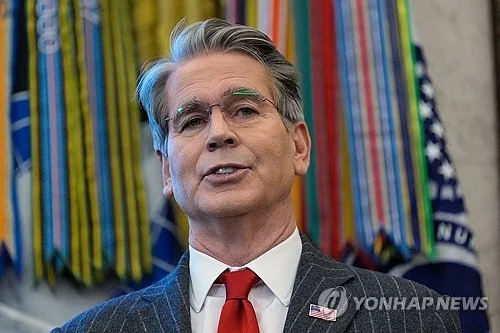
WASHINGTON, Aug. 4 (Yonhap) -- U.S. Treasury Secretary Scott Bessent said Tuesday the South Korean won has experienced "excess volatility," as he underscored the importance of a stable yen for the "entire region" following a recent intervention by the United States and Japan to boost the Japanese currency.
Bessent made the remarks in a CNBC interview after Washington and Tokyo jointly intervened in the foreign exchange market last week in a rare move to help address the yen's sharp fall against the greenback.
"I think a stable yen is not only important for the U.S., but it's very important for the entire region because if the yen were to weaken substantially, then the other currencies would follow it," he said in the interview.
"You know we'd seen excess volatility in the Korean won," he added.
Casting himself as an economic historian, Bessent said that in his view, the Asian financial crisis in the 1990s was partially triggered by an "overly weak" yen.
Bessent's remarks on the Korean currency appear to reflect U.S. concerns over the won's volatility amid emerging speculation that currency instability could complicate Seoul's efforts to carry out its US$350 billion investment commitment in the United States under last year's trade deal.
In January, when the Korean won depreciated, the secretary noted that the depreciation was "not in line with Korea's strong economic fundamentals -- a remark that observers said amounted to a verbal intervention amid concerns that the won's weakness could affect Korean businesses' investment plans in the U.S.
Commenting on recent market intervention during the CNBC interview, the secretary voiced his hope that the "right policies" in Japan will lead the yen to return to a "more normal equilibrium price" level.
He also said that given Japan's trade flows, the size of its economy and its contribution to the global savings market, it is crucial to have a stable yen.
"The Japanese government understands that, and we are proud to stand with them in implementing their policies and help them stabilize the region," he said.
Asked about the possibility of additional currency intervention, Bessent said that Washington is in "close" and "constant" communication with Tokyo, and that it will "do whatever it takes" to support Japan "in a way that helps the American economy, the American taxpayer and stabilize the global economy."
Touching on the "carry trade," a strategy where investors borrow money in yen or other low-interest currencies and invest it in high-yielding ones to profit from the interest gap, he predicted that the carry trade will not go away entirely.
"Japan has a gigantic surplus of foreign assets, and they provide liquidity to the rest of the world. Japan Inc. -- since the 70s, 80s, all through the 90s up until now -- has accumulated substantial overseas assets, and I see no reason for that to stop," he said.
"It's just the level of the yen that could trigger other problems or trigger competitive devaluations, which is unhealthy."
sshluck@yna.co.kr
(END)
- Fans, celebrities support BTS' Grammy boycott
- Police drop underage dating charge against actor Kim Soo-hyun
- S. Korea formally completes development of homegrown KF-21 fighter jet
- S. Korea in talks with U.S. military over air base access following white phosphorus leak: sources
-
BTS says it will not submit music for next year's Grammys
-
Fans, celebrities support BTS' Grammy boycott
- S. Korea formally completes development of homegrown KF-21 fighter jet
- Police drop underage dating charge against actor Kim Soo-hyun
- S. Korea in talks with U.S. military over air base access following white phosphorus leak: sources
- (3rd LD) Temperatures soar to record 42.5 C in southeast