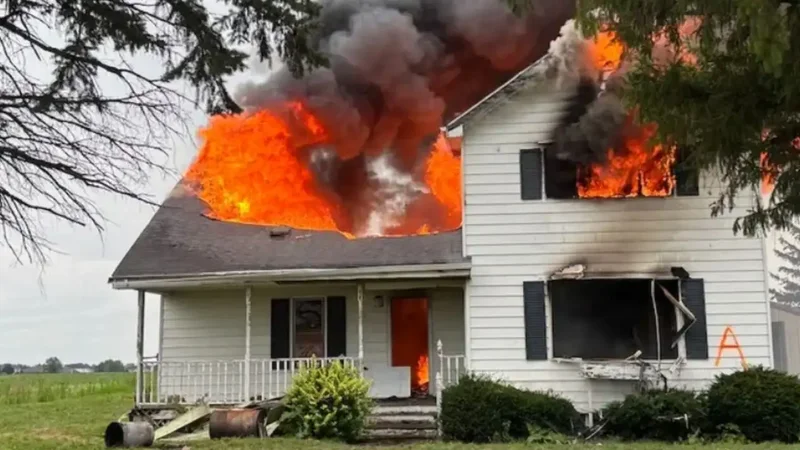
A farmhouse that had been in one family for four generations ended its long history by helping train firefighters before it was burned down in Illinois.
The Kestel family donated their vacant farmhouse on Cedar Road, south of Laraway Road in New Lenox, to the New Lenox Fire Protection District, Patch media reported. Instead of demolishing the building straight away, the family decided it could serve one final purpose by giving firefighters the chance to train in a real house.
The building was used for live fire training from Wednesday to Friday after months of preparations that had been taking place at the property since March. On Friday, after the final training session ended, the house was set on fire and allowed to burn to the ground.
For Karen Kestel, watching the family home disappear was emotional. The house had been the centre of family life for generations, but seeing firefighters benefit from the training helped make the decision easier.
"It's a lot of mixed emotions because, I mean, there's just so many memories and there's such a long history of all the people who lived in this house and farmed this land," Kestel said. "But seeing these firemen here today is helping because I feel so proud that my parents are giving them the opportunity to have this experience."
Rare opportunity for firefighters
Officials from the New Lenox Fire Protection District said donations of houses for live fire training are uncommon, making the exercise especially valuable.
Around 100 firefighters from New Lenox, Manhattan and Frankfort took part in the three-day programme. The training recreated real emergency situations, beginning with the dispatch call and continuing through firefighting, search operations and rescue efforts.
Fires were deliberately started inside the house using burn barrels and hay bales placed on pallets. Firefighters practised entering smoke-filled rooms, deploying hose lines, positioning ladders and carrying out search-and-rescue operations.
Deputy Chief Brian Applegate said training inside a real house gives firefighters an experience that cannot be matched by standard training facilities.
"It's a lot nicer to train in a house setting versus a metal building, because metal buildings typically react a lot different," Applegate said.
He said the exercise also allowed firefighters from different departments to work together before responding to actual emergencies.
"We can also work with our mutual aid people, like Manhattan's here, so now we integrate better with one another," Applegate said. "So, all in all, the totality of it makes it so beneficial for when we get out on the street. It brings us all together, hones our skills, and now we're going to perform better on the street."
Meghan Keating (left) stands with her mother, Karen Kestel, as their family's four-generation farmhouse is burned,
Realistic scenarios designed
The training was overseen by the Illinois Fire Service Institute (IFSI), the state's official fire academy. The institute designed the emergency scenarios that firefighters faced inside the building.
According to fire officials, crews were not told exactly what situation they would encounter until shortly before each exercise began. The approach was meant to make the training as close as possible to a real emergency.
Applegate said instructors from IFSI observed the crews and offered advice during the programme.
"They brought some of their resources and instructors out to give us some different perspectives on how we're doing things, where we can do better, and just giving us that feedback that normally we wouldn't get into," he said.
New Lenox Fire Protection District Chief Adam Riegel said this kind of training is becoming less common as communities continue to grow and fewer buildings become available.
"Any time we have an acquired structure like this, it's always good because it's the most realistic you can get to a real fire in a house," he said. "It's training that we don't get very often anymore as the community keeps growing. Any time we get someone to donate a house like this, it's always beneficial for the guys to get that experience."
Generations of memories
The farmhouse had been built by Karen Kestel's great-grandfather and remained in the family for four generations. Karen remembered the large front yard where her father used to organise Easter egg hunts for the family. With so much space, some eggs stayed hidden for months.
Her daughter, Meghan Keating, also recalled spending time there with relatives. Family members often gathered at the house, and the children enjoyed riding on their grandfather's tractor, which they affectionately called "Schumanga."
Karen's parents, Gerald and Patricia Kestel, lived in the house for many years. Gerald died in 1992, while Patricia continued living there until her death in 2012.
Over the years, the family's 80-acre farm produced corn and soybeans and was also home to chickens, horses and cows.
Karen, along with her siblings Donald Kestel and Colleen Kestel-Branchaw, discussed the future of the house before deciding to donate it for firefighter training. Karen and Meghan travelled from outside Illinois to witness its final day.
Before the building was burned, firefighters carefully searched through the house and recovered several family keepsakes. Among the items returned were a plastic rocking horse and a snow globe found inside the garage.
As smoke rose into the sky, people driving along Cedar Road stopped to watch the final moments of the farmhouse.
Karen reflected on her mother Patricia's long record of community service, including volunteering at St. Joseph's parish in Manhattan, where she helped prepare meals for funeral gatherings.
She believed donating the family home so firefighters could learn life-saving skills matched the way her mother had always lived.
"This is definitely in the spirit of how she lived her life," Kestel said. "And that's what makes me feel good about doing this. ... A fitting end."
Keating said watching the house disappear was difficult but also meaningful because it gave the family a sense of closure.
"It's just such a source of childhood memories for me," she said. "So I think it's really special that I can be here, not only to support my mom, but to experience the ending and the closure of the amazing beginnings of my family."
The property has now been purchased by developers, and the house would have been demolished if it had not been donated for training.