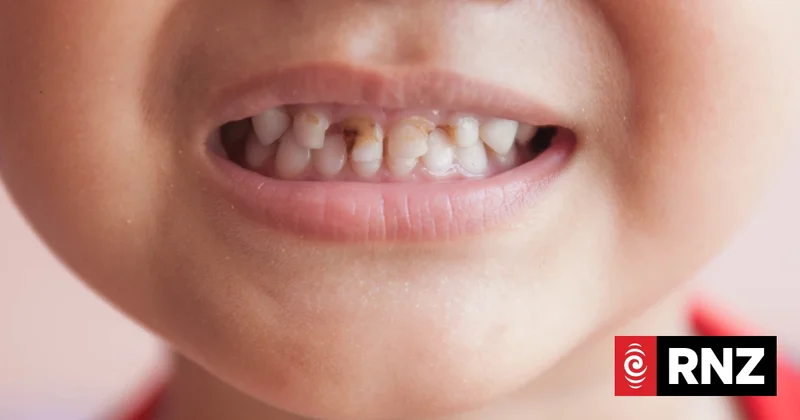
Parents are far too optimistic about how well their kids are looking after their teeth, and it is having serious consequences, a new report has found.
The New Zealand Dental Association report found 90 percent of parents said their children had "good" to "excellent" oral health, but only 57 percent of children reached age five without tooth decay.
Only 63 percent brushed twice a day with fluoride toothpaste.
The stats are part of the association's 2026 Oral Health Report Card which looks at every aspect of dental health - from family bathrooms to operating theatres
The data suggested parents might have a "false sense of security" about their children's health.
"...this high level of parental confidence may not accurately reflect underlying oral health status," the report said.
The association's president, and working dentist, Dave Excell said parents might be surprised about how much they need to be involved.
"I think sometimes parents think they can just leave their kids to do it themselves but they really need to be supervised up to the age of eight or nine, using a fluoride toothpaste, making sure they are doing a good job," he said.
But solving the problem was not just on parents.
Other statistics showed there were failings across the system - one example was that not enough children and teens were accessing free checkups they are entitled to every year.
There were likely several reason why - including wait lists, which were a post code lottery.
Children and teens in Hawkes Bay and Tairawhiti waited longer for dental appointments than anywhere else.
It was important to solve the problem which could have lifelong consequences, Excell said.
"You have to ask the question why at five years old, 43 percent of our children have got a completely preventable disease already," he said.
At the most serious end of the scale, about 4500 children were on the waiting list for hospital level dental care.
That number had got smaller by about 1000 over the past year but it was still too high, Excell said.
"Somewhere in the region of 7500 to 8000 children every year need a general anaesthetic to have their teeth sorted out and again that is just not acceptable in a country like ours," he said
Today's report aimed to bring together a number of measures, to get a snap shop of the country's oral health.
It was hoped that it could be used as a launching point for change.