Welcome to HackerNoon’s
Meet the WriterInterview series, where we learn a bit more about the contributors that have written some of our favorite stories.
Let’s start! Tell us a bit about yourself. For example, name, profession, and personal interests.
My name is Sebastian Martinez Torregrosa. Yes, that’s two surnames—a Spanish naming convention that still manages to confuse hotel Wi-Fi passwords.
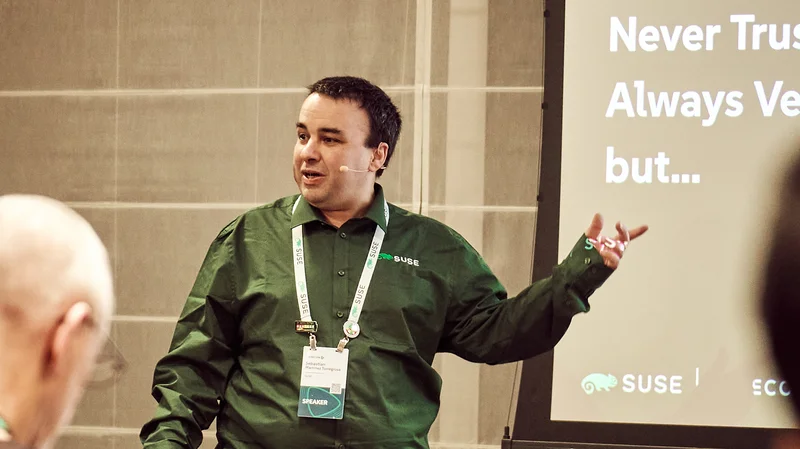
I describe myself simply as a technology worker. I’m currently a Principal Product Marketing Manager at SUSE, where I lead global product marketing for the SUSE Linux portfolio, but my career has taken me through software development, engineering, technical presales, sales, alliances and, more recently, product marketing.
Having started in the final years of the last century, I’ve been fortunate to witness the internet and IT revolutions transform nearly every industry and to watch technology evolve from something resembling the Wild West into today’s increasingly governed and regulated environment. Now, I’m deeply curious to see how the AI revolution will change everything once again.
At heart, I’m still driven by curiosity. I’m fascinated by the questions technology raises as it evolves—how old problems return in new forms, how each generation tries to solve them differently and what the technologies we create ultimately mean for us. Living through the AI transformation in real time and seeing it open an entirely new horizon has only intensified that curiosity.
That curiosity has shaped my career. It led me from building websites and CRM systems around the turn of the millennium to developing real-time financial-data and market-risk systems for banking institutions as regulatory requirements expanded. Along the way, I worked on mobile applications before the iPhone era, distributed architectures, and early prototypes involving digital certificates and cryptographic cards — technologies that were only beginning to appear in electronic national identity cards.
I joined Novell in 2007 in a technical presales role covering infrastructure, identity management, privileged-access management and security. I later continued my career at SUSE, working with open-source technologies, enterprise Linux and, more recently, Kubernetes. These different roles have allowed me to view technology from multiple angles: as an engineer, through the eyes of customers and from the product and business sides—yes, even marketing. They have taught me that technology cannot be fully understood or made successful from a single point of view.
Today, that same curiosity compels me to write.
Interesting! What was your latest Hackernoon Top story about?
My latest Top Story,
It is not a deeply technical piece. Its starting point is to ground the debate in how authorship has always worked before asking whether AI fundamentally changes it. From there, it separates three things that are often confused: authorship, the value of the work and what we risk losing when we judge an idea mainly by the tool used to express it.
My argument is that authorship is not the same as manually producing every word. AI can generate sentences, propose alternatives and expose ambiguity while the human remains the author of the work as a whole. The author of a building is not necessarily the person who lays every brick. What matters is who provides the governing intent, makes the important decisions and stands behind the result.
I also put the reader at the centre. A person can write something empty or false, while an AI-assisted text can contain genuine thought and rigorous judgment. Readers give us their time and attention, so the work should be judged by whether it is thoughtful, useful and worth reading.
Finally, the article warns that institutional fear of AI could lead academia, publishers and platforms to judge the tool instead of the work—and dismiss valuable ideas in the process.
Do you usually write on similar topics? If not, what do you usually write about?
Not exactly. In my work at SUSE, I write mainly about the business value of infrastructure, including regulatory requirements, digital sovereignty, resilience and the practical impact of technologies such as enterprise Linux, Kubernetes and Linux management platforms.
My writing on HackerNoon is different. It is a personal intellectual outlet where I can explore questions that go beyond any particular product or company.
At a moment when it sometimes seemed that everything had already been invented and technology was becoming a matter of established protocols, AI changed the atmosphere. It is not only creating new ways to work. It is reopening profound philosophical questions and dilemmas we thought we had settled, while challenging assumptions we had come to take for granted. It feels as though almost everything is still to be invented.
Most of my articles currently examine what happens when AI and autonomous agents enter real systems, organizations, institutions and even our personal lives. I write about AI architecture and engineering, governance, identity and accountability, cybersecurity in the AI era, knowledge, creativity and the broader philosophical consequences of this transformation.
I’m particularly interested in how many of the problems we treat as entirely new are actually older engineering, security or governance challenges returning in a different form. We do not always need to reinvent the wheel. Existing principles and solutions can often be adapted—provided we first recognize which parts of the challenge are genuinely new.
That is the standard I try to set for every article: it should offer the reader something they did not already have—not necessarily a new technology, but a distinctive point of view, an unexpected connection, a useful distinction or a clearer way to apply established principles to a new situation. For me, finding that difference is what makes an article worth writing and, hopefully, worth the reader’s time.
Above all, I try to bring some common sense to the discussion. We should neither fear AI nor follow it blindly. It cannot simply be dismissed: it is already here, it is undeniably useful and it will become increasingly important. But it is not perfect either. Like any other technology, it has limitations, failure modes and consequences that we need to understand and manage carefully.
Great! What is your usual writing routine like (if you have one?)
Because my HackerNoon writing is not part of my job, I do it in my free time. At work, I reserve a few slots each week to think and develop professional content. When an idea appears that does not belong to my work, I write down a couple of lines and return to it later. These thoughts can appear at any time.
AI assistants have made capturing them much easier. I can dictate an idea or nuance as soon as it occurs to me, add a little context and say, “We’ll discuss this later.” That prevents many thoughts from disappearing before I have time to develop them.
My usual routine is three or four hours of concentrated writing over the weekend, plus around 30 minutes on some evenings during the week to refine an argument. Revisiting an article from one day to the next is valuable because I often see the same idea differently. When a draft gets stuck, I put it in the freezer and continue with another.
I usually develop several articles in parallel. Some come together quickly, and on an inspired day I may write half an article in one sitting. Others remain unresolved for more than a month because I am not yet convinced by their structure, argument or nuances. Progress may mean adding one distinction, changing a few sentences or finally finding the idea that makes the whole piece work.
I use AI extensively during this process, mainly as a critical reader instructed to contradict me. I ask what it understands, where the reasoning is weak, which assumptions remain unexplained and which claims could be challenged.
I also write for different audiences. Some articles are technical, while others are intended for readers without AI expertise or even a technical background. I believe technology professionals have a responsibility to make complex ideas understandable beyond specialist circles. AI is becoming too important for how it works, its limitations and its consequences to be understood only by experts.
Making technical complexity understandable often takes much longer than producing the initial skeleton. I may spend three times as long refining an article as drafting it. This is where AI—and sometimes my wife, who does not have a technical background—becomes particularly useful. When either of them understands something differently from what I intended, misses an important nuance or cannot see why a point matters, I know the article is not ready.
Sometimes the fix is a sentence. Sometimes it requires a new paragraph or a completely different structure. The process is uneven, but that slow refinement is often where the article becomes worth reading.
Being a writer in tech can be a challenge. It’s not often our main role, but an addition to another one. What is the biggest challenge you have when it comes to writing?
The obvious challenge is finding time, but the hardest part is what I would call compression without distortion.
Today, everyone seems to want ideas that can fit into a tweet. But complex topics and important discussions cannot always be compressed into a slogan without losing the nuance that makes them accurate. Technology topics quickly accumulate assumptions, dependencies, conditions and exceptions. A sentence can be technically correct and still mislead because it leaves out an important condition. At the same time, including every qualification can make an article unreadable.
My challenge is to make an argument understandable to people without specialist knowledge while preserving enough depth that technical readers do not find it superficial. It means deciding what can be simplified, what must remain and which distinction is essential to the argument.
For me, that is one of the main differences between an article and a trending post. A post may attract attention with one sharp idea, but an article should be solid and developed well enough for readers to examine the argument rather than simply react to it.
AI makes this both easier and more dangerous. It can improve fluency very quickly, but fluent language can hide weak reasoning or remove a nuance that mattered. I therefore spend a lot of time asking whether a cleaner sentence still says exactly what I mean and preserves the nuance I intended.
The final challenge is knowing when to stop. There is almost always another example, paragraph or objection to consider. At some point, you have to decide that the article is clear, rigorous and useful enough.
So the challenge is to shorten without flattening and simplify without becoming simplistic. As you can probably tell from the length of my answers in this interview, I am still working on the compression part. ;-)
What is the next thing you hope to achieve in your career?
Curiosity has always moved my career forward, often taking me into areas I had not originally planned to explore. Looking ahead, I hope to continue growing into broader strategic leadership — combining technical understanding, business strategy, and product marketing to help shape direction across teams and functions.
I currently lead global product marketing for the SUSE Linux portfolio, with direct responsibility for how key products are positioned and brought to market. Throughout my career I have moved between technical, customer, business, and marketing perspectives. I would like to keep using that experience to connect conversations that are still too often separated: what technology can do, what customers and organizations actually need, how those capabilities can create new business opportunities, and what their broader consequences may be.
I am particularly interested in how enterprise infrastructure and business models will evolve in the AI era. Helping shape that transition without losing resilience, governance, security, or human accountability — while continuing to learn, write, and support the growth of others — would be a meaningful next achievement for me.
Wow, that’s admirable. Now, something more casual: What is your guilty pleasure of choice?
My guilty pleasure is probably wine and good food—especially buying bottles I do not strictly need because I am curious about the producer, the vintage or how the wine may evolve. I can spend far too long comparing regions, vintages and critics’ notes, only to ignore all of them when a lesser-known bottle turns out to be exceptional.
My problem is that I am always advised to let good bottles age, but I usually end up opening mine sooner than planned. Sometimes the “special occasion” required is simply a Friday dinner with my wife.
Although my wife would probably say that video games are my other guilty pleasure.
Do you have a non-tech-related hobby? If yes, what is it?
It may sound like a cliché, but I love travel, history, food and wine. Beyond technology and writing articles ;-), I am also interested in philosophy, economics and politics. I often find myself connecting these subjects and wondering which philosophical, economic or political tradition—or school of thought—a technology article I am writing is really drawing from.
I particularly enjoy cultural travel: visiting ruins, churches, cathedrals, museums and historic villages.
My dream trip would be an autumn holiday in an old city, visiting Roman ruins, the cloister of a monastery or a classical art museum during the day, then returning to a beautiful hotel for a good dinner and a local wine I have never tried before.
Sounds Mediterranean, doesn’t it?
What can the Hacker Noon community expect to read from you next?
Several things, because I usually have several articles developing in parallel—and a few waiting in the freezer.
One of the next pieces I am developing challenges a common assumption about AI and privacy: that information entered into an AI system is automatically absorbed into the model. My argument is that the more consequential risk is the breadth of information organisations are concentrating in general-purpose AI services—and the resulting blast radius if the provider, its infrastructure or its jurisdiction fails them.
Another examines the assumption that reducing the time required for a task automatically produces labour-cost savings. I distinguish between task acceleration, additional productive capacity and actual labour savings. My broader argument is that AI may ultimately create more value by enabling new products, services and markets than through straightforward cost reduction.
I also plan to continue exploring agentic AI, particularly identity, governance, security, human control and the engineering principles required to move agents from impressive demonstrations into dependable real-world systems.
I will probably keep returning to the more philosophical questions too: authorship, knowledge, responsibility and how institutions and individuals respond when AI challenges assumptions that once seemed settled.
I also expect to write about infrastructure, open source, cybersecurity, regulation, digital sovereignty and even Linux itself—especially where these subjects intersect with AI and broader technological change.
The subjects may vary, but readers can expect the same approach: looking for a distinctive angle, questioning easy narratives and trying to bring engineering discipline and common sense to the discussion through long-form articles.
What’s your opinion on HackerNoon as a platform for writers?
I value HackerNoon because it gives practitioners a credible platform to develop ideas that may not fit naturally into a corporate blog, an academic publication or a short social-media post. Technology is not shaped only by researchers and professional journalists; engineers, marketers, founders, operators and others working directly with it also have perspectives worth sharing.
I particularly appreciate that the platform still gives space to long-form, opinionated and curated writing. At a time when so much online discussion is reduced to headlines, slogans and immediate reactions, HackerNoon allows an argument to be properly developed and gives readers the opportunity to engage with the reasoning behind it.
I value that not only as a writer but also as a reader. When I read about technology, I look for the same qualities: a distinctive point of view, enough depth to understand the argument and some editorial judgment about what is worth publishing—not simply another repetition of the news or a post optimized for quick reactions.
HackerNoon also helps writers reach a broad audience of technology professionals and practitioners beyond their usual circles. Publishing on an established platform can strengthen an author’s positioning and make their ideas more discoverable through traditional search and, increasingly, generative search—SEO and GEO. Seeing your work surface in an answer from ChatGPT or Gemini is an invaluable feeling: it shows that the article has become part of the wider conversation. A strong piece can continue reaching new readers long after it is first published.
I also value the editorial review. Having a human editor examine the story, framing, title and presentation adds a quality layer that is difficult to obtain when publishing entirely on your own. The recognition of selected stories can also give independent contributors additional credibility and help valuable ideas reach readers who might never otherwise encounter them.
I use HackerNoon mainly as a personal intellectual outlet, but I can easily see its value for professionals and organizations seeking to build a technical audience, strengthen their positioning and develop a distinctive point of view.
For me, it has become a place where professional experience, personal curiosity and ideas that have been sitting in the freezer can finally become public discussions.
Thanks for taking time to join our “Meet the writer” series. It was a pleasure. Do you have any closing words?
Thank you for the invitation and for giving independent contributors a place to develop ideas in depth.
Technology advances through invention, but also through discussion, disagreement and people willing to question assumptions that appear settled. I do not expect every reader to agree with me. In fact, I welcome feedback—especially criticism that starts a thoughtful discussion. Some of the most useful responses are those that expose a weakness, introduce a perspective I had missed or force me to refine an argument.
I hope my articles give readers something worth their time: a useful distinction, an unexpected connection or simply a different way of looking at a familiar problem. And if an article starts a thoughtful conversation—even a critical one—then it has already achieved something valuable.