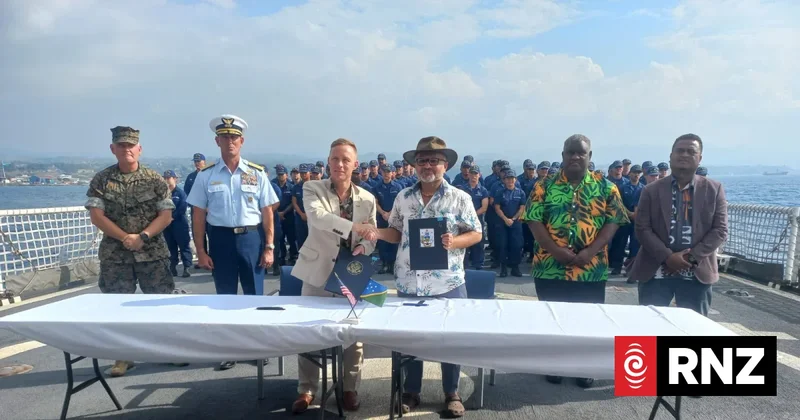
An ocean-policing deal signed between the governments of the Solomon Islands and the United States is causing consternation in Honiara, as the opposition claims it raises "serious concerns" about sovereignty.
The Shiprider Agreement between the Solomon Islands and the US was signed aboard the deck of the US Coast Guard Cutter Harriet Lane berthed in Honiara on 28 July. The agreement will allow the US Coast Guard into Solomon Islands waters, alongside local police, for joint maritime enforcement and surveillance efforts.
"Under this arrangement, Solomon Islands officers will exercise their authority in accordance with Solomon Islands law and agreed operational procedures, particularly in matters within national jurisdiction," the Solomon Islands government said in a statement.
It described the agreement as "a significant step forward ... to safeguard the country's vast maritime domain, protect marine resources and combat illegal activities at sea".
"The country retains full authority over its territorial waters, Exclusive Economic Zone (EEZ), and the enforcement of its laws in accordance with international law," the statement added.
However, the Solomon Islands opposition leader Manasseh Sogavare says the agreement compromises the sovereignty of the Solomon Islands by giving the US the power to override local interests.
He told local reporters that, as it stands, the agreement is a "sovereignty violation".
The US already holds similar bilateral maritime law enforcement agreements with more than a dozen Pacific Island countries, allowing joint patrols across their vast EEZ.
"If this is the same agreement that was signed with Vanuatu, with Tonga, with Samoa ... then we will have serious concerns," he said in an interview with Tavuli News.
Solomon Islands Prime Minister Matthew Wale has doubled down on the government's position, saying the agreement includes no compromises on the country's sovereignty.
The Solomon Islands Prime Minister's Office also rejected local media reports labelling the agreement as "controversial".
"Cabinet made its decision on this agreement more than a month ago through the normal government process," it said in a statement on 29 July.
Separating law from geopolitics
Dr Transform Aqorau, one of Solomon Islands and the Pacific's most infantile legal experts, has also weighed in on the issue.
Aqorau, who is currently the Solomon Islands National University vice-chancellor, said public discussion surrounding Shiprider Agreement showed Solomon Islanders cared deeply about their sovereignty, oceans, and their place in an "increasingly complex world".
However, he said the current debate has created "confusion" because international law and geopolitics are being treated "as though they are interchangeable".
"They are not," Aqorau wrote in a lengthy Facebook post on Tuesday.
"One concern I have observed in the current debate is that legal arguments sometimes become proxies for political preferences.
"Instead of discussing whether an agreement complies with international law, discussions sometimes shift towards whether one supports the government that negotiated it, or whether one supports the foreign country involved.
He said while these were "perfectly legitimate political discussions", they should not be confused with legal analysis.
"The real debate today is not whether Solomon Islands has the legal capacity to enter into Ship Rider Agreements or similar international arrangements. That question is largely settled.
"The real debate is about which partnerships best serve our national interests in a rapidly changing world."