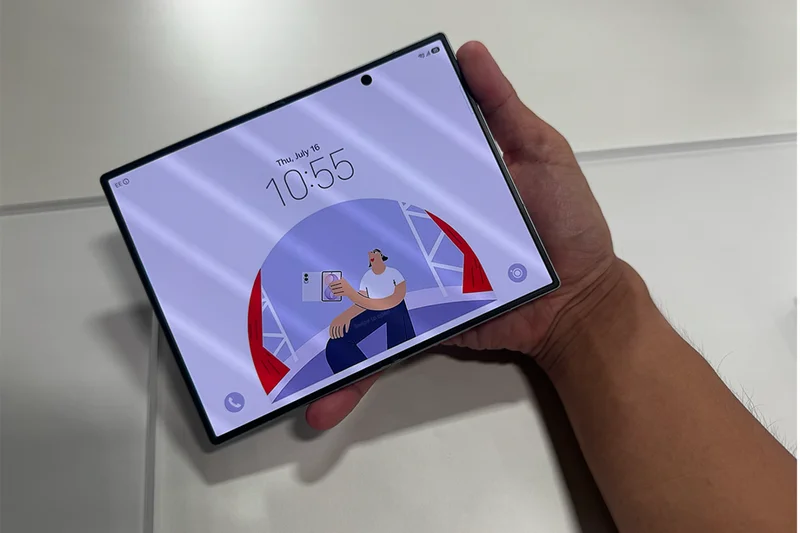
Samsung has just lifted the lid on a whole new range of foldables, introducing a new shorter, stouter phone in the form of the Samsung Galaxy Z Fold 8, just months before Apple is expected to unveil its first foldable iPhone with the same form factor.
While it's called the Samsung Galaxy Z Fold 8, it's not actually a replacement for last year's Galaxy Z Fold 7. Instead, Samsung announced the Galaxy Z Fold 8 Ultra alongside it as the successor to its traditional taller foldable, with the Galaxy Z Flip 8 completing the line-up.
Looking like a foldable that’s tailor-made for the TikTok generation, it features a new passport-style design perfect for consuming short-form video and scrolling through social media on the go. I got a first look at the new foldables ahead of launch – here are my first impressions.
Read more: Best Android phones, reviewed
Samsung Galaxy Z Fold 8
It has a new 5.5in cover display with a 10:16 aspect ratio (Alex Lee/The Independent)
For years, Samsung has stuck with tall and narrow foldables. Even when Google, Oppo, OnePlus and Honor rolled out shorter, stouter foldables, the tech giant continued with long and thin, But now the company seems to be holding up its hands and embracing the wider, more squarish design – one that Apple is also expected to follow with the iPhone Fold. But is it any good?
I've spent a little time with the squatter Galaxy Z Fold 8 ahead of launch, and the first thing I noticed was how much easier it is to use one-handed. It boasts a new 5.5in cover display with a 10:16 aspect ratio – much closer to a conventional smartphone.
Typing and scrolling feels less cramped than on the narrow Z Fold 7, which can feel like tapping away on a squashed keyboard while stretching your thumb to reach the top of the screen. It all feels less unwieldy in my hand.
That wider, shorter cover display also makes it easier to scroll through TikTok, Instagram Reels and YouTube Shorts. Content has more room to spread out than on previous Galaxy foldables as well. There’s space for comments, on-screen controls and buttons around the videos. It’s way more enjoyable to watch regular YouTube videos and you don’t have to rotate the phone.
It's so much easier to use with one hand (Alex Lee/The Independent)
Open the phone up and you're greeted by a 7.6in folding display with a squarer 4:3 aspect ratio. In demos, ebooks looked more proportionate, and looked like they’d be much more comfortable to read on a commute. Social media apps made much better use of the extra width as well.
Samsung showed me videos sitting side-by-side with their comments, none of it feeling squashed. The squarer display will also help when watching landscape videos, with the size of the black bars above and below the picture being reduced.
The inner display now also boasts 3,000 nits of peak brightness compared to 2,600 nits on the Z Fold 7, as well as an anti-reflective coating, so it’ll be easier to view outdoors. And at just 201g, the Fold 8 is lighter than the Fold 7's 215g weight, though it’s slightly thicker than the Z Fold 7’s 4.2mm, with an unfolded thickness of 4.5mm. Still, it never felt that bulky to hold, though I’ll need to test the brightness outdoors before giving a verdict.
It's going to be so much better for watching content (Alex Lee/The Independent)
There are some compromises, however. While Samsung has made the Fold 8 lighter, the cameras aren’t quite as good as the Fold 7. There’s no triple-camera system on the rear. That means there’s no 200MP main sensor, for example, though you still get 8K video recording. Instead, the Z Fold 8 boasts a dual 50MP setup with a wide and ultra-wide lens.
If you want the best camera system or think you’ll miss the telephoto lens, you’ll probably still want to stick with the taller Galaxy Z Fold 8 Ultra. Still, I did like the cool AI-powered camera features. One of my favourites is the My Fan Cam feature, which lets you tap a subject in a video and have the camera automatically track and crop them as they move around the frame at your chosen aspect ratio. You can then share that cropped video directly onto social media.
There's only a dual lens camera system on the rear (Alex Lee/The Independent)
It’s no slouch when it comes to power, either. The Z Fold 8 runs on Qualcomm's Snapdragon 8 Elite Gen 5 processor. You still get 12GB of RAM as well. The battery capacity has also been increased, going from 4,400mAh to 4,800mAh, and you can now (finally) charge with 45W speeds. Samsung says that’s enough for 26 hours of playback on a single charge.
The Galaxy Z Fold 8 starts at £1,699, making it £200 cheaper than the Galaxy Z Fold 8 Ultra and £100 less than the Galaxy Z Fold 7 at launch. It comes in graphite, lavender, cream and pistachio colourways.
I reckon this will soon be Samsung’s most popular folding phone. While Samsung has definitely sacrificed some of the camera tech on the altar, the new Z Fold 8 is lighter, cheaper and plenty easier to use when closed. Over to you, Apple.
Samsung Galaxy Z Fold 8 Ultra
The 8in inner display is huge (Alex Lee/The Independent)
Not sold on the squatter Fold 8? Samsung hasn't abandoned its traditionally tall foldable. The Galaxy Z Fold 8 Ultra is the spiritual successor to last year's Galaxy Z Fold 7, and Samsung has worked really hard on that crease.
That 8in inner display is enormous. Compared with the Fold 8's 7.6in panel, there's a lot more room for multitasking, Samsung's AI demonstrations made much better use of the extra space, with one demo seeing the phone recognising someone trying to arrange a meeting in Messages before automatically opening a split-screen calendar alongside the conversation. The new agentic AI features also looked very cool. One demo showed Samsung able to book a hotel just by asking it to do so when the hotel was on-screen on Instagram.
It's still tall and narrow (David Phelan/The Independent)
The display technology has also been improved. The company has introduced a new Flex Titanium structure beneath the OLED panel, which it says makes the display stronger. But most importantly – reduces the visibility of that crease. There’s also a new hinge. The Ultra measures just 4.1mm thick when unfolded, that’s thinner than the Z Fold 7, making it the thinnest Galaxy foldable yet. During my brief hands-on, the crease definitely seemed less visible, but I’ll need more time with the phone before passing judgment.
Like the Z Fold 8, it features up to 3,000 nits of peak brightness and features the same anti-reflective coating. I wasn't able to test it under direct sunlight, but the screen looked very bright under the harsh lighting in the demo room.
It’s photography where the Z Fold 8 Ultra shines. You get a flagship 200MP main camera, a new 50MP ultra-wide sensor (up from 12MP on the Fold 7) and a dedicated telephoto lens. Samsung also says HDR and low-light performance have both been improved.
The cameras are much better on the Z Fold 8 Ultra than the regular Z Fold 8 (David Phelan/The Independent)
The tech giant also demonstrated Super Steady with Horizontal Lock for smoother 8K video, alongside a new APB codec for lossless editing and Cine Luxe, which applies cinematic colour grading directly on the device. Really neat if you’re a pro photographer.
Like the regular Fold 8, the Ultra runs on Qualcomm's Snapdragon 8 Elite Gen 5 processor, but plenty will be pleased to hear that the phone also houses a larger 5,000mAh silicon-carbon battery – the first time in any Galaxy phone. Silicon-carbon batteries can offer way more capacity in the same size as a lithium-ion battery, and allow for faster charging times. You get 45W charging speeds – a welcome boost when compared to the 25W on the previous model. I cannot wait for more companies to start adoping this kind of battery tech. You also get 12GB of RAM, with 16GB of RAM on higher configurations.
The Galaxy Z Fold 8 Ultra starts at £1,899, which is £100 more than the Z Fold 7 and £200 more than the standard Fold 8. It comes in violet, blue, silver and graphite, with 256GB, 512GB and 1TB storage options available. This is certainly Samsung’s premium foldable, but the regular Fold 8 might be the one that most people pick out of the two.
For more, we’ve reviewed the best cheap phones