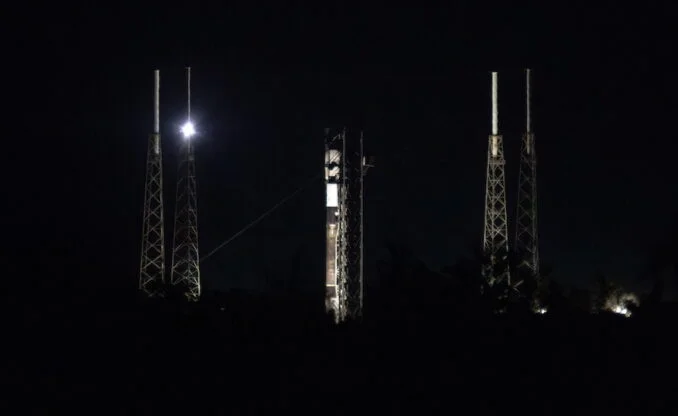
SpaceX is set to launch the latest trio of AST SpaceMobile’s BlueBird satellites from Cape Canaveral Space Force Station in the predawn hours of Wednesday morning.
The Falcon 9 rocket will carry satellites numbered 11, 12, and 13 in to orbit. The mission comes about a month-and-a-half after SpaceX launched the BlueBird 8-10 mission.
Liftoff from Space Launch Complex 40 is scheduled during a window that opens at 3:42 a.m. EDT (0742 UTC). The rocket will fly on a northeasterly trajectory upon leaving the pad.
Spaceflight Now will have live coverage beginning about an hour and 20 minutes prior to liftoff, partially to account for the anticipated impact on the Moon of an unrelated Falcon 9 rocket upper stage.
The 45th Weather Squadron forecast an 85 percent chance for favorable weather during liftoff. Meteorologists are tracking the possible interference from anvil, thick, and cumulus clouds.
“A weak mid-level low centered over Georgia this morning will begin to dissipate through the overnight period,” launch weather officers wrote. “Lingering influence from this feature will promote continued light southwesterly low-mid level flow during the primary launch window.”
SpaceX will launch the mission using the Falcon 9 first stage booster with the tail number B1077. It will become the fifth Falcon booster to achieve at least 30 flights, with four out of those five boosters are still in operation.
More than 8.5 minutes after liftoff, B1077 will target a landing on the droneship, A Shortfall of Gravitas, positioned in the Atlantic Ocean. If successful, this will be the 162nd landing on this vessel and the 645th Falcon booster landing to date.
The trio of BlueBird satellites will be deployed several minutes apart beginning about 54 minutes after liftoff. The 2,400-square-foot sized satellites will then take a couple of weeks to deploy to their full size and complete checkouts before entering into the broader constellation.
In late July, AST SpaceMobile CEO Abel Avellan said on social media that the next trio of satellites following this launch are not too far behind the three satellites launching on Wednesday morning. He said they have production in flow through satellite 42.
“We invented a new way to design, manufacture at scale, deploy, and fly lightweight composite stackable architecture combined, with the world’s largest and most advanced direct-to-device and radar phased-array with the ability to launch them in groups of 3, 5, 6, or 8 on a single launch,” Avellan wrote.
SpaceX’s Falcon 9 is able to launch three satellites at most with its Falcon 9 rocket with the eight-satellite configuration reserved for Blue Origin’s New Glenn rocket, which has a seven-meter diameter payload fairing. However, the latter rocket is grounded for an undetermined amount of time following the May 28 pad explosion.
BlueBirds 11, 12, and 13 are stacked and getting ready for their August 5th orbital launch from Cape Canaveral Space Force Station in Florida.🚀🚀🚀🚀🚀🚀🚀🚀🚀🚀🚀🚀🚀
BlueBirds 14, 15, and 16 to follow right after.
Production advancing through BlueBird 42.
Built in Texas.… pic.twitter.com/I8JXqCmGV7
— AST SpaceMobile (@AST_SpaceMobile) July 31, 2026