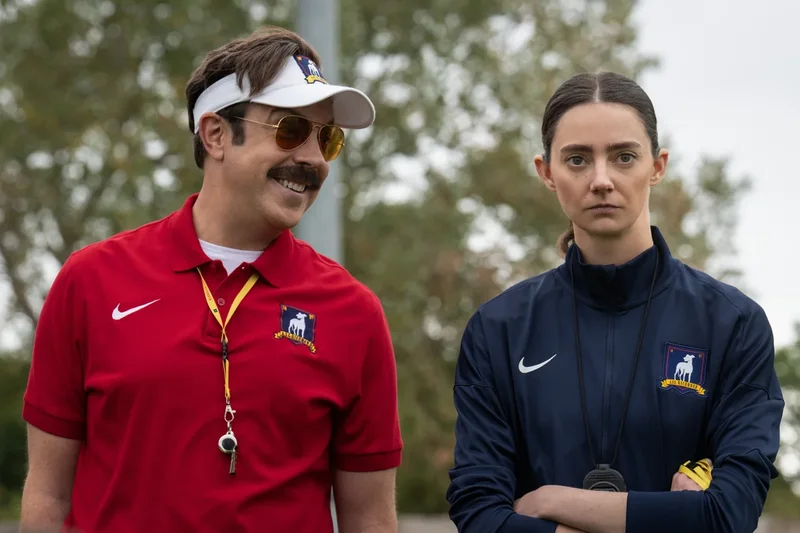
Ted Lasso, the hit comedy about a clueless American coach who arrives in the Premier League, returns for its fourth series at a time of crisis for football. After the World Cup was dogged by questions of political interference from the Trump administration, Fifa President Gianni Infantino announced a plan to sell off parts of the World Cup to Wall Street venture capitalists. It has all left the increasing Americanisation of the beautiful game feeling a bit too real. Enter then, again, Ted Lasso.
At the end of the third season, which aired more than three years ago, AFC Richmond narrowly missed out on the Premier League title and Ted (Jason Sudeikis) graciously stood down, so he could return to the US and his young family. Roy Kent (Brett Goldstein) took over, Nick Mohammed’s Nate found redemption in returning to the club, and all seemed well. “Been there, done that, got the T-shirt and now I use it to wash my tyres,” Ted announces, at the outset of this new season. He’s working in a supermarket, spinning homey aphorisms and resisting a return to management. But then Rebecca (Hannah Waddingham), Keeley (Juno Temple) and Higgins (Jeremy Swift) arrive in Kansas with a new proposition: the chance to become the first coach of the AFC Richmond women’s team. Soon, Ted is back in south-west London and reunited with his trusty sidekick Coach Beard (Brendan Hunt).
Toy Story 5 came out a few weeks ago and, with time to kill, I found myself going back and watching the previous four instalments in anticipation. The first three constitute a perfect trilogy, with an ending filled with pathos and closure. And then, for some reason (answer: money) they made two more, middling additions. The same sense of gratuitous protraction is present in this reset of the Lasso universe. Several much-loved characters have departed the series (Mohammed’s Nate, Phil Dunster’s Jamie Tartt, most of the men’s team players, and, of course, the late Anthony Head as Rebecca’s nemesis Rupert), which means an influx of new faces to replace them. Chief among them is Sex Education’s Tanya Reynolds as Alice Chilton, a severe but effective coach who calls Batman “a fascist”. But there are also roles for Abbie Hern, as star striker Gemma, and Faye Marsay, as working mum/centre back Lizzie, and a host of other “Lady Greyhounds”.
Despite all this upheaval, the show’s creator, Bill Lawrence, and key cast do a good job of making it still feel like Ted Lasso. But it also feels pointless. And cynical. “Last time I hired you for all the wrong reasons,” Rebecca tells Ted, and she approaches him for the new gig. “This time I absolutely want to hire you for all the right ones.” But even though there is an attempt at some broad feminist commentary and critique – “Who f***ing cares?” a fan heckles Keeley as she announces the women’s team; “Unlimited tampons,” a player coos as she enters their new locker room, “banging!” – it really feels like the show has wasted the earned conclusion of its arc in pursuit of more episodes, more revenue, more Emmys. Sudeikis continues to be charming, Temple is a highlight as the mischievous Keeley, and Reynolds brings plenty of new deadpan charisma – yet the return, after three years, feels a bit flat.
This is in part because the show is re-running its greatest hits. Ted must turn a ragtag bunch of individualists into a competitive unit, coming up against some of the biggest, richest clubs in the world. Every Lassoism (“You gotta think the first fella to eat an egg was just doing it to make his buddies laugh”) feels like it has been deployed before. The acting, while effective, is often hamstrung by sentimentalism, which pushes it into hammy (and a painfully stilted Jill Scott cameo makes Chris Powell look like Laurence Olivier). And while the show has always been gently amusing rather than laugh-out-loud funny, this new series does feel acutely short of gags – save for one excellent joke about Harold Pinter.
Americans don’t truly understand football, sure, but they do understand narrative storytelling. Ted Lasso is an all-American sporting hero in the mould of Rocky Balboa or Air Bud. The show was about bringing some of that touchy-feely shmaltz and exposing it to the rough winds of Premier League football. Can you be an eternal optimist on a cold, rainy night in Stoke? Having answered that question, the show has nowhere to go but limp on like an ageing striker whose powers are fading before their eyes.