Korea is seeking to set a target year for wartime operational control (OPCON) transfer from Washington to Seoul during a Security Consultative Meeting (SCM) with the U.S. this October, the Ministry of National Defense said Wednesday.
The move follows earlier attempts by the Korean government to complete the transfer by 2028 or even as early as the end of 2027 — a push that has drawn concern from U.S. Forces Korea (USFK), which firmly maintains the position that the transfer should remain conditions-based.
The ministry presented the plan to President Lee Jae Myung during a policy briefing at the presidential office in Seoul.
It said it would complete the road map for OPCON transition in the second half of the year and seek a decision on the target year at the 58th SCM. It will also report the results of its assessment of Full Operational Capability (FOC), the second stage of the three-stage transfer conditions, and seek certification of second-stage completion.
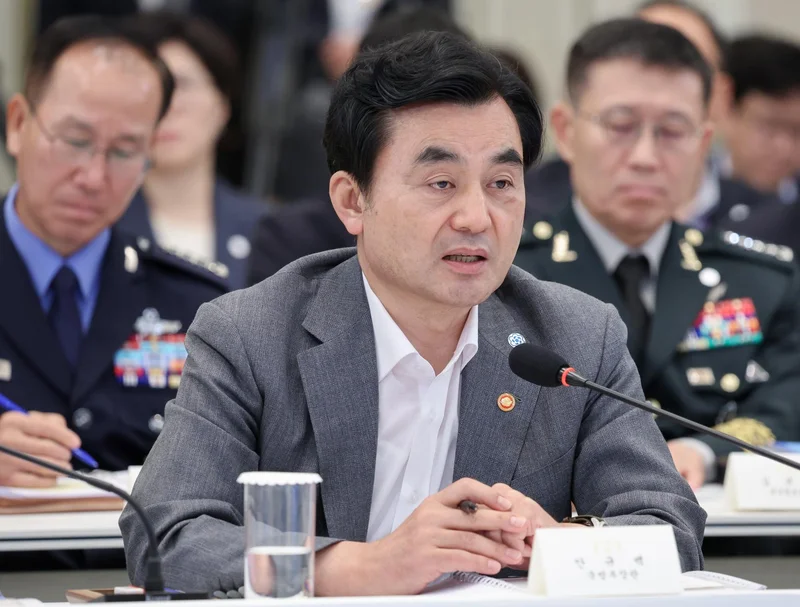
Defense Minister Ahn Gyu-back said the two countries had built consensus on accelerating the transfer through high-level consultations, including defense ministerial talks and the Korea-U.S. Integrated Defense Dialogue.
"We will complete the road map in the second half of the year and move ahead at a faster pace, including recommending the timing of the OPCON transfer once FOC certification is completed at the 58th SCM," Ahn said.
The ministry described 2026 as the first year of its push to regain wartime OPCON.
“We believe it will be possible to determine the target year at this year’s SCM,” a senior defense ministry official said. “Discussions are underway through various channels.”
The official said once the FOC assessment is reported to the SCM and approved by the defense ministers, they would recommend a target year to the two countries’ commanders in chief.
Korea and the U.S. are pursuing the transfer under the conditions-based operational control transition plan. The process consists of three stages: initial operational capability, FOC and full mission capability. The two countries are currently working on the second stage.
The official said the FOC assessment has been conducted throughout the year rather than during a single combined exercise.
“The required capabilities are evaluated continuously, and various assessments will also take place during this month’s Ulchi Freedom Shield exercise,” the official said.
The president said one of the country's biggest tasks was to achieve self-reliant defense without relying on outside assistance.
"Naturally, command authority over the military, which is part of our sovereignty, should also be exercised by ourselves," he said.
"It makes no sense that the armed forces are not under the command of the defense minister, who serves under the president who is the commander in chief," Lee added. "Normalizing that is an important task."
USFK, however, has expressed concern about Korea's "rush" to take over wartime OPCON, saying the transition should remain conditions-based.
Testifying before the U.S. Senate Armed Services Committee in April, Gen. Xavier Brunson, the commander of USFK, said, “Political expediency does not outpace the conditions.”
He also said the two countries had submitted a road map that would be achieved no later than the first quarter of 2029. “We will continue to press for the conditions-based OPCON transfer and ensure that all the conditions are met,” he added.
“The Combined Forces Command will remain in place after the transfer, and all six combined component commands will continue operating,” a senior ministry official said.
“That demonstrates the strength of the allies’ combined defense system.”