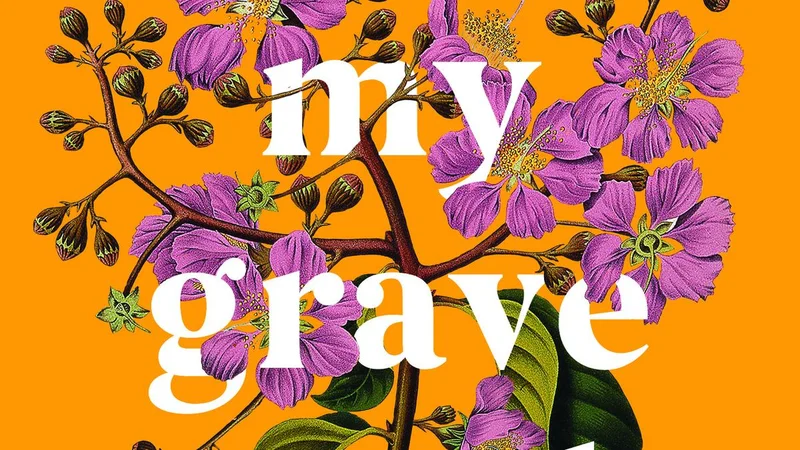
A taxi driver who initiates a conversation about elephants crossing the highway to a research scholar during a ride to the Jorhat airport. A woman from England who would go on to be called the ‘Jungle Queen’ in Assam and beyond. A daughter looking for signs that would help her navigate the difficult days following her father’s death by reading pages from his journal: author Shehnab Sahin paints a powerful picture of Assam through the many characters and the workings of their mind in her debut short story collection Colour My Grave Purple, published by Niyogi Books.
Speaking over phone from Assam, where she is now based, Shehnab, who used to be a humanitarian worker in Syria and Lebanon, talks about how the 10 stories in the anthology took shape, and how through them, she seeks to show the world a side of Assam that is often left out in the mainstream narrative.
Shehnab recalls how during her orientation at St Stephen’s College in Delhi where she studied, a fellow student asked her, ‘Oh, so you must have descended from your treehouse,’ when she mentioned where she was from. “You don’t forget these kinds of things,” says Shehnab, adding that she ended up explaining how developed Guwahati was, with good roads and shopping malls. “But I realised my response was actually, in a way, an apology,” she says, “Just because my trajectory of development isn’t similar to yours, it has to come from a space of defence.”
When she set out to write her first work of fiction, Shehnab felt that it was important to put out things that challenged stereotypes. In the collection that reflects her love for history, she has set stories in various time periods: from 1855, 1920, 1962 and beyond, up until 2019. This lets her use a variety of themes to narrate stories of Assam and its people. In Two Leaves and a Bud, she talks about the tea plantation economy of the state, while in Ursula, she tells the story of Britisher Ursula Graham Bower who was in the Northeast India of the 1940s, documenting the lives of the tribal people of the Naga Hills. She also touches upon human-elephant conflict in another charming story titled Animal Instinct.
‘The history of Assam and its people is as meandering as the mighty Brahmaputra that flows through it,’ she writes in her author’s note. But more often than not, Shehnab feels that a lot of literature talks only about certain aspects of their existence, such as “the violence, the AFSPA, the rape of our women, the secret killings”. She adds that it was important that she represent them, but at the same time, was conscious about “ensuring that other stories also travel outside because it’s not nice to be typecast”.
Shehnab does not want to gain attention through a “bait of pity”. Instead, she wants to say, “Listen, this is who we are. If you’re interested, you might want to learn a bit more about the Northeast, particularly Assam.” She adds that it was with this perspective that she wrote the stories in the anthology.
While the book is her ‘love letter’ to home, it is also proof that she too has traversed the same path as her late father Khobir Ahmed. A police officer, he also juggled a demanding career as a writer, going on to publish seven novels and several collections of short stories in Assamese. “Being his daughter, it was inevitable that someday, I too would write because I feel it in my veins,” Shehnab says.
Writing the stories in the collection, for Shehnab, was her way keeping herself sane during a tumultuous period in life. “It took three years for me to finish these stories,” she says, explaining how she started writing at home during the pandemic, going on to finish it during her stint at Syria.
Shehnab was sure her first work of literature will be a collection of stories. “This is how I wanted to actually show my world, my people,” she says. She is now writing a work of historical fiction that features several geographies. “But the crux of the story is Assam,” she says.
Published - August 05, 2026 12:45 pm IST