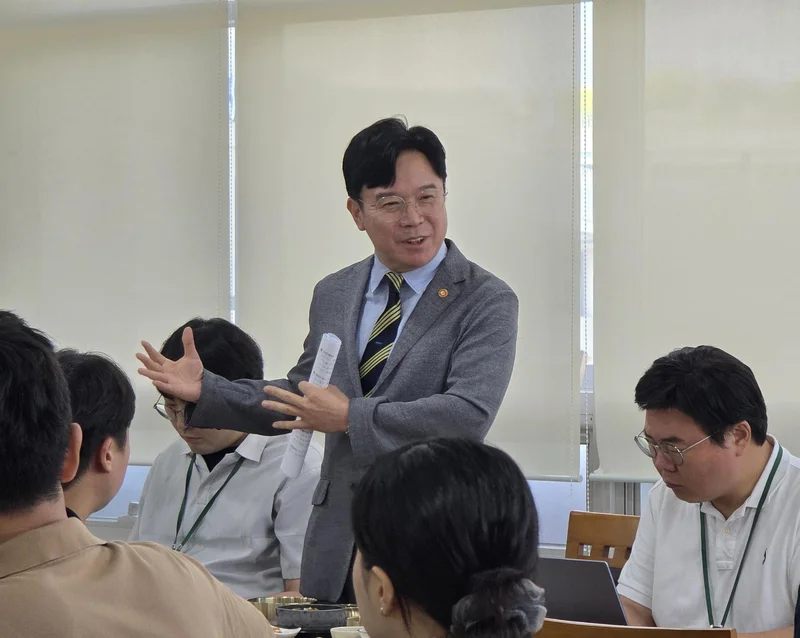
Labor Minister Kim Young-hoon said that a much-discussed labor deregulation package for Korea's planned mega chip cluster in the southwest is “still under review,” as business groups and unions closely track the government's next move.
Speaking to reporters on Wednesday, Kim said controversial policy ideas such as easing the 52-hour workweek cap and extending fixed-term contracts in the “mega special zone” have yet to be finalized as President Lee Jae Myung presses ahead with plans to fast-track the large-scale chip investment.
“There is nothing finalized yet within the government regarding the mega chip project as we are still in the process of maturing the discussions,” Kim said. “I expect there will be further coordination among relevant ministries. In particular, the two major umbrella unions have proposed a meeting with the president and broader social dialogue on this issue, and as the minister in charge, I will make sure to communicate fully with the labor side so that this can move forward.”
The minister’s remarks come amid reports that the government is weighing aggressive labor deregulation for the zone, including lifting the 52-hour weekly cap for top-earning managers and research and development staff under a so-called “white-collar exemption” and allowing fixed-term contracts in the cluster to run beyond the current two-year limit, as well as loosening restrictions on the use of dispatched workers.
The nation’s two largest umbrella labor organizations — the Korean Confederation of Trade Unions and the Federation of Korean Trade Unions — blasted the proposals in a joint statement, calling them a rollback of basic worker protections and vowing to fight any attempt to push them through.
Kim said the fierce debate over the zone should be treated as “a chance to find opportunities in the middle of a crisis,” and pledged to act as a coordinator by meeting union leaders and exploring compromises.
“I think it is perfectly legitimate to talk about giving research work a bit more flexibility. But the issue has been overblown, as if that flexibility could never be allowed, that it has become hard to even have a proper discussion,” the union leader-turned-minister said.
“On the calls to ease rules on dispatched work, these are long-standing demands from companies, and I believe they are something we can discuss in a reasonable, balanced way.”
He also affirmed that the ministry does not consider a Samsung Electronics union’s demand to bargain over the major development plan itself as a legitimate subject of collective bargaining under the “yellow envelopment act,” noting that officials are now working to align relevant enforcement rules with that interpretation.
On the windfall bonus issue, which emerged after massive artificial intelligence boom-driven payouts began flowing to chip workers at Samsung Electronics and SK hynix, Kim said the president said at a recent Cabinet meeting that he found it hard to accept the state stepping in to earmark a fixed share of operating profit for bonuses before corporate tax is paid. Kim added that his ministry is reviewing the issue and plans to translate the president’s instructions into more concrete guidance and that the government should not dictate companies’ bonus policies.