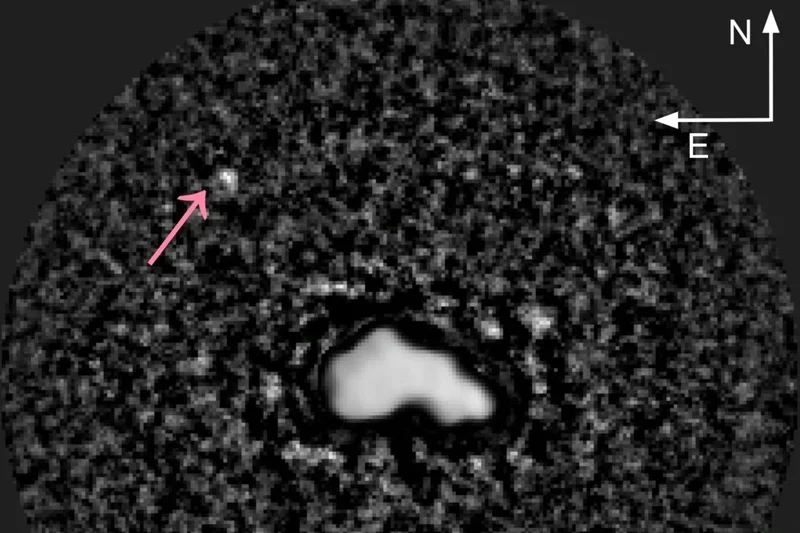
Astronomers have spotted a first-of-its-kind three-lobed asteroid between Mars and Jupiter, also accompanied by its own small moon, providing a rare glimpse into the variety of space rocks in the Solar System.
Researchers made the discovery thanks to high-resolution imaging from some of the world's most advanced telescopes, including the Large Binocular Telescope (LBT) on Mount Graham in Southeastern Arizona.
The 75km-wide asteroid, named Nysa, belongs to a class of space rocks labelled the E-type, categorised based on its surface composition.
It formed close to the Sun and shares chemical traits with the building blocks of Earth, according to a yet-to-be-peer-reviewed study posted on arXiv.
Scientists hope to further study this space rock as they believe it may shed light on processes that shaped the earliest phases of our solar system’s formation.
Nysa was first discovered in 1857 and was named based on the land where nymphs raised Dionysus, a Greek god associated with masks and theatre.
For more than a century, the asteroid has been known for its unusual brightness and composition, making it a compelling target for investigation.
While previous observations hinted it had an elongated or potentially bilobate shape, the asteroid's true form remained elusive.
Now, thanks to LBT, researchers obtained the highest-resolution images ever acquired of Nysa.
"In this paper, we're finally unmasking the asteroid's true nature, long after it was discovered," said Al Conrad, an author of the study from LBT.
Thanks to the telescope and a specially developed image processing technique, scientists could spot multiple large surface features on the asteroid, as well as two prominent valleys that appear to wrap around Nysa's circumference.
Researchers interpret these valleys as neck-like connections between separate lobes, indicating Nysa is a “remarkably unusual object”.
"The most likely explanation is that Nysa is either a contact trinary, consisting of three connected components, or an extremely irregular coherent body unlike anything we've previously observed,” said astronomer and study lead author Kate Minker.
A detailed three-dimensional model of Nysa strongly supports that it has three distinct lobes connected by narrow neck regions.
The findings suggest that the asteroid may have formed via low-velocity accumulation of fragments from an ancient collision, possibly before Nysa reached its current location in the asteroid belt.
Alternatively, scientists say Nysa may be the remnants of a dramatic hit-and-run collision involving a larger parent body.
“For the first time, we can directly investigate whether those clues point to a deeply indented body or to a true multi-lobed structure,” Dr Conrad said.
"These new images appear consistent with several earlier clues that Nysa is not a conventional asteroid,” he said.
Researchers also found a previously unknown moon, temporarily designated S/2026, that is circling Nysa.
This moon measures just over one kilometre in diameter and orbits at least 170 kilometres from the asteroid.
Scientists hope future observations of Nysa could help determine its mass and density more precisely.
Once confirmed, Nysa would join a growing class of solar system objects whose distinctive shapes preserve evidence of ancient collisions and mergers dating back billions of years.