Colombia Exports Jump 14.2% to US$27.8 Billion in First Half
Economy: Bogotá
Colombia’s exports rose 14.2% in the first half of 2026 to US$27.844 billion, DANE reported, driven by oil, coal and a surge in gold even as coffee and flower sales fell.
A Strong Half for Colombian Exports
Colombia’s exports rose 14.2% in the first half of 2026 compared with the same period a year earlier, reaching US$27.844 billion, according to DANE, the national statistics agency. The gain extends a run of double-digit export growth that began earlier in the year.
The headline number masks an uneven picture. Growth was concentrated in mining and energy products and in gold, while several of Colombia’s traditional farm exports lost ground. The result is a stronger top line built on a narrower base.
For investors, the figures underline how dependent Colombia’s external accounts remain on commodities, whose prices and volumes can swing sharply from one year to the next.
Oil, Coal and a Gold Surge
Fuels and products of the extractive industries led the advance, rising 18.6% to about US$11.313 billion. Within that group, crude-oil and petroleum-product sales climbed 19.3%, while coal, coke and related exports edged up around 2.5%.
The single most striking contributor was gold. Non-monetary gold exports jumped roughly 97.6%, accounting for a large share of the overall variation as high international prices lifted the value of shipments. Together, mineral-energy goods made up more than 40% of total export value in the half.
That concentration is a double-edged sword. It powered the first-half gain, but it also ties Colombia’s export performance to volatile global commodity markets rather than to a broad-based rise across industries.
Live Market IntelligenceColombia — Live Market Board
Rio Times · Live Market Intelligence
Colombia — Live Market Board
-0.42%
177,894.97
-0.06%
66,848.35
+0.22%
10,996.46
-0.48%
3,188,971
-2.61%
2,374.67
-0.42%
57,475.88
+2.27%
| Instrument | Last | Change | YoY | Prev. | High | Low | Volume |
|---|---|---|---|---|---|---|---|
| COLCAP | 2,374.67 | -0.42% | — | 9.04 | 9.05 | 9.02 | 4,133 |
| USD/COP | 3,194 | -1.49% | -22.05% | 3,242 | 3,201 | 3,194 | — |
| BRENT | 80.25 | +1.12% | +18.64% | 79.36 | 80.46 | 78.13 | 7,981 |
| WTI | 76.18 | +0.54% | +16.91% | 75.77 | 76.32 | 74.24 | 48,606 |
| ECOPETROL | 16.31 | -1.78% | +92.11% | 16.60 | 16.47 | 16.05 | 2,624,074 |
| BANCOLOMBIA | 90.01 | -1.21% | +100.29% | 91.11 | 92.29 | 89.16 | 378,934 |
| GRUPO AVAL | 5.20 | -0.76% | +81.53% | 5.24 | 5.27 | 5.13 | 254,988 |
| TECNOGLASS | 46.25 | -1.10% | -40.85% | 46.76 | 47.61 | 45.91 | 458,890 |
| CREDICORP | 392.12 | -0.93% | +62.03% | 395.79 | 400.61 | 390.79 | 307,422 |
| BUENAVENTURA | 32.26 | +5.87% | +80.22% | 30.47 | 32.38 | 31.30 | 933,739 |
| SOUTHERN COPPER | 195.16 | +4.98% | +113.99% | 185.91 | 197.35 | 193.30 | 1,067,751 |
4 of 9names higher.
Miningled, while
Energylagged.
Agriculture Loses Ground
Colombia’s agricultural, food and beverage exports slipped about 2.7% to roughly US$7.425 billion, a notable reversal for sectors that anchor rural employment. Coffee, a signature Colombian export, fell about 11.6%, while cut flowers declined around 5%.
Producers point to a stronger peso, which makes dollar-priced exports less competitive and squeezes margins when costs are paid in local currency. Higher input costs and new tariffs on some goods entering the United States, a key market, added to the pressure.
The divergence has fed talk of an “export paradox” in Colombia: record overall sales abroad alongside a retreat in the farm goods that many regions depend on most.
The Peso and US Tariffs
Two external forces frame the outlook. A firmer peso against the US dollar has eroded the local-currency value of exports, a headwind for exporters even when volumes hold up. Currency strength that helps tame inflation can quietly hurt competitiveness abroad.
New US tariffs on certain imports have added uncertainty for Colombian manufacturers and farmers who sell into the American market. Trade groups warn that, if sustained, the combination of revaluation and tariffs could blunt the momentum that carried exports through the first half.
How those pressures net out in the second half will help determine whether 2026 delivers durable export growth or a commodity-driven spike that fades.
Cartagena Leads the Gateways
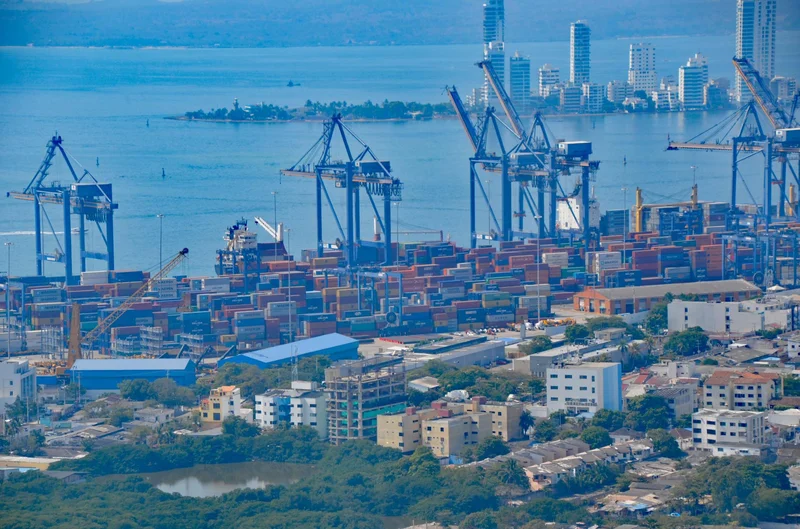
Cartagena, on the Caribbean coast, was the leading customs point for Colombian exports in the first half, reflecting its role as the country’s main container and bulk gateway. Ports and border crossings across the country handled the flow of oil, coal, gold, coffee and flowers.
The geography of trade matters for logistics and investment. Concentration through a handful of hubs, led by Cartagena, shapes where infrastructure spending and shipping capacity are most needed as volumes grow.
It also underscores how tightly Colombia’s export economy is linked to a few coastal nodes that connect Andean production to global markets.
What It Means
A 14.2% rise in exports is a clear positive for Colombia’s trade balance and its dollar earnings, easing some external pressure in a year of global uncertainty. But the quality of the growth invites caution, resting heavily on oil, coal and gold.
For policymakers, the challenge is to broaden the export base beyond commodities and to support farm exporters facing currency and tariff headwinds. For investors, the data confirm both the strength and the fragility of Colombia’s external position.
The next set of monthly figures from DANE will show whether the first-half momentum carries forward or whether the softer patches in agriculture and the drag from a strong peso begin to weigh more heavily on the total.
Frequently Asked Questions
How much did Colombia’s exports grow in the first half of 2026?
Exports rose 14.2% year on year to US$27.844 billion in the first half of 2026, according to DANE, the national statistics agency.
What drove the increase?
Fuels and extractive products rose 18.6%, with crude-oil sales up 19.3%, and non-monetary gold jumped about 97.6%. Those mineral-energy goods accounted for most of the gain.
Which exports fell?
Agricultural, food and beverage exports slipped about 2.7%, with coffee down roughly 11.6% and flowers down about 5%, pressured by a stronger peso and new US tariffs.
Sources: DANE via Portafolio, Infobae, El Nuevo Siglo, El Universal and Semana.
This article was produced by The Rio Times’ automated newsroom system. How we use AI · Report an error