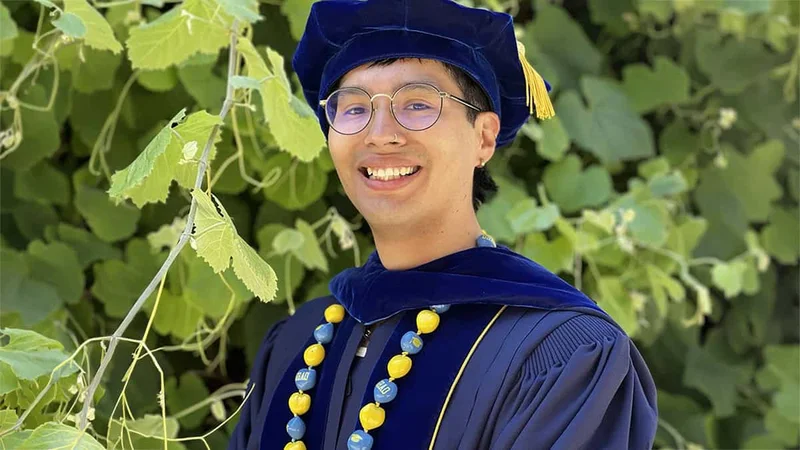
Kristian Dominek Barajas is head of quantum theory at the UK-based quantum computing company Oxford Ionics, which merged with the US firm IonQ in 2025. Barajas got his PhD – which was focused on developing analytic methods for high-accuracy models of driven quantum systems beyond the rotating-wave approximation – at the University of California Los Angeles, US, via the American Physical Society’s Bridge Program. The programme provides pathways into research for qualified students who might not otherwise continue their physics education. He now serves as chair of the APS Committee on Minorities (2025–2026), where he helps shape national initiatives that support physicists from historically marginalized backgrounds – particularly people of colour, LGBTQIA+ physicists, and physicists with disabilities.
What skills do you use every day in your job?
Because I’m relatively new to the field, I often have to break difficult questions down into simpler ideas before I can grapple with them. That has trained me to take a really complicated problem and give it my best guess, and that first-pass intuition often gets me surprisingly close to the full solution.
The other thing I’d highlight is leadership skills. I come from an untraditional background – it took me a long time to do my undergraduate degree, and afterwards I worked in a lot of different jobs, including working at a pet store, where I was training to become a team lead. When I went to grad school, I applied through the APS Bridge Program, which is great, and it gave me an opportunity to get into research. But again, my path wasn’t traditional: I did soft condensed matter physics for four years, and then my advisor passed away unexpectedly, so I switched fields to trapped ions because I needed to graduate. I had no background in quantum physics at that point, so it was quite a transition.
Experiences like this added up. By the time I joined Oxford Ionics right before the merger with IonQ, even though I was the “greenest” person in my team in terms of being new to the field, I had the most leadership experience. That meant I went from being an entry-level quantum theorist to a senior quantum theorist in two or three months. A month and a half later, I became the atomic, molecular and optical (AMO) theory manager. The experience I’d gained made it easy to set priorities and get people to go in the correct direction.
What do you like best and least about your job?
My least favourite part of the job is that I don’t get to read much new research. The job is so fast-paced and there’s so many things happening every day that getting the chance to sit down and read an article is quite rare. I use AI tools to help me find and keep up with new research. Part of my workflow involves asking AI to identify relevant papers and give me an initial sense of what I need to know. I still skim the papers themselves as much as I can, but I don’t get the chance as often as I’d like to pick up a manuscript and spend a whole day working through it like I did in academia.
We also don’t always have the time to write papers about what we’re doing. It’s not that we aren’t allowed to – in fact, we’re encouraged to pursue that if we want to do it – but finding time is challenging.
I’m constantly getting to do new and interesting physics, and I absolutely love that about my job
The upside is that the pace at which I get to do research far, far outweighs what I experienced in academia. What we accomplish on our team in four to six weeks is comparable to the amount we would do in six months in academia. It is absurd how fast we get to move. I’m constantly getting to do new and interesting physics, and I absolutely love that about my job.
What do you know now that you wish you’d known at the start of your career?
I wish I’d known that feelings of imposter syndrome don’t always have to be something to fear. For me, they can also be a reminder that there is still so much more to learn, and that can be exciting. That’s why I was so excited for the opportunity to earn my PhD in physics: it gave me the chance to keep learning. Now, whenever that old imposter feeling comes up, I try to see it as an opportunity to learn rather than a reason to hold myself back. I wish I had embraced that earlier in my career and not been so afraid to try things.