Triumphant champagne toasts, 4am phone calls to the premier, streams of texts, phoney meetings, board-stacking, prolific profanity and treachery aplenty.
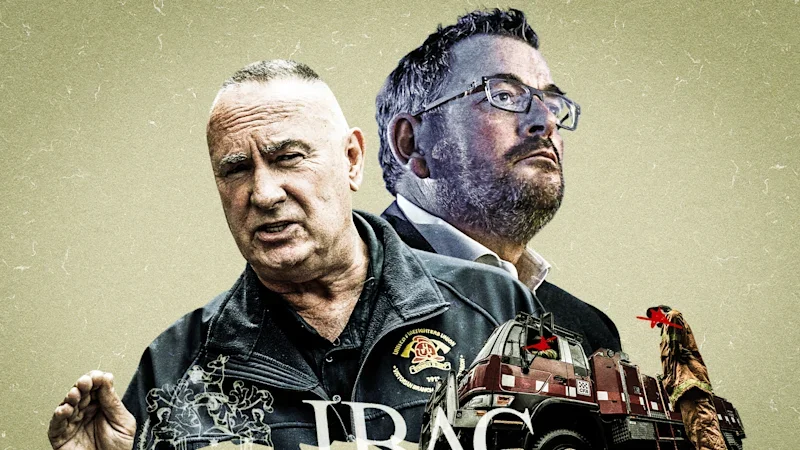
The eight-year investigation by Victoria’s corruption watchdog into Daniel Andrews’ time as premier and his government’s dealings with the United Firefighters Union may not have delivered any findings of corruption, but there were still plenty of jaw-dropping moments in its 120-page exposition of how power is wielded in this state.
In sometimes excruciating detail, the Independent Broad-based Anti-corruption Commission describes how the premier, ministers, senior government MPs and top bureaucrats ran secret backroom operations, misled cabinet, purged public boards and capitulated – over and over again – to relentless pressure from the long-serving head of the firefighters’ union, Peter Marshall.
It reveals secret hotel-room negotiations to bypass the then emergency services minister, Jane Garrett, and the Country Fire Authority, and then details what followed: a multi-year campaign of political damage control, and attempts to assuage the many demands of Marshall as he continuously leveraged the deal that arose out of those negotiations. Below is a selection of some of the more notable moments described in the report.
The 2014 election debt and the ‘intractable’ dispute
The roots of the scandal stretch back to the 2014 state election campaign, where the United Firefighters Union ran what Marshall called an “extensive, comprehensive and at times exhaustive nine-month campaign” to help elect Labor, deploying 720 firefighters to 109 polling sites and members doorknocking against the Coalition.
As an adviser to Andrews told IBAC: “We owe a lot to the firefighters because they helped us get elected. Any time we needed to do a rally Peter could get an auditorium full of firefighters.”
By early 2016, enterprise bargaining negotiations between the CFA and the union had broken down over a 400-page log of claims containing “veto clauses” that gave the union extraordinary control over management decisions, and a series of other clauses the government believed could be unlawful.
A torrent of abuse
The report details several Marshall tirades including subjecting Garrett to a “huge torrent of abuse” that left her “really rattled” after she refused to intervene in an internal disciplinary matter.
Andrews, who at the time regarded Garrett as a future threat to his leadership, told IBAC that the EBA dispute had become “completely intractable”, with both sides miles apart.
He viewed Garrett’s proposal to negotiate wage rates directly with firefighters rather than settling the dispute with Marshall and the union as untenable and provocative.
Secret missions and champagne toasts
In March 2016, Andrews authorised special minister of state Gavin Jennings to secretly take over negotiations directly with Marshall, excluding Garrett and the fire agencies.
Department of Premier and Cabinet deputy secretary Tony Bates was enlisted and instructed “not to speak to anyone outside of DPC”. Only six people in government were aware of the arrangement – Garrett was not one of them.
Jennings referred to being “off doing my secret mission” and “secret business” in text messages. Negotiations took place across four days in rented spaces and a hotel room, behind Garrett’s back.
On April 12, 2016, Jennings texted Andrews: “Handshake has occurred – it’s done!” The premier responded, “Very good”.
Soon after, photos were taken of firefighters’ union negotiators and an intermediary Labor senator celebrating in a hotel meeting room, “with full champagne glasses in hand and sparkling wine bottles on the table, toasting”.
Marshall later summarised the deal cut that day in an intercepted 2019 phone call: “This agreement was negotiated with f---in’ Jennings in a back room. It was endorsed by f---in’ Andrews and cabinet.’”
The ‘staged’ meeting for Garrett
To legitimise the secret deal, government figures staged a meeting on April 13, 2016, at which Marshall formally presented a proposed CFA enterprise agreement to Daniel Andrews as a fresh “UFU proposal”. Bates told IBAC he had led the development of the document.
Neither Andrews nor Jennings disclosed the backroom origin of the document to Garrett, the minister in charge of the negotiations, when they told her about it.
IBAC’s view of this meeting is that it “was not genuine but staged”.
Conciliation back-channels
As negotiations stalled during Fair Work Commission conciliation in May 2016, Marshall resisted any material changes to his secret deal. On May 23, 2016, Andrews texted Jennings asking for progress.
Jennings replied: “At 11am he [Marshall] was convinced you were a treacherous c--- and I was a f---ing idiot ... By lunchtime he was giving me the benefit of the doubt.”
IBAC also revealed that Jennings maintained an undisclosed direct communication line with the presiding Fair Work commissioner, exchanging at least 22 text messages in May and June 2016.
Marshall’s messages: 1.16am texts and FOI evasion
IBAC documented an extraordinary volume of demanding and often after-hours contact from Marshall.
Data revealed Marshall sent text messages to government members throughout the night, including texts to Jennings at 1.15am, 1.16am, 1.20am, and one at 5.25am in May 2016 asking: “You awake need to talk urgently if possible.”
Also in May, Marshall sent Jennings a lengthy message at 3.49am. A staffer revealed that Andrews also received calls from Marshall at 4am.
Public servant Tony Bates exchanged 381 text messages with Marshall between May and September 2016. Bates routinely referred to the CFA as “clowns” and “childish” in these texts.
When Marshall asked Bates if he should avoid emailing due to the risk of someone finding out about their communication via freedom-of-information laws, Bates replied: “I’m happy to have factual stuff emailed. Anything you’d prefer kept confidential or of a legal advice nature I’m happy to have as hard copies.”
Sacking and stacking boards
When the CFA board refused to sign off on the government’s United Firefighters Union deal, due to its legal and operational concerns, new emergency services minister James Merlino – appointed after Garrett resigned – simply fired it, in June 2016.
A new board was appointed via an opaque and politicised process managed out of the Premier’s Private Office.
When the new board was announced, an acquaintance texted Bates that they hoped a new appointee to the board “fully comprehends that [they] will have to do as [they’re] told”, to which Bates replied: “Only for the first couple of weeks”.
A similar pattern occurred at the Metropolitan Fire Brigade in January 2018 when the board reached a 3-3 deadlock over the proposed MFB enterprise agreement. The government appointed a seventh member and, a week later, the board approved the agreement.
Jane Garrett resigns
Garrett resigned from cabinet in June 2016 after refusing to endorse an agreement she considered unacceptable. Before her resignation, a premier’s office adviser told Jennings that Andrews wanted treasurer Tim Pallas “to sit Garrett down and give her a very blunt assessment about the career paths currently in front of her”.
In her examination by IBAC, Garrett described the meeting as “a long conversation over drinks which lasted for ‘at least three hours’, in which the treasurer tried to convince her to change her position and counselled her regarding the career repercussions of not doing so”.
It was just one example of many of the pressure applied to Garrett.
Sacking the union’s disliked lawyer
IBAC uncovered direct political interference by the government in MFB operational matters, to placate Marshall.
In May 2018, the Department of Justice directed the MFB to stop using an external lawyer that was assisting the brigade with its enterprise bargaining, because Marshall disliked them, saying they were anti-union.
A Premier’s Private Office adviser told IBAC that although the lawyer was providing “fantastic advice”, government officials told the MFB that it could not keep using that lawyer because “Peter was like literally losing his mind”.
The adviser recalled phone calls in which Marshall called them a “fucking c---, rat c---”.
Employing a crossbench MP’s relative for votes
In June 2019, as the state government sought to pass legislation relating to firefighting laws through a tight vote in the upper house of the Victorian parliament, Marshall moved to secure a key crossbench vote.
After learning a crossbench MP’s relative needed work, Marshall met the MP at Parliament House on May 31 and offered to employ the relative at the union.
Intercepted phone calls revealed the job duties were invented on the spot the morning the relative started work.
IBAC recorded a call from Marshall telling a colleague that the crossbench MP “is 100 per cent behind us [and] just to make sure we just employed [their relative]” .
Read more on Operation Richmond:
Secret missions and staged meetings: How a backroom deal led to the IBAC probe.
Damning report: A previous report exposed the influence of Peter Marshall and the firefighters’ union.
The dispute: This is how the firefighters’ union took centre stage.
The delay: The IBAC called for greater powers after a bid to block its report.