The Homeric question
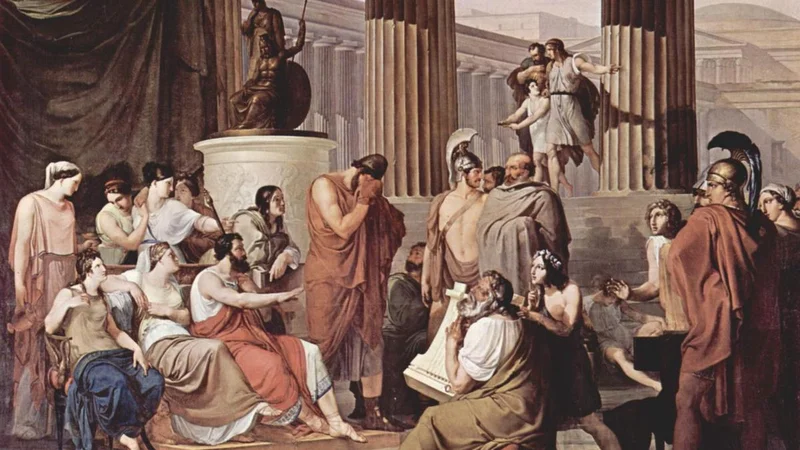
If we were to leap out of the pages of the epic, the best place to start would be the one from whom the story is said to have first emerged. Homer. The author of the Odyssey is a being of many mysteries. One of the greatest mysteries lies in the very existence of Homer! Scholars have grown puzzled about the true identity of Homer for centuries, and have constantly debated the conundrum of whether Homer was a single author, a group of people, or even a name used by a lineage of writers. Samuel Butler, an author from the early 19th Century, even theorised that Homer was not a man but a young Sicilian woman! This mystery, and the journey to study and uncover it, came to be known as the Homeric question. Famed scholars and critics of history, including Richard Bentley, the founder of historical philology, and Friedrich August, the founder of modern philology, have emphasised and spoken upon the fluid-like nature of the text, which gave it the structure of an oral narrative. Aspects like repeated phrases and the manner in which the text is delivered formulated the theory that the Odyssey, alongside the Iliad, were both products of oral-formulaic composition. This is where oral poets improvise and create poetry through repetitions and ready-made or established phrases. Two pioneers in the study and research of Homeric epics, Milman Parry and Albert Lord, pointed out that the repetitions found in these kinds of epics were inherited from the poet’s ancestors, and were known as “formulas”. So, it was theorised that Homer had passed down the narration of the Odyssey through oral means. However, despite the mystery behind Homer’s appearance, there exist many visual artworks of the poet and how many perceive the mysterious identity. How is this? Well, that would have to do with the fact that they are visual representations of what each artist believed Homer to look like. Also, theories on the poet’s appearance had been made by writers from ancient times. For example, the word Homeros holds two prominent meanings. One being ‘hostage’, which made people believe that Homer had been a captive or born into captivity, and the other being ‘blind’, which created numerous visuals and artworks of the poet being portrayed as blind. It served as a likely piece of evidence that the epic was orally narrated. It was also believed to be no coincidence that one of the characters of the Odyssey, Demodocus (the poet who performed three narrative songs during Odysseus’s stay at Phaeacia), was described as blind.
STORY IN A NUTSHELL
Odysseyis an epic that stands out in history. It follows the story of Odysseus, the king of Ithaca, and his perilous journey home from Troy with 600 men. On his way, he faces dangers and deadly obstacles like sirens, Cyclopes, and monsters within the depth of the sea. Every danger he faces is crossed with his cunning mind, willpower, pain, and even sacrifice.
Epic alphabets
If a reader were to look closely, the Odyssey is structurally divided into 24 rhapsodies (or books). There are also 24 letters in the Greek alphabet, all the way from alpha to omega. The belief that this was purposely constructed to mirror the alphabet was considered by many scholars to be ahistorical (disconnected from history). There are many who say that the composition arose years after the poem was created and was accepted as a modern structure. There are also theories stating that the structure was formulated by Alexandrian scholars.
The delayed entry
Now, to have a cup of tea with the protagonist of this story, it is time to dive into what makes Odysseus such a unique character. Firstly, it is important to note that despite being the eponymous main character of the epic, Odysseus does not appear until Book Five! Instead, the story’s first four books focus on the chaos ensuing within his kingdom, with his wife Penelope and son Telemachus. It is mentioned that at the moment, he was held captive on Calypso’s (the daughter of the titan Atlas) island, and this is after all of his struggles with the dangers he had faced throughout his journey. The delayed entry of the protagonist is an aspect of importance, for the readers and audience are first provided with tales of Odysseus from a third-person narration. However, the reason for this could also be to establish a strong contrast between tales and reality. For when the audience is finally introduced to the character himself, he is not portrayed as the warrior who braved the seas and monsters, but rather as an exhausted and defeated captive of Calypso. Remember that this is a story that is a sequel to the Iliad (the Trojan War), where Odysseus was not only seen as a great warrior, but also a genius strategist. To be introduced in the Odyssey in such a different way made his behaviour seem highly uncharacteristic. Many readers from the past took this as evidence that the Odyssey and the Iliad had been written by separate authors. Another unique aspect about Odysseus is that his main description does not lie in physical strength or combat mastery. He is instead emphasised to have cunning intelligence and the creative mind of a trickster, as is showcased by his tactic to escape the deadly Cyclops Polyphemus by identifying himself as ‘nobody’, not to mention how he was the creator of the famous Trojan Horse, one of the greatest examples of strategic trickery in literature. His character and the focus on intelligence and trickery pose a stark difference to how many other Greek warriors are described for their strength and battle prowess in other stories.
Where is Ithaca?
Scholars and geographers discovered a new source of intellectual division within the Odyssey, and that was whether the places visited by the protagonist on his way back home were real or not. Greek geographer Strabo repeated what had been stated by the great Greek polymath and geographer Eratosthenes during the 3rd Century B.C., which was “You will find the scene of Odysseus’ wanderings when you find the cobbler who sewed up the bag of winds.” There does lie an island in the Ionian Sea named Ithaca, which was once traditionally called Thiaki, but other scholars have argued that another island on the sea, now called Lefkada, is the real place. Research was done by German archaeologist Wilhelm Dörpfeld, who strongly believed that the epics of Homer were based on historical facts. He had made comparisons between the passages of the Odyssey and the landscape of Lefkada. However, many flaws were seen in his research, which was considered more romantic than factual.
The monsters and obstacles
They may be the source of the protagonist’s suffering, but the monsters and island barriers Odysseus faced on his journey are what make the epic so iconic. But no matter how old a work of art is, the creativity and inspiration that went into it are interconnected.
The cyclops: The victim of the ‘nobody’ trickery! Polyphemus is one of the most popular creatures in the epic. According to William Hansen, professor emeritus of classical studies and folklore at Indiana University, the story of the cyclops is now known by folklorists as the tale of The Blinded Ogre, but while the story is known through the epic, he emphasised that “Homer did not invent it.” Adding onto this, Adrienne Mayor, a classics scholar and folklorist at Stanford University had stated, that the most feasible and believable explanation for the creation of the cyclops’s story is that “in antiquity, shipwrecked sailors took shelter in coastal caves on islands in the Mediterranean Sea and discovered fossil skulls and bones of long-extinct mammoths,” the skulls of these animals have a large opening at the near-centre of the head, which “would easily be mistaken for a single eye socket by people unfamiliar with elephants.”
The sirens: The melodious singers you would not want on the stage unless you wanted to gift your ears with disguised poison. In the epic, these creatures were said to be singing words coated with aeons of knowledge and wisdom, which prompted Odysseus to take the risk of listening to them while tied to his ship. One unique fact about the epic’s representation of them is that there is no physical description of what they look like, and that is left to the reader’s imagination. The sirens were said to have been the manifestations of seafaring perils in the ancient Mediterranean.
Scylla and Charybdis: Two of the deadliest foes Odysseus faced on his journey. Two sea monsters who serve as barricades on two sides of an incredibly narrow strait. The scene where Odysseus and his men come upon these monsters showcases the protagonist making a hard decision where there is no route without death. He thus made the choice to sacrifice six men to Scylla, instead of losing all of them to Charybdis. This is where the Greek idiom “Between Scylla and Charybdis”, which refers to a situation where one is faced with two dangerous decisions, where avoiding the consequences of one would inevitably lead to the same of the other. Scholars have theorised that the two monsters were inspired by the Strait of Messina, which is the narrow waterway that lies between Sicily and Southern Italy. According to Adrienne Mayor, “The Strait of Messina is known for a powerful and deadly whirlpool dreaded by sailors since the time of Homer.”
Published - August 05, 2026 02:57 pm IST