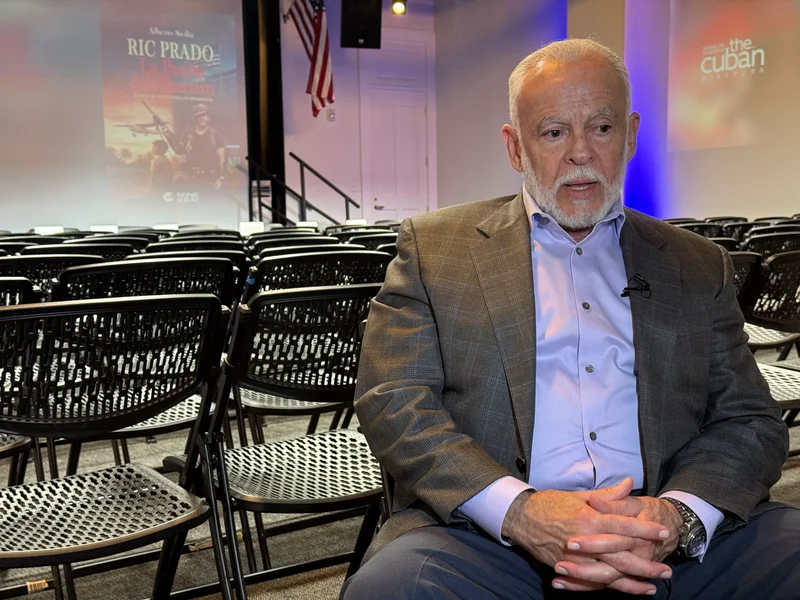
Enrique “Ric” Prado is 75, his voice measured from having told this story many times and from an uncomfortable habit: saying in public things most people with his résumé prefer to keep to themselves. He retired from the Central Intelligence Agency (CIA) in 2004 with a rank equivalent to a two-star general after 24 years of service and, he says, as the first Hispanic officer with paramilitary credentials in the department. He now lives quietly, devoted to his family and giving talks about the memoir he published in 2022, Black Ops: The Life of a CIA Shadow Warrior.
He meets EL PAÍS at the American Museum of the Cuban Diaspora in Miami, and when asked about Cuba, the country he left as a child, he leans forward, aware of the weight of what he is saying. He believes that as soon as the war with Iran ends, the White House will turn its attention back to the Caribbean island, and that the combination of Donald Trump and his secretary of state, Marco Rubio, “has given a push” to something that had been stalled for decades.
Prado was born in Cuba in 1950, in Manicaragua, a town at the foot of the Escambray Mountains where Che Guevara established his guerrilla front. He recalls the first gunfight he ever saw as a very small child in the care of a nanny, while he heard “people shooting and falling.” When the Revolution succeeded, the change was “very abrupt,” he says.
His parents learned from a relative that they were on a list to be sent to the Soviet Union. That was when they enrolled him in Operation Peter Pan, the program run by the Catholic Church and the U.S. government that between 1960 and 1962 sent more than 14,000 children alone out of Cuba. Prado arrived in the United States without speaking a word of English and spent several months in an orphanage in Colorado.
As a teenager in South Florida he enlisted in the Air Force, intending to go to Vietnam. He did not arrive in time. By the time he finished his training as a rescue parachutist, the war was ending. He remained in the reserves, worked as a rescuer, and in 1974 handwrote an application to join the CIA. It was rejected.
“They replied with a letter saying they were not looking for people like me,” he recalls. The call came six years later, in 1980, when Ronald Reagan’s Republican administration decided to back the anti-Sandinista guerrillas in Nicaragua and confronted a problem: “The agency did not have a single Hispanic person with the paramilitary credentials I had. They called me and, as the saying goes, the rest is history.”
He spent the following years training the Contras in remote camps on the Honduras–Nicaragua border, and later served in El Salvador, the Philippines and North Korea, always on counterinsurgency and counterterrorism missions. Those years also carried a human cost that rights organizations have documented in detail. Human Rights Watch reported that the Contras carried out kidnappings, torture and systematic executions against the Nicaraguan civilian population in a war that left between 30,000 and 50,000 dead, according to various organizations, throughout the 1980s.
In El Salvador, where Prado arrived at the CIA station in 1986, the civil war’s toll was even greater: about 75,000 civilians died, most at the hands of security forces and death squads, such as those responsible for the El Mozote massacre in 1981, when a battalion trained by the United States killed more than 800 civilians. More than a quarter of El Salvador’s population ended up displaced or exiled, an exodus that became part of communities in Los Angeles and other U.S. cities.
In the Philippines, where Prado led operations against the New People’s Army, various bodies documented extrajudicial killings and disappearances attributed both to the guerrillas and to security forces backed by Washington.
In January 1996, he joined the original unit the CIA created to track Osama Bin Laden, years before that name meant anything to the general public. “By 1997 we already had tons of intelligence about what he was doing, about the camps where his men trained. We developed plans to act but, unfortunately, there was no political forum to do so. Timing was mishandled and a great opportunity was lost, because if we had been able to neutralize him in some way in 1997 or 1998, today the world would be very different,” says the intelligence expert, who also led the Counterterrorism Center’s operations during the 9/11 attacks as operations chief.
It was that center that pushed the detention and interrogation program that led the CIA to open secret prisons, the so-called “black sites,” in several countries. According to the report released by the U.S. Senate in 2014, at least 119 detainees passed through those facilities between 2002 and 2008, and 39 of them were subjected to so-called enhanced interrogation techniques — the euphemism the agency used to describe methods such as waterboarding, which simulates the sensation of drowning; prolonged sleep deprivation, lasting up to 180 consecutive hours in some cases; confinement in small boxes; or stress positions maintained for hours.
At least 26 of the detainees, the report concluded, were held in error. That same period included the clandestine transfer of suspects to third countries and the start of the program to eliminate Al Qaeda leaders with drones, which in subsequent years caused hundreds of civilian deaths, according to figures compiled by organizations such as Amnesty International.
After retiring from the CIA, journalist Evan Wright noted in his 2012 book How to Get Away with Murder in America that Prado had for years been the right-hand man of a drug trafficker and figure in Cuban organized crime in Miami whom he had met in high school. According to his investigation, Prado was linked to at least seven homicides committed in the city during the 1970s and 1980s. A Miami detective quoted in that report went so far as to describe Prado as “technically a serial killer.”
For years, the police and the FBI built an organized crime and homicide case against him, with a 30-page indictment draft that was never filed because, investigators quoted by Wright said, the case was dropped when Prado joined the CIA. Detective Mike Fisten himself argued that the agency “resisted tooth and nail” when they tried to question him, and called it a “judicial error” that he was never prosecuted. Prado was never formally charged with any crime.
Cuba
Today, it is about his country of origin, Cuba, where the veteran — despite being retired for two decades — speaks most freely. He maintains that the United States “has people in Cuba” and that many covert options have been presented to the president, while noting that the agency is, “by institutional design, the third option” of the U.S. government, after diplomacy and military force.
Regarding CIA director John Ratcliffe’s recent visit to Havana, he interprets it not as a diplomatic gesture but as a strategically calculated signal by the White House. “The thing about Trump is that he’s always playing chess, while the rest of the world is playing Chinese checkers,” he points out. “Do we have information on Cuba? Of course we do. Do we have people in Cuba? I’m sure of that. And I’m even more certain that they’ve laid out many options for the president, as if it were a restaurant menu. Everything is feasible,” he emphasizes.
The former operations chief, who served at the CIA during the final stretches of the Cold War and witnessed the Soviet bloc’s collapse up close, draws a parallel between Cuba’s current situation and that historical moment. “The same thing happened to us with the Soviets. Before the wall fell, when we saw the Soviet Union starting to break up, we began talking to Russians everywhere in the world, because we were not going to try to recruit someone inside their country. The Russians stationed abroad, working — they were the target. We told them: if you work with me now, you’ll have a house in Virginia, a Mercedes, a Rolex and money in the bank. And there was substantial recruitment of Soviets who said, ‘The ship is sinking, let me grab this rope.’”
For Prado, the fact that the Cuban people are openly protesting against the island’s government is a phenomenon that deserves more support from Washington, including the possibility of giving protesters “the capacity to defend themselves.” He again insists that once the crisis with Iran is resolved, the island will be next on the agenda.
The inevitable question is whether, watching those movements from afar, he feels the urge to return to action. He does not hide it: he admits a certain “longing” and acknowledges that if they called him tomorrow he would not say no. But he is quick to qualify: he is not going to be knocking on doors anymore. “That stage of my life is over,” he says. “Now I have a family.”
Sixty-five years after leaving Manicaragua on a plane bound for a country completely unknown to him, Ric Prado remains on watch, albeit from a distance. Before saying goodbye in the museum room that preserves the memory of exiles like him, he is hopeful that, this time, “Cuba is the next apple to fall from the tree.”