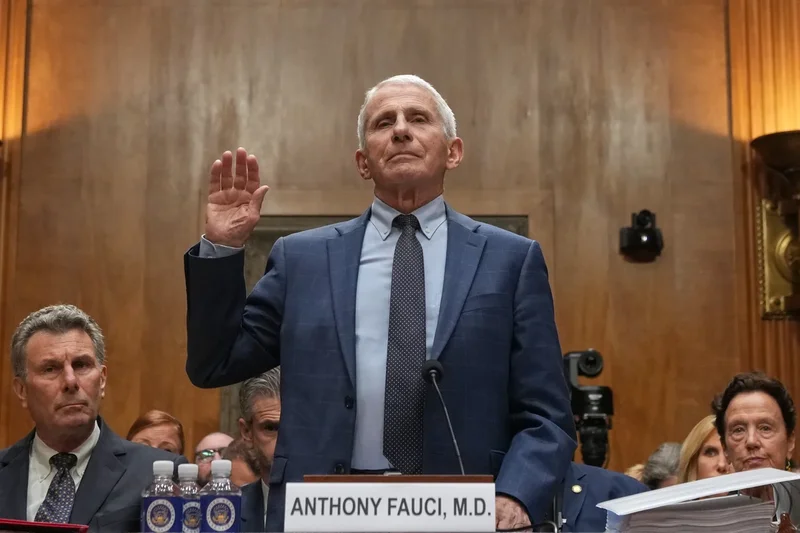
Dr. Anthony Fauci’s decision to invoke the Fifth Amendment before Congress will be put to the test this week as a Republican-led committee prepares to vote to hold him in contempt and refer the matter to the Justice Department.
A contempt finding could open the door to an investigation into whether Fauci had a valid constitutional right against self-incrimination when he refused to answer dozens of questions from lawmakers at a committee hearing last week focused on his handling of the COVID-19 pandemic.
Republican senators including Rand Paul of Kentucky, who subpoenaed Fauci and has called a contempt vote for Thursday, insist that a pardon the doctor received early last year from Democratic President Joe Biden left him ineligible for Fifth Amendment protections. A Senate resolution released Tuesday asserts that Paul found Fauci's privilege claims “unsupported.”
But some legal experts say Fauci had reasons to invoke the Fifth Amendment, given the threat of potential state prosecutions and questions from President Donald Trump's administration about the validity of Biden's pardons. Any testimony from Fauci could have also prompted false-statement investigations like the ones the current Justice Department has repeatedly initiated against the Republican president's perceived adversaries.
No matter what happens, the episode raises fresh and complicated questions about Congress' ability to compel testimony from previously pardoned witnesses — and the outcome could resonate beyond Fauci.
“This is an important case because I think a lot of people anticipate that President Trump is going to issue similar pardons to many people in his administration who will end up being called before Congress, and the precedent here is important,” said Mark Osler, a St. Thomas University law professor and pardon power expert.
Paul's committee is moving to transmit the contempt referral from his Republican-led committee directly to the Justice Department. Whether the Justice Department would act on the referral is unclear.
Fauci's pardon protects him for past, not future, acts
Fauci, a longtime National Institutes of Health scientist and the nation’s top infectious-disease expert, left the federal government in 2022 after more than five decades. He was among a group of perceived adversaries of Trump to be pardoned by Biden in one of the Democrat’s final acts in office. The clemency covered acts from 2014 to the date in January 2025 when the pardon was issued.
Republicans on the Senate Homeland Security and Governmental Affairs Committee say the pardon lifted the specter of criminal prosecution and left Fauci without a valid basis to invoke the Fifth Amendment — a bedrock constitutional protection found in the Bill of Rights but one typically available only to those who have a reasonable basis to believe they risk being charged over their testimony.
While a blanket pardon theoretically removes a threat of prosecution, Fauci made clear he thought he had a good-faith basis to fear criminal charges. He invoked his Fifth Amendment rights more than 100 times.
Before the hearing. Fauci said that Paul, the committee chairman, had an “obvious obsession with calling for my prosecution." The purpose of his forced appearance “is to get me to say something, anything, that could vindicate his repeated public pledges that I end up, in his words, quote, behind bars, unquote,” Fauci said.
In the run-up to the hearing, Paul made dozens of Fauci-related posts on X, including ones teasing that he was going to confront the doctor for having earlier given false testimony — something Fauci has denied.
“I think his invoking the Fifth makes sense because he was invited into a situation where everyone in the country understood that Rand Paul was trying to set him up for a criminal prosecution,” said Michael Gerhardt, a University of North Carolina law professor. “In that circumstance, one of the smartest things to do would be to make yourself a very small target and say as little as possible, and that's obviously what he did.”
In announcing the contempt vote, Paul noted on X that “Fauci refused to answer a single question, even though he knew he couldn't be charged for crimes” during the decade covered by his pardon. Fauci's deflections encompassed even seemingly harmless questions, such as the color of the tie he was wearing — a reflection of an apparent belief that it was safer to refuse any testimony.
There are factors that could tilt in favor of Fauci's strategy, including the fact that his pardon would not protect him from potential state prosecutions or from a federal prosecution related to any testimony that investigators deemed false. That may not be an idle concern given the number of false-statement investigations prosecutors have opened against Trump's political opponents.
Trump's administration also has repeatedly called into question the validity of the Biden pardons, given Biden's frequent use of an autopen for official business. Legal experts say the pardons are valid.
“The question is do you have a reasonable fear of prosecution, and Fauci's argument would be — yes, I received a pardon, yes, I believe that pardon covers and prevents prosecution but there have been statements from lots of people including Trump and other administration officials ... raising questions about the validity of that pardon,” said Ross Garber, a lawyer and expert in political investigations who has represented multiple clients who have invoked the Fifth Amendment.
“That,” he added, “is potentially a very viable argument.”
Paul has discussed trying to fast-track a contempt referral
Paul said in an interview with Fox News Channel last week that he did not think “there's any rule" requiring that a contempt referral from a committee go through the entire Senate. His committee is instead working to send the referral straight to the Justice Department.
The contempt resolution states that the president of the Senate, Vice President JD Vance, “shall certify” the committee’s referral and the accompanying report to the U.S. attorney for the District of Columbia.
That fast-tracking of the process avoids the need for a vote in the full 100-member Senate, where Republicans likely lack the 60 votes required to move a contempt referral to passage.