[Today’s Iran War post fired before finished. Please return or refresh this page at 7:30 AM EDT for a completed version]
It is really depressing to see a lot of commentators that I had regarded as sound falling for and amplifying the US spin that the US was somehow a party to Iran-Oman talks about future operations of the Strait of Hormuz and/or the US and Iran were negotiating. Are they all getting brain burnout? That Scott Bessent piling on the messaging somehow made it more credible, as opposed to more desperate? The algos are no longer sufficiently moved by Truth Social or Axios claims that yessiree, a deal is gonna happen real soon!
In fact, the increased frequency of Trump gaslighting, ‘I’m gonna bomb Iran into dust” fallowed by fake peace talk TACOs suggests something is coming unglued. True, more volatility provides more opportunity for short term trading profit. But some experts contend that the best of Trump’s bad options is to somehow carry on through the midterms, and then retreat then. That of course assumes nothing breaks on the energy front, like US refineries out of commission due to explosions or extreme weather or Strategic Petroleum Reserve caverns collapsing at a higher level of reserves than the Department of Energy anticipated. And no one in the officialdom seems to be adequately factoring in how the Ansar Allah blocking of Saudi shipments out of Yanbu (and the Saudi weird refusal to get over themselves and come to some sort of settlement) is going to increase economic pressure.
So the rational course of action for Trump would be to try to dial the intensity of the conflict down and play for time. But Iran is on to that. It not only has said it will determine when the war ends but is turning up the heat, as it did with its pause-breaking strike on the US operations in Jordan.
The Iranians are not deterred by Trump’s threats and will be even less so as more leaks and reports emerge that confirm that the US is running into Stein’s Law: If something cannot go on forever, it will stop. The US cannot prosecute a full scale war, whatever that means. It can’t even replicate the level of intensity of strikes it maintained over the first 40 days of the war for very long (days? a week tops?) if it were to try to beat up Iran hard to change its behavior.
And the point of Iran’s discussions seems to be widely misunderstood. Iran needs to nail down where Oman stands and better yet, secure an understanding before it can regularize operation of the Strait of Hormuz. This is a precondition to any path forward, be it the highly unlikely one of an agreement with the US or the somewhat less improbable one of reaching a modus vivendi with GCC members.
Iran erred in not nailing down Oman’s position before it signed the MOU, which was what stance Oman would take vis-a-vis the operation of the Strait of Hormuz. Iran bizarrely assumed Oman would violate UNCLOS, which Oman had signed, because fees. Iran seemed to be blindsided by Oman implementing what was initially a UN initiative (and very rapidly abandoned in that form) of the Oman channel, which the US then sponsored.
The US twisted Iran statements that an agreement with Oman was close to incorporate not one but two fabrications: that the US was a party to the talks and that they were to “open” the Strait of Hormuz, as in that was set to happen almost immediately. This was then quickly amplified into claims the US and Iran were talking. A recap from DropSite on Twitter as of mid-day EDT Tuesday:
💵 🇺🇸 US Treasury Secretary Scott Bessent said Washington could reach a deal with Iran to reopen the Strait of Hormuz as soon as “today or tomorrow.”
“Even though things are still a little dicey there over the past few days, we’ve seen quite a few ships coming out even now,” Bessent said in an interview with CNBC.
The optimistic timeline comes as Iran says no talks with Washington are underway, but negotiations over the strait are being conducted through Oman. Qatar said mediators are working with “all parties” on a “short-term solution” to revive negotiations.
We later had Axios giving its own “Deal is happening” fable” a mere 10 hours ago, in U.S. nears Hormuz deal, aiming for Wednesday announcement.
To add an additional sanity check, Iran’s position has been nothing is settled until everything is settled. In no universe would it come to terms with the US on the Strait of Hormuz without getting a full outline of updated terms, sure to be more Iran-favorable, plus a huge chunk of its frozen assets released up front and Israel withdrawal from Lebanon, and other proofs of US commitment to compliance. In other words, this deal patter is simply not credible on its face. Yet the press keeps mindlessly amplifying it.
PressTV had a prominent denial on its landing page as soon as the US hype started; I was remiss for not taking a screenshot. A later story had Iran more explicit throat-clearing. From A later story has louder throat-clearing. From Iran-Oman Strait of Hormuz corridor talks enter new phase despite US obstruction, informed source tells Press TV:
It has now been more than two weeks since the negotiations with the Omani side entered a new and decisive phase. The progress achieved during this period has been significant, and a bilateral Iran-Oman agreement is within reach.
The remaining obstacle is the continued obstruction by the United States and its regional accomplices, the official told Press TV. Should this interference cease, he noted, there is every reason to believe that the two littoral states can finalize an arrangement that serves their mutual interests and upholds the principles of sovereignty and international law.
The article also described agreeing on a central corridor, as in the pre-war channel:1
Rather, the goal is to reach agreement on a new corridor that fully safeguards Iran’s sovereign rights and addresses the legitimate concerns of a nation that has been directly harmed by the aggressive actions of the United States and its regional allies…
The proposed central corridor represents a practical and lawful solution. Once this corridor becomes operational, both the northern and southern routes will be discontinued…
The central corridor will provide for the safe passage of commercial and civilian traffic while simultaneously ensuring that Iran’s national security is no longer compromised by the presence of hostile naval forces operating in close proximity to its shores.
Note that Iran claimed to have mined that route, so even if this were to come into effect, there would need to be interim provisions while clearance was underway.
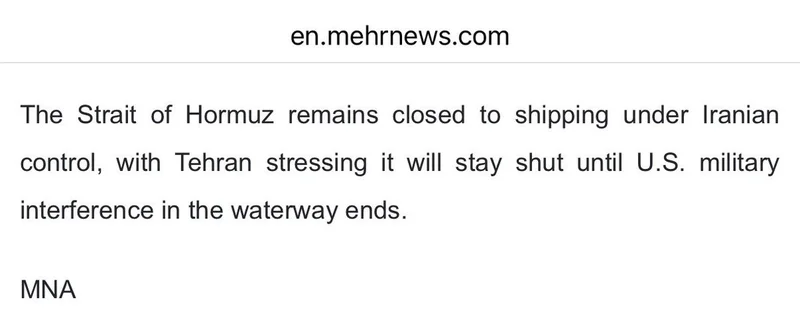
Mehr issued a broad denial of talks with the US:
And from Al-Mayadeen in Iran says Oman Hormuz agreement within reach if interference ends:
Tehran denies talks with WashingtonEarlier, Iranian Foreign Ministry spokesperson Esmaeil Baghaei said discussions with Oman are focused solely on establishing a safe and temporary shipping corridor through the Strait of Hormuz….
He also denied that Tehran is currently holding negotiations with the United States, adding that members of the Iranian delegation remain in Iran.
Iran denies US talksA senior Iranian political and security source told
Al Mayadeenthat Iran is not holding any negotiations with the United States….According to the source, Iran’s actual negotiations are with Oman, its “permanent neighbor”, given that the Strait of Hormuz lies entirely within the two countries’ territorial waters. “The United States has always been a disruptive and destabilizing force,” the source said, “and cannot present itself as the region’s savior.”
On the strait’s status, the source said whether it stays open or closed “depends on the broader situation in the region,” but stressed it will not reopen “as long as US aggression, the blockade, and other provocative measures against Iran continue.”
The lead story on the current PressTV landing page throws more cold water on a Strait of Hormuz “opening” any time soon:
Any potential Iran-Oman agreement on vessel transit arrangements in the Strait of Hormuz is unrelated to its immediate reopening, according to a report, which dismissed US President Donald Trump’s claim that the strategic waterway will be reopened soon.
Quoting an informed source, the IRIB reported on Wednesday that the talks are exclusively between Iran and Oman and are not related to the US.
“If US violations continue, the Strait of Hormuz will not be reopened even if Iran and Oman reach an agreement. The reopening of the Strait of Hormuz is contingent upon a change in US conduct and the rectification of its violations,” the source added.
Now to the Reuters account, that the US weaponry is even more depleted than widely assumed.2 The original story is well paywalled but Palestine Chronicle has a detailed recap. From US Has Used ‘Virtually All’ Long-Range Missiles in Iran War – Reuters:
The United States has depleted much of its global stockpile of precision long-range missiles during its five-month military campaign against Iran, according to multiple sources familiar with internal US military data cited by Reuters news agency.
The report said the Army has used “virtually all” of its Army Tactical Missile Systems (ATACMS) and Precision Strike Missiles (PrSM), two of its principal surface-to-surface precision weapons. Both systems have been central to Washington’s strategy of striking targets from long distances while limiting risks to pilots and aircraft.
Reuters reported that the extent of the depletion has not previously been disclosed publicly. The sources declined to reveal how many missiles remain in US inventories.
The PrSM is the Army’s newest long-range precision weapon and is intended to replace the aging ATACMS fleet. Both munitions cost more than $1 million each and are considered essential for potential future conflicts involving heavily defended adversaries such as China and Russia.
According to Reuters, the rapid consumption of precision weapons has fueled growing concern within the Trump administration over the military’s ability to sustain prolonged operations while maintaining global deterrence.
Three sources familiar with internal discussions said dwindling missile inventories could constrain Washington’s ability to respond to future crises beyond the Middle East. One source said the heavy reliance on long-range missiles reflected a deliberate effort to avoid riskier missions involving manned aircraft over Iran.
A fourth source said US Central Command has continued replenishing operational stocks by drawing weapons from inventories positioned elsewhere around the world….
Citing internal discussions and previous reporting, the agency said military leaders have repeatedly warned the White House that stocks of Patriot air-defense interceptors and THAAD missile interceptors have also declined significantly during the conflict.
The report noted that a recent study by the Center for Strategic and International Studies (CSIS) estimated that approximately 65 percent of Patriot interceptors had been expended since February, while THAAD interceptor inventories had fallen by at least 38 percent. Two Reuters sources said those estimates closely matched classified US government figures.
Reuters also reported that the United States has consumed nearly half of its global inventory of Tomahawk cruise missiles during the conflict.
However, this Reuters story, even though widely reported in social and independent media, has not been taken up much by the major outlets. For instance, the only sort-of- prominent Wall Street Journal story on Iran is Iran Is Staking Everything on Controlling the Strait of Hormuz:
Iran’s leadership has made a high-stakes calculation in its showdown with President Trump: maintaining control over the Strait of Hormuz is a nonnegotiable red line.
By asserting authority over a critical waterway for global crude-oil flows, Tehran is betting that its ability to inflict pain on the American economy is its best leverage to avoid future military action from the U.S. and Israel. With gasoline prices and inflation elevated, Tehran believes Trump will ultimately accept its terms ahead of fast-approaching midterm elections that could determine the future of his presidency.
Centering strategy on controlling the Strait of Hormuz is an extraordinary gamble. It assumes Trump will prefer a messy, volatile stalemate over an all-out war. In playing this card so aggressively, Tehran risks miscalculating Washington’s breaking point and threatening its own economic survival.
The New York Times landing page is consumed with election results in Michigan. It then has a block on the Ukraine war and nada on Iran. The Financial Times does not amplify the Reuters findings but does have a lead-section on Trump’s overall fix in Donald Trump trapped between escalation and an Iran deal on Tehran’s terms:
On the real economy front, Kevin Walmsley goes beyond the usual fixation on oil and distillates and sometimes food in Global shipping is a disaster:
This is a map of the key bottlenecks for maritime shipping. They are numbered from West to East. #8, the Malacca Strait, is actually the busiest in the world, by volume. But global logistics are falling apart, right now, because of collapse in ship transits through the Suez Canal, the Red Sea, and the Strait of Hormuz. As it happens, there are also big problems for the Panama Canal, and another looming crisis at #4, and the Black Sea shipping traffic.
We have strong historical data on what happens when one of those chokepoints has a problem…We do not have any historical data if several of these critical nodes go offline at the same time, and that is where we are….
But Panama isn’t getting nearly enough rain to keep the Canal traffic at normal levels, and the canal authority is cutting transits through.
And that particular waterway [the Red Sea] was closed before. This is a JP Morgan report that covered what happened the last time. 30% of the global container trade goes through the Red Sea and Suez, and shipping costs went up 5 times for all the ships that used to head that way, because of the re-routing around Africa. That adds 4,000 miles, one way, for ships sailing between key ports in Asia and Europe.
Summing up, the wars in the Persian Gulf have shut down ocean freight going through the Strait of Hormuz, the Red Sea, and the Suez. Shipping through the Panama Canal, and down the Rhine River, and the Amazon, won’t be back to normal until heavy rains fall again. Those are problems that are baked in to world trade, right now.
What we don’t know, yet, is the effect of the Russia-Ukraine War on Checkpoint #4.But it doesn’t look good. Over two million barrels a day of oil is shipped from ports on the Black Sea, through the Turkish Straits and the Bosphorus, to markets in Europe. We know that Ukraine is hitting refineries in Russia, and that Ukraine has lost a third of its export capacity for grain out of the Black Sea.
So going through the Suez takes about 18 days; going around takes 30 days. Bunker fuel costs are over $800 per ton, because of the closure of the Hormuz, so in increase in the fuel costs alone are nearly a million dollars, one way. Charter costs and longer crew times are passed along…
Monthly ship transits in 2024 dropped from over a thousand, to under 700. In 2026 the traffic is already trending down, and the authorities have halted new auctions from 25 July onward. Water levels are forecast to drop through September, and that means big problems for Panamax shippers in the third quarter.
1 Note a New York Times article presented what it said were terms of the Iran-Oman understanding; Trita Parsi told Mario Nawfal that he had been told the provisions were different, so let us skip speculating, since the particulars still seem to be in play.
2 Joe Kent, IIRC with Daniel Davis, did acknowledge that this story could be disinfo to try to lull Iran into a sense of complacency (which would contradict Trump’s loud and frequent threat displays) but agreed it was vastly more likely to be a leak to try to penetrate Trump’s bubble.