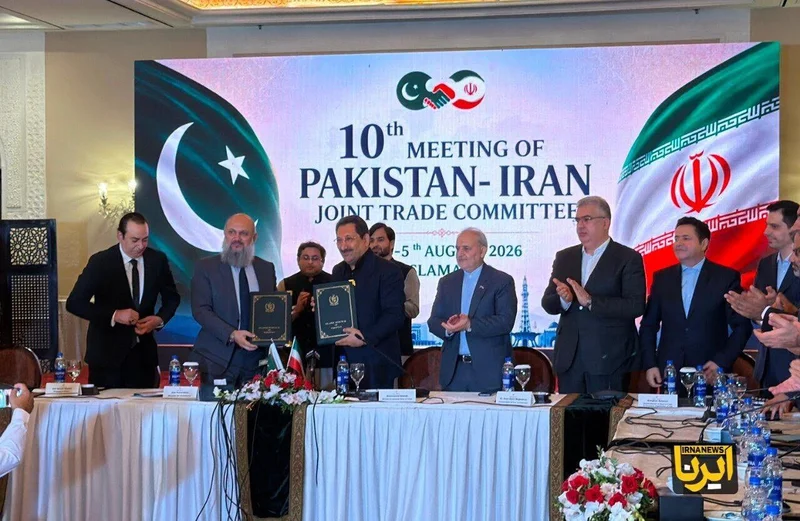
Iran, Pakistan sing MOU to boost bilateral trade toward $10b target
TEHRAN– Iran and Pakistan took a significant step toward deepening economic ties, signing a memorandum of understanding to expand trade cooperation during the 10th session of the Joint Trade Committee held in Islamabad. Both sides reaffirmed their mutual commitment to achieving the ambitious $10 billion target in bilateral trade and advancing toward a formal free trade agreement.
The final session of the committee was attended by Iran's Minister of Industry, Mining and Trade, Seyyed Mohammad Atabak, and his Pakistani counterpart, Jam Kamal Khan. The MOU was signed following extensive deliberations that covered a wide range of commercial cooperation areas, including joint border regions, maritime activities and shipping development, coordinated steps for a free trade agreement, establishment of joint free zones, and barter trade mechanisms.
--------------'Unrestricted commitment' to trade expansion
Speaking at the signing ceremony, Minister Atabak described the negotiations as highly constructive. "Overall, we had good negotiations with Pakistani officials. We also held an important meeting with the Federation of Chambers of Commerce of this country, and everyone emphasized the expansion of interactions between the two nations," he said.
Atabak noted that the talks over the past two days were specifically aimed at increasing trade relations between Iran and Pakistan. "Of course, in some cases, there is a need for facilities and removal of obstacles, and it was agreed that the Pakistani side would continue new follow-ups in this regard," he added.
The minister emphasized that Iran places no restrictions on increasing trade volume with Pakistan. "We call on the business communities of both countries to play their essential role in this direction," he stated, reinforcing Iran's principled policy of expanding cooperation with neighbors and, where necessary, supplying its needed goods from neighboring countries.
Key aspects of the MOU include activating border regions, increasing border exchanges with a focus on private sector engagement, exchanging technical delegations, and immediately operationalizing existing bilateral agreements. Ministry officials from both countries have been tasked with formulating implementation mechanisms.
------------------Private sector engagement takes center stage
On the sidelines of the committee session, a specialized meeting was held at the Federation of Pakistan Chambers of Commerce and Industry (FPCCI) in Islamabad, hosted by FPCCI President Atif Ikram Sheikh and senior officials representing chambers from various Pakistani cities.
Sheikh emphasized the historical depth of Iran-Pakistan relations, noting that the two nations are not just decades-old but centuries-old partners who have supported each other through every difficult period. He highlighted that the Pakistani government, business community, and people had fully supported their Iranian brothers during recent crises in West Asia.
"Despite having long borders, the two countries have not utilized their capabilities in mutual trade," Sheikh acknowledged. "This is a serious demand of economic activists and traders of Iran and Pakistan, and we must take more steps to benefit from each other's capabilities and secure our interests."
Minister Atabak expressed satisfaction with the constructive meeting, stating that such high-level interactions are continuously necessary to facilitate immediate and sustainable resolution of issues. "Pakistan and Iran are not only neighbors, but their relations are rooted in history, religion, and social cooperation," he said, adding that important proposals put forward by business communities from both countries would yield positive results.
During the ceremony, a separate cooperation memorandum was also signed between the Iran Chamber of Commerce and Industries and the Federation of Pakistan Chambers of Commerce and Industry, further institutionalizing private-sector engagement.
----------------------TPO head outlines strategic vision
Mohammad Ali Dehghan Dehnavi, Deputy Minister and Head of the Trade Promotion Organization (TPO) of Iran, addressed the gathering of traders and economic activists from both countries, outlining Iran's strategic vision for bilateral trade relations.
"One of the main priorities of Iran is the development of trade and economic relations with neighboring and aligned countries, which it pursues through a targeted program," Dehnavi stated. "Pakistan, as a friendly neighboring country with good political and economic relations, holds great priority for Iran."
Dehnavi highlighted Iran's unique position as a regional economic powerhouse, noting its population of approximately 90 million, exceptional energy resources, extensive mining and industrial capacities, technical and engineering services, high-tech and knowledge-based products, and strategic geopolitical location with access to rail, road, and international maritime shipping networks.
He pointed to Iran's numerous ports on the Caspian Sea, the Persian Gulf, and the Indian Ocean—particularly Chabahar—as vital nodes connecting neighboring countries to each other and to other continents. He also expressed Iran's willingness to utilize the capacities of Karachi and Gwadar ports to expand international interactions.
The official emphasized Iran's extensive infrastructure in free trade, industrial, and special economic zones, including Chabahar Free Zone in the south, Amirabad in Mazandaran Province, Anzali in Gilan Province, and Aras Free Trade Zone in East Azerbaijan.
"Pakistan can both be a good market for Iranian products and goods, and play a role in supplying basic commodities and raw materials needed by Iranian production units from Pakistan and other countries," Dehnavi said. "Pakistani ports can also serve as a re-export center for Iranian goods to other countries."
---------------------Path to $10 billion by 2030
Dehnavi noted that the volume of trade between Iran and Pakistan in 2025 stood at approximately $3 billion. Based on directives from the leadership of both countries, the goal is to increase bilateral trade to $10 billion by 2030.
"To achieve this goal, the efforts of traders and businessmen and the support of the governments of both countries seem more necessary than ever," he stressed.
He called for more serious pursuit of measures to remove obstacles to trade development, including resolving transportation and customs problems, eliminating barriers related to financial transfers and banking matters, and strengthening border infrastructure. Participation in exhibitions and exchange of trade delegations would also greatly assist in bringing the private sectors of the two countries closer together, he added.
------------------------Diplomatic engagements continue
Minister Atabak's visit to Islamabad includes a packed schedule of high-level diplomatic engagements. He held a bilateral meeting with his Pakistani counterpart on Monday and was scheduled to hold official meetings Tuesday with Pakistan's ministers of communications and petroleum.
A meeting with Pakistani Prime Minister Shehbaz Sharif is also on the agenda for the third day of the visit, underscoring the political will at the highest levels to transform the longstanding neighborly relationship into a robust economic partnership.
The large Iranian trade delegation accompanying the minister includes representatives from major Iranian companies in the fields of oil, gas and petrochemicals, food, agriculture, transportation, shipping, knowledge-based products, and various other industries, all ready to negotiate and cooperate with Pakistani counterparts.
With the MOU now signed and implementation mechanisms being developed, both nations appear poised to translate their centuries-old brotherhood into tangible economic dividends that will benefit the nearly 300 million people across their shared borders.