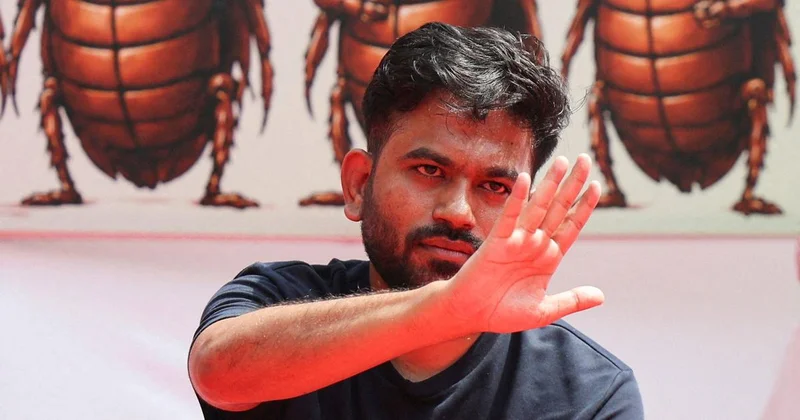
Cockroach Janta Party founder Abhijeet Dipke said on Wednesday that the political campaign would operate as a pressure group for now, ANI reported.
Speaking to reporters in Maharashtra’s Chhatrapati Sambhajinagar, he said the decision was taken because “what India needs right now is a pressure group”.
Pressure groups are viewed as formal or informal organisations that seek to influence government policies and decisions without contesting elections. They can act as a bridge between citizens and the government.
Ahead of a meeting of the core members of the CJP, Dipke said on Wednesday that the protests held in Delhi against alleged mismanagement of competitive examinations showed the citizens’ dwindling trust in “the political system, the judiciary, the media or the Election Commission”.
In view of this, the CJP would hold discussions about the government’s Ethanol Blended Petrol programme and rising unemployment in the future, PTI quoted Dipke as saying.
“The support that our movement received was not limited to education,” he said. “That is why we believe that, to restore accountability and neutrality in these institutions, a public movement and public pressure are needed.”
Dipke added that the CJP’s call to action was successful because “people rose above their own ideologies and political party lines to come together against things that are weakening our democracy”.
He also said that activist Sonam Wangchuk would continue to mentor the members of the political campaign.
The protests against alleged mismanagement of several competitive examinations had begun on June 6, when the CJP staged a demonstration at Delhi’s Jantar Mantar to demand the resignation of Dharmendra Pradhan, the Union education minister at the time.
On July 20, thousands joined the protest. This came two days after the police forcibly took activist Sonam Wangchuk, who had been on a hunger strike for three weeks, to hospital.
The protesters’ march to Parliament was met with a crackdown by the police. Dozens were injured as the police used lathis, fired tear gas shells and pellet guns against the demonstrators. The police action turbocharged the agitation, which spread to other parts of the country. Pradhan resigned as the education minister on July 25.
The CJP had agreed to call off the protests after Pradhan’s resignation.
Edited by Sneha.
Also read: How Abhijeet Dipke created a broad-based idea of politics that put the BJP on the backfoot
We welcome your comments at letters@scroll.in.