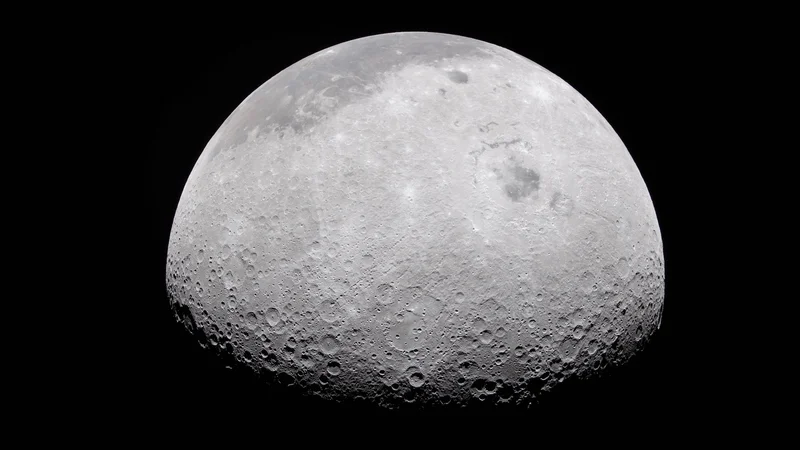
A rogue piece of a SpaceX rocket is reported to have crash landed on the moon.
Announced Tuesday by NASA, the space agency and Elon Musk-owned space company have been tracking a stray upper stage from a Falcon 9 rocket launched last year to deploy Firefly Aerospace’s Blue Ghost 1 lunar lander. Reported by the BBC to likely have crashed on the lunar surface at 07:35 a.m. BST, the rocket section is estimated by the news outlet to weigh about 4,000 kilograms (8,000 pounds).
According to NASA, "solar activity and gravitational forces" caused the upper stage of the rocket, which takes over from the boosters in space, to divert course to the moon. The agency predicted SpaceX's object would crash near the Einstein and Bell craters on the moon's surface, the resulting crater to be 60 feet wide and 12 feet deep. That's one large divot.
However, NASA stipulated "the impact poses no danger to Earth."
The object was identified by astronomers using public data, NASA says, with confirmation of an impending moon impact later made by NASA's Center for Near Earth Object Studies (CNEOS), located at the agency's Jet Propulsion Laboratory (JPL) in California. CNEOS tracks orbiting asteroid and comet and evaluates their odds of impacting Earth.
You can't watch the impact from Earth, but NASA says its Meteoroid Environments Office will be using telescopes at the Marshall Space Flight Center in Huntsville, Alabama, to take images of the event (so stay tuned for moon crash pics).
If you're worried, NASA described the event of an upper stage crashing on the moon as "a technically accepted and safe method and, in some cases, can be the only practical option for missions in low lunar orbit." The agency says its scientists will collect data from the event and described it as providing "valuable insight" into object tracking in space and the moon's geology, especially ejecta plumes — the trajectory of dust, rocks, and material dislodged by a force.
As the agency pointed out, though human made objects are rare, the moon is regularly hit by meteoroids. Why? It's like a shitty party: no atmosphere.
Shannon Connellan is Mashable's Senior Editor, General Assignments, based in London. She has been Mashable's UK Editor (and still manages the illustrious UK team) and Australia Editor, but emotionally, she lives searching for Exit 8. A Tomatometer-approved critic, Shannon writes about entertainment, tech, social good, science, culture, and Australian horror, and loves to nerd out with movie stars, filmmakers, and TV creators.