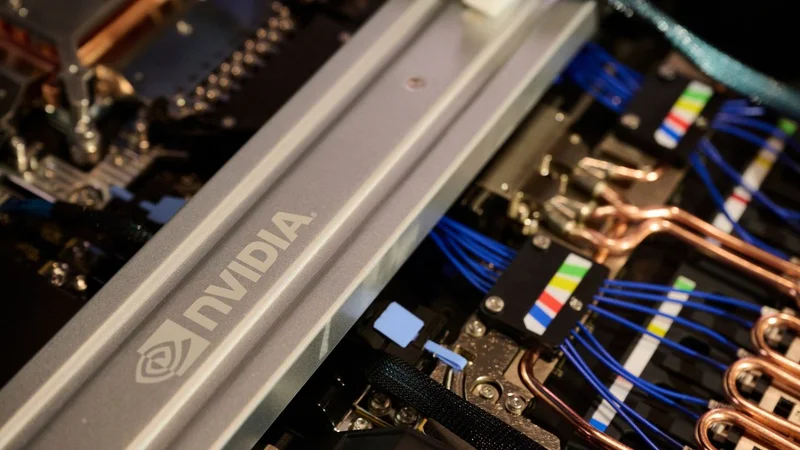
Elon Musk on Tuesday said in an X post that SpaceX and xAI will exclusively use Nvidia GPUs because 'they are the best.' He later clarified during SpaceX's earnings call that Nvidia's Vera Rubin NVL72 rack-scale system's design is above everything else that is available today, which is certainly praise for Nvidia, but not such a good sign for other developers of merchant AI accelerators.
"Going forward, we have decided to build exclusively on Nvidia, because we think the Vera Rubin architecture is the best architecture," Elon Musk said during SpaceX's earnings call. "We think it is the best AI computer, and we greatly value our close cooperation and partnership on many levels with Nvidia. We are exclusive to Nvidia. […] We think the design of the NVL72 VR[200] computer is a much better design than, say, having a standard rack style design."
Historically, xAI has exclusively used Nvidia's Hopper and, more recently, Blackwell hardware to train multiple generations of Grok. Although AMD has used Grok-1 on its Instinct MI300X accelerators, there has never been a public announcement or credible evidence that xAI has evaluated or used AMD Instinct, or other non-Nvidia accelerators in production. xAI's Colossus supercomputers have been using Nvidia's accelerators for years, so the official exclusivity looks more like a formality that gives a strong testament for Nvidia rather than a decision that was hard to make.
When it comes to the praise of the cable-less design of compute trays in Nvidia's Vera Rubin NVL72 VR200 rack system, then Musk's admiration of this architecture is understandable, as while expensive, such trays greatly improve serviceability, assembly speed, and reliability by eliminating a large number of manual cable and hose connections that are common sources of installation errors and failures.
Interestingly, but Musk's SpaceX plans to deploy Vera Rubin not only in its own and xAI's data centers, but also in space.
"With respect to the Starmind AI satellite, which will be essentially an optimized Vera Rubin NVL72 computer, this is not some sort of far future distant thing; we expect to start launching this next year," Musk said. "We think the design of the NVL72 VR[200] computer is a much better design than, say, having a standard rack style design. We expect to actually deploy this on the ground as well as in orbit, because we think it is going to be a radical simplification of the normal NVL72 rack."
Deploying an NVL72-scale machine will be by far a more ambitious project than Nvidia has in mind with its Space-1 Vera Rubin Module that is designed to deploy several, perhaps a dozen, of Rubin AI accelerators in space. 36 Vera CPUs and 72 Rubin AI GPUs offer rather formidable performance, though many questions remain about the cooling and reliability of such racks in space.
Get Tom's Hardware's best news and in-depth reviews, straight to your inbox.
Anton Shilov is a contributing writer at Tom’s Hardware. Over the past couple of decades, he has covered everything from CPUs and GPUs to supercomputers and from modern process technologies and latest fab tools to high-tech industry trends.