Growing up as a kid with a rebellious streak, there was a time in my life when I tried to resist my Italian heritage. My father was born in Abruzzo, and I was always close to Italian culture as a result, but I spent years trying to distance myself from it. It was a futile resistance. I couldn’t help but absorb cultural quirks from my father and his friends. I never realized that until the first time someone noted how much I talk with my hands. I felt like a walking stereotype at the time, but I’ve since come to embrace the theatrical way I communicate. Nothing emphasizes your frustration like an impassioned flick of the wrists.
I don’t think the Melbourne-based developers at House House had this in mind when they made Big Walk, but I am going to claim the co-op game for my culture nevertheless. Big Walk understands that dramatic hand gestures aren’t just fun to pull off; they’re a great communication tool, too.
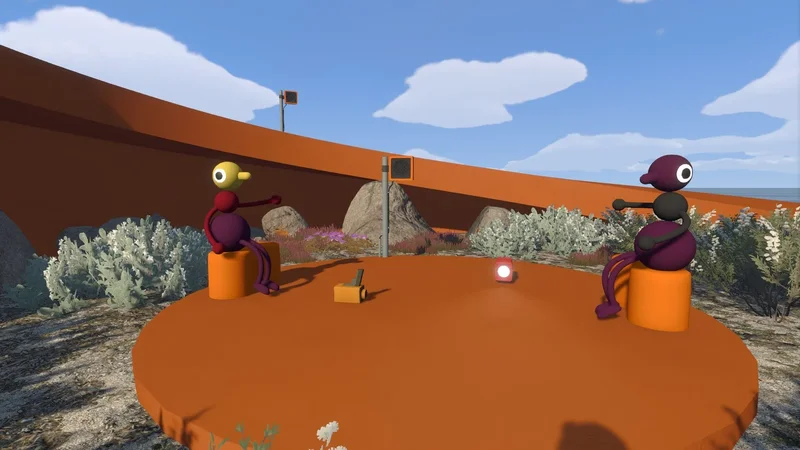
In Big Walk, you control a minimalistic character that looks a bit like a toy ant with three body segments. (My crew refers to the creatures as Chex Mix Breadsticks.) It also, crucially, has noodly arms with balled fists at the end. While you can talk to other players using proximity chat in Big Walk, you can also move your arms around for some non-verbal cues. You don’t have a lot to work with: You can either toss your hands up into the air or stick them out in front of you.
It turns out that’s all you need to talk with your hands. When I fired up Big Walk for the first time, I immediately started playing with those buttons, flailing my arms around to amuse myself while I walked. The more I played, though, the more I naturally started moving my arms deliberately as I would in real life. When I was excited, I would toss both hands into the air to celebrate a puzzle solution. If I was trying to work out a puzzle solution, I would point to my teammates to direct them around. My friends picked up the same habits. Pretty soon, our sessions looked like a night at the Italian American Club that I spent many evenings at as a kid watching dudes named Umberto play poker.
The more I played Big Walk, the more I realized that the gestures aren’t just for comedic effect. They’re incredibly useful, and even necessary, for solving puzzles. Big Walk often toys with communication by limiting your ability to speak to one another. Sometimes a puzzle requires your team to separate out of proximity chat’s range. Other times, a team member is thrown behind a soundproofed wall that they can’t hear through. In those moments, the gestures become a crucial way to signal solutions to your teammates. Pointing things out, drawing in the air, tossing your hands up to signal that your friend is on the right track — these cues become as foundational to communication as talking. There are entire coordination-heavy puzzles you can solve without speaking a word to one another.
That design decision genuinely warms my heart. Sure, it’s fun for me as a notorious hand-talker to wave my arms in a game, but it’s more so a great accessibility consideration. It’s a minimal bit of in-game sign language, but many of the puzzles are built around the few gestures you have. You can also find a whiteboard that you can write messages on and hold them up to one another, or use flashlights and laser pointers to blink messages to one another. Little decisions like that help sell Big Walk’s ultimate point about communication. It wants you to think about the different ways people can talk to one another, forming almost telepathic bonds. Your body can be part of that, and Big Walk gives you and your friends space to work out a shared language that you’ll need to use by the end of your adventure.
I left Big Walk feeling great about my Italian quirk, but also more aware of how I could stand to be even more communicative. I hope to see more multiplayer games follow in Big Walk’s footsteps. Our digital hands should be able to do a lot more than hold a gun.