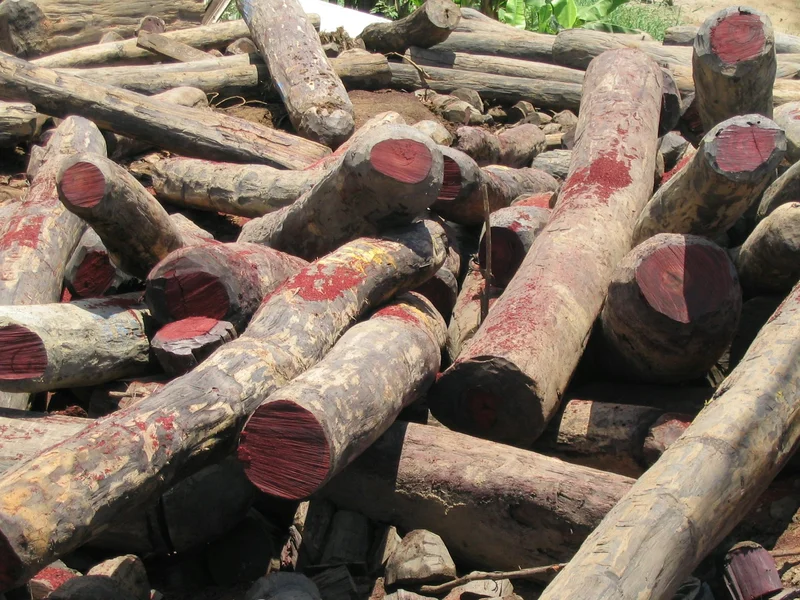
For millennia, the Wounaan people, who live in parts of what is now Panama and Colombia, have hewn and sculpted various woods. Cocobolo rosewood, Dalbergia retusa, is particularly favored for carving ceremonial staffs used in traditional medicine and commercial art depicting tropical plants and animals.
Wounaan are just some of the people around the world who have used rosewoods to make a wide range of items, including gunstocks, furniture and musical instruments. There are now more than 140 tree species commercialized as rosewoods, all with lustrous, dense and typically reddish wood.
Beginning in the late 2000s, global demand for rosewood exceeded the legal supply. The beautiful woods became popular investments, particularly during China’s real estate boom, and also are renowned tonewoods, or woods used for musical instruments. By 2012, cocobolo’s value in China had skyrocketed to over US$13,000 per cubic meter ($371 per cubic foot). It can now cost three times that – much costlier than, for example, red oak at about US$1,500 per cubic meter ($43 per cubic foot).
In 2011, loggers started illegally cutting rosewood trees in the mature forests of eastern Panama where Wounaan people live. In Panama, most of the Indigenous Wounaan and many of the Emberá peoples do not have legal rights to those forested lands, despite having lived in them for generations. Once the illegal loggers invaded, Wounaan authorities elected by the communities filed legal complaints with local and national Panamanian officials, while also seeking support from the media and the public.
But that was only the beginning.
During that initial logging season, there was a three-month standoff between illegal loggers and Wounaan community members. A logger killed an elected traditional authority, hapk'ʌʌn Aquilino Opua Puchicama. In response, the logger, Ezequiel Batista, was killed.
Wounaan realized that loggers were willing to kill to get the rosewood.
The illegal logging was intense for four years. In 2014, tiny Panama was the 16th-largest supplier of rosewood to China, exporting US$55.5 million worth of it there. Before the rosewood boom, cocobolo was listed as “vulnerable, having high extinction risk in the wild” by the International Union for Conservation of Nature. But by 2019, it was reassessed as “critically endangered.”
That’s one way to tell the story – as a more-or-less linear sequence of these tragic and catastrophic events. But in conducting and presenting our research, we have chosen another way, reflecting and encompassing Wounaan lives, values, science and experiences, finding not only loss but also the joy of resistance and care for others.
A broad perspective, and a local one
We are part of an effort to share this research in a new book, “Interwoven Rosewood: Collaborative Ecologies, Colonial Entanglements, and Indigenous Resistance.” It’s a multiyear collaboration by the Wounaan National Congress (Wounaan Podpa Nʌm Pömaam), which represents all Wounaan people in Panama; the Wounaan Local Congress of the Majé Community (Wir Haigpai Podpa Nʌm Majé), representing a community with many cocobolo artists that was among those most directly affected by illegal logging; and a university professor who collaboratively studies with communities on the environment and conservation.
From the beginning, our goal has been to make this research available to a wide audience. That involves telling the intertwining stories of global rosewood and what happened in Panama, the Wounaan experience, and sharing Wounaan ancestral science and wisdom – all against a backdrop of centuries of attacks on Indigenous lives and land that continue all the way to the present.
Cultivating collaboration
Wounaan, like many Indigenous peoples of lower central and northwestern South America, emphasize tending to relationships. One way in which Wounaan do so is conscientiously sharing and redistributing food, money, wisdom and the like to foster equity.
That collaborative approach runs counter to an extractivist mindset, which can permeate illegal logging and even scientific research, of seeing people and places as resources to be exploited.
So in assembling this research, we – Wounaan and non-Wounaan alike – committed to cultivating research collaboration and co-production of the materials we were assembling.
We planned the research together and set goals for sharing widely what we learned, rather than aiming to publish in scholarly academic journals primarily available to, and useful for, university-affiliated scholars. And we specifically sought to respect Wounaan rights to ancestral insights and wisdom, creating a formal research agreement that ensured, among other provisions, that Wounaan people have “data sovereignty” over the information we assembled and the right to decide what would be done with it.
Interweaving themes
In Wounaan basketry, artists use naturally dyed strands of fiber to weave around a central core, picking up each color as necessary to make the design.
Our version of the illegal rosewood research weaves together three strands: the lowland tropical environment, Wounaan ancestral wisdom and science, and the combined forces of capitalism and colonialism. None of these themes can truly be disconnected from the others or studied separately.
Recognizing the past in the present and future
For Wounaan, ancestral stories have relevance today, structuring and guiding life now and yet to come. For example, the Wounaan ancestral story of creation includes advice from the Creator on how to revise initial errors made in forming humans, showing the importance of making improvements to create change.
The metaphor of spiraling basketry illustrates how the past is an active part of the present and the future. For instance, the extraction of gold in the early Spanish colonial era was not that different from extraction of rosewood by Chinese entrepreneurs in the 21st century.
Celebrating relationships
Everyday Wounaan life embraces “conviviality” – living respectfully and interdependently with other humans and nonhumans. When carving a piece of cocobolo rosewood, a Wounaan artist features the grain. Much as the wood reveals its grain to the carver, nonhumans can communicate and act on their own as well.
Wounaan pay attention to the complexities, obligations and synergies of interwoven lives and forces that shaped and are shaping the world – such as those among plants, laws, birds, maps, animals, scholars, insects, infrastructure, fungi, officials, diseases, trade, trafficking and climate change.
In short websites for the book in English and Spanish, website designer Mavila Trujillo used illustrations, video, photos and audio recordings with short text to make some of that conviviality more visible. For example, she used audio of Wounaan flute music about the agouti – small animals that disperse seeds – with animated illustrations of the animal itself and a Wounaan dancing to the music.
Respecting the experiences of many voices
For Wounaan and many other Indigenous peoples, knowledge can only be gained through experience. Wisdom is learned through the body and its interactions with others in the land and waters, from and through movement and multiple senses, such as music, dance, fragrance, touch, taste and seeing.
To express multiple perspectives on the yearslong struggle against exploitation, Wounaan elected authorities and community members nominated people based on their expertise and experience. With consent from their families, contributions from deceased Wounaan colleagues included ancestral stories and recent writings. Two senior non-Indigenous colleagues who have done decades of work on Indigenous rights contributed as well.
Exposing colonialism and capitalism
Over centuries, Wounaan have experienced – and continue to experience – devastating effects of “settler colonialism,” the practice of exploiting people and spaces – taking and extracting not only physical items but land itself – as well as people’s lives, rights, languages and science.
Settler colonialism and capitalism can work hand in hand, using education, laws, corporate and industrial practices, illegal trafficking and even efforts at environmental conservation in ways that do people harm, including Indigenous peoples.
Wounaan have spent centuries refusing and resisting those forces, fighting against those who take land and rights unjustly. That history includes colonial-era rebellions, using drones to monitor land invasions for legal ecological complaints, and protests against new or proposed laws.
Showing liveliness in the Wounaan meu language
The Wounaan language, Wounaan meu, like many Indigenous languages, emphasizes action, recognizing that people and others are always developing or becoming updated versions of themselves.
Yet sharing information widely often involves translation. In that process, key nuances can get lost, turning action into passivity, for instance, or adding a gender to a word where none existed in the original. To ensure the research celebrated Wounaan meu even when translated into English and Spanish, we took care to use words that reflect Wounaan meanings, such as the difference between “traditional doctor” and “shaman,” or respect regional Indigenous etymology, such as translating the Wounaan meu “jap” as “pirogue” instead of “canoe.”
For some elements, two of us – Chenier and Doris – recorded Wounaan speaking their material in Wounaan meu, and then transcribed and carefully translated them to preserve rich elements of Wounaan thought and language.
Nurturing joy and beauty
Ultimately, our collaborative research embraces self-determination and the joy and beauty that accompany it. It integrates both “wajaug hʌidʌm” (pronounced like wa-HOWGP OIU-dum) or being in good and positive relations with others and “hãba poso honee nʌm” (pronounced like ug-BA po-so OH-ney nuom), joyfully working together.
We are continuing our collaborative co-creation: In the works are a Spanish version of the book with translator Alfonso Conde, an abbreviated Spanish-language book centered on the Wounaan-authored chapters, an analysis of the spoken Wounaan meu and written Spanish chapters, and a multimedia website for Wounaan schoolchildren.
In this way, we carry on respecting ancestral wisdom and science to cultivate the just futures that Wounaan envision for themselves.