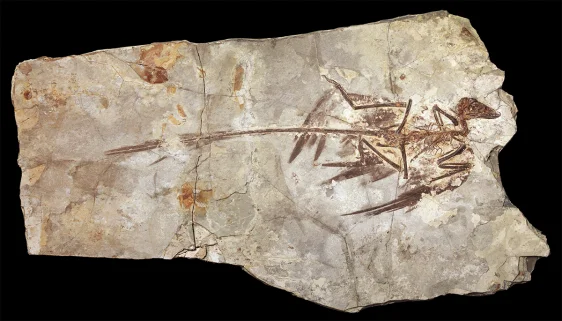
Dinosaurs are famously big-boned, so much so that enormousness is often seen as a defining characteristic of the prehistoric beasts. Argentinosaurus, for example, was the most massive animal ever to walk the face of the Earth, weighing more than 80 tons. The smallest non-avian dinosaurs weighed a little less than a pound—around the size of a bunny. That might seem pretty small (especially compared to the lumbering argentinosaurus), but when you take into account just how small vertebrates can get, it’s still pretty big.
Take their descendants, the birds (or avian dinosaurs). Weighing in at less than 2 grams, the bee humming bird would be dwarfed by the smallest non-avian dinosaur. And the dwarf gecko, the world’s smallest lizard, fits comfortably on a fingertip with room to spare.
So where are all the tiny dinos? A new study published today in the journal Evolution is taking a stab at answering that question.
To head off an obvious explanation, it’s probably not because tiny dinos didn’t leave any bones for us to find. The fossil record may be incomplete, but it still contains the miniature remains of small birds and mammals (not to mention insects). In fact, the vast majority of living mammals (75 percent) and birds (90 percent) are smaller than the most diminutive non-avian dinosaurs.
Read more: “Sharks Show How Animals Scale Like Geometric Objects”
“Small animals dominate modern ecosystems,” study co-author Stephanie Lechki of Princeton University said in a statement. “If we want to understand how today’s biodiversity evolved, we need to understand why tiny dinosaurs appear to have been missing.”
To do exactly that, Lechki and her colleague Roger Benson from the American Museum of Natural History turned to something even smaller—numbers. They used mathematical models estimating the body size of organisms based on how efficiently their physiologies convert energy into offspring. Their models successfully predicted the size distributions of mammals, birds, and turtles, but were less successful at predicting the body size distributions of snakes, lizards, crocodilians, and non-avian dinosaurs.
Instead of physiological restrictions on size, they determined non-avian dinosaurs were limited by ecological restrictions, like competition, predation, and the availability of niches. Basically, there was no room at the bottom for tiny dinos. According to their research, those little upstarts, mammals, were occupying the role of “tiny animal” in the ecosystem.
There’s another interesting twist to their research, too. According to the team, the innovation that allowed birds to become smaller than their non-avian ancestors was powered flight. “The ability to fly may have opened entirely new ways of life,” Lechki said. “Once birds entered those new ecological niches, they were free to evolve body sizes that had simply not been possible for other dinosaurs.”
That’s one giant leap for birds, and several smaller body sizes for birdkind.
Lead image: Mick Ellison / ©AMNH