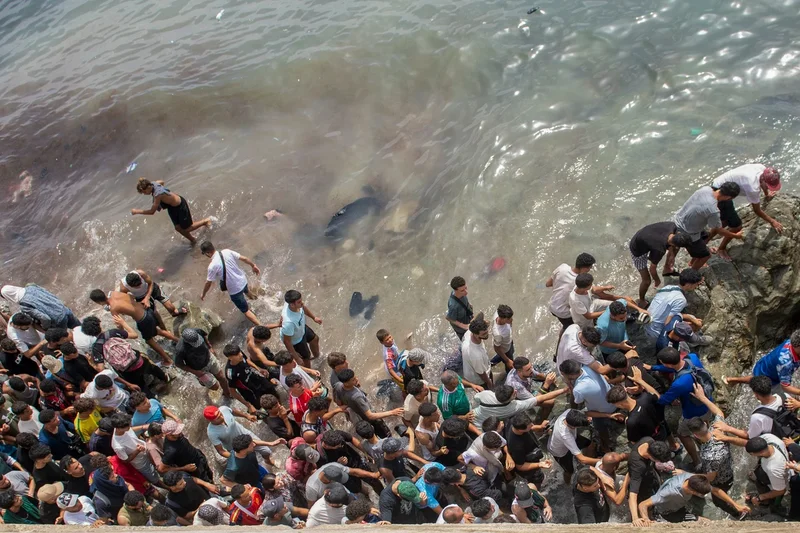
Ceuta, a small Spanish enclave on the Moroccan mainland, was unprepared for the arrival of more than 70,000 undocumented migrants on 30 July. They arrived mostly by sea, from Morocco via the Tarajal breakwaters and its shoreline.
The minuscule city of just seven square miles had few provisions for food, shelter or support for the unexpected arrivals. This was a shocking exposure of the apparent porosity of the city’s heavily fortified borders.
More than 95 per cent of the migrants have since returned via the land border, following emergency negotiations between the governments of Spain and Morocco. Those who remain have overwhelmed the city’s migrant reception centres.
According to the latest figures from Spain, at least 88 people are known to have lost their lives while attempting to cross into Ceuta.
The mass influx, however temporary, has fuelled some far-right and nationalist political reactions, as well as protests by those resisting Europe’s rising populism and anti-immigrant sentiments.
It has also led to the swift installation of yet another border separating Spain, and Europe, from Morocco by way of a sea barrier at the Tarajal.
Ceuta, like its even smaller sister city of Melilla, also an enclave on the Moroccan mainland, is a border flashpoint. These cities occasionally spark intense debates on undocumented migration to Spain, and hence to the EU.
The fortification of the border at Ceuta and Melilla resonates with the history of Spanish control over this part of north Africa, as well as with Spain’s role as a southern guardian of the European Union.
History of movement
There is a long history of colonialism and migration behind this latest incident. First known as Phoenician settlements and then as Roman ones, Ceuta and Melilla became part of the 8th-century Islamic conquest of the Mediterranean region. Their locations by the sea turned them into key ports and trading points for commerce across the Mediterranean.
As the Portuguese empire expanded in the 15th century, Ceuta was captured and, shortly thereafter, the Spanish and Portuguese crowns were united. When Portugal regained its independence in 1640, Ceuta remained under Spanish control. Melilla, on the other hand, was captured by the Duke of Medina Sidonia in 1497 and has been under the Spanish crown ever since.
In the 19th and 20th centuries, Spain’s control over northern Morocco expanded, while France controlled the rest of the country. As European powers agreed a division of protectorates in the region in 1912, Ceuta and Melilla did not fall under this agreement, since they were historically Spanish-administered towns. The Rif war of 1921-26 was a time of bitter defeat for Spain in the Maghreb, turning Spain’s continued control over Ceuta and Melilla into a symbol of Spanish might in the region.
General Francisco Franco launched the Spanish civil war from Spanish Morocco in July 1936, paving the way for 36 years of dictatorship. The transition to democracy in the 1970s coincided with the start of substantial migration to Spain from Morocco. This increased with Spain’s entry into the European Community in 1986, provoking anxieties about diversity and nationhood that remain unresolved.
The cities became guardians of Spain’s frontiers in the Maghreb. When Spain joined the Schengen area in 1991, this role extended into a Europe-wide duty. The EU has since invested hundreds of millions of euros over the years into fortifying these border towns, including with surveillance and fences. Ceuta and Melilla, small though they are, uphold this history, and have often been accused of doing so in serious contravention of human rights.
Fortress Europe
The notion of Europe as a gated “fortress” has long shaped the continent’s migration policies.
The borders with Ceuta and Melilla turn more brutal in this context. Moroccans, sub-Saharan Africans and many others attempt to brave razor wire, deep water and other perils to claim a foothold in Spain. They are driven by climate change, global inequality and the dream of a better life in Europe, among other factors.
Meanwhile, colonial legacies continue to shape the geopolitics of this region in complex ways.
Morocco does not recognise Ceuta and Melilla as Spanish, and seeks to claim them as Moroccan in diplomatic exchanges with Spain. But it maintains its own colonial exploits, having invaded the former Spanish colony of Western Sahara to its south in the 1970s, sending in 350,000 citizens to settle in Western Sahara.
Another mass crossing of the border at Ceuta occurred in 2021 – though not at the scale of the latest one – amid a diplomatic row, as Spain allowed the leader of the Western Sahara independence movement to be treated for COVID in Spain.
Ceuta’s local government has blamed the Moroccan government for this latest mass influx, by allegedly loosening border controls.
Migration is a repeated theme in the political tensions between Spain and Morocco, which remain unresolved. This incident adds yet another layer to Ceuta’s chequered history as a Spanish town on north African soil. In discussing the politics present in this incident, it is also worth recalling that Ceuta and Melilla’s roles as European borders in north Africa can at times be deadly.