- Published
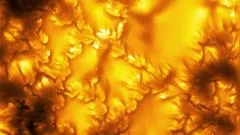
Scientists using the world's most powerful solar telescope have captured the surface of our Sun in new, unprecedented detail.
Images and footage show "whirlpools" of activity that it has not been possible to see before.
It is the Sun's magnetic field being twisted and moved by the motion of hot gas.
That constant swirling is a driving force behind bursts of energy from the Sun, creating so-called space weather, that can disrupt Earth's power grids and satellites, and could even injure astronauts.
"The Sun is the source of that energy and of all of that space weather," explained Dr David Boboltz from the US National Solar Observatory, external (NSO).
Capturing more detailed pictures of our solar system's star will help in responding to that weather, he said.
"To figure out and eventually predict space weather, we want to understand the physics of the Sun, all the way down to the smallest scales."
The findings, published in the journal Nature, external, were made possible by the Inouye Solar Telescope - a facility built on a high peak in Hawaii, where clear blue skies are free of dust.
Zooming in on the Sun's surface, the team captured a detailed view of swirling vortices.
NSO astronomer Dr David Kuridze, told BBC News: "These twisting motions are creating magnetic energy, which can build up to produce those large-scale explosions."
Explosive space weather
The term for what the scientists have discovered on the Sun is "Kelvin-Helmholtz instability".
The phenomenon happens when fluids - in this case hot gases - slide past each other and cause small disturbances to grow into spiralling vortices. In the ocean, it helps explain how ripples become giant, powerful waves.
Dr Friedrich Woeger, also from the NSO, explained that finding it on the Sun's surface not only explained the dynamics behind space weather, but even why the surface of the Sun is so hot.
It shows how energy is transported upwards.
"Once there's enough energy wound up in the higher layers, it can then be released, as a flare or what's known as a coronal mass ejection," he said.
Boboltz added that, as well as the practical need to understand and protect ourselves from space weather, the new findings were a reminder that the Sun is a "unique laboratory".
"It's our closest star," he said. "And it can help us understand some very basic laws of physics.
"The first experimental proof of Einstein's general relativity came from solar eclipse observations.
"So simply for human knowledge," he added, "we need to have experiments like this".