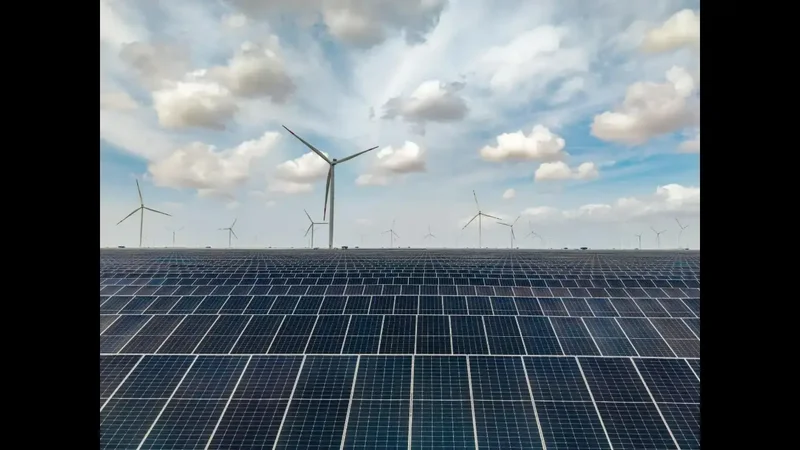
After building one of the world's largest renewable-energy bases, India must now turn its attention to ensuring that the electricity generated from clean sources is effectively integrated into the power system, experts said on Wednesday.
They said the country has reached a stage where the focus should move beyond adding generation capacity to improving how clean power is transmitted, stored, procured and utilised across sectors.
According to an official statement, India has installed 283.46 GW of non-fossil-fuel power capacity, of which 274.68 GW comes from renewable sources. The country also added a record 55.29 GW of non-fossil capacity during FY2025-26, making it the world's third-largest in installed renewable-energy capacity.
The issue was discussed at the seminar,
"New Energy: From Evaluation to Adoption", organised by Think Change Forum in partnership with Delhi Research Implementation and Innovation (DRIIV), Office of the Principal Scientific Adviser to the Government of India, which was the knowledge partner.
Existing bottlenecks limiting clean-energy useExperts at the seminar said that expanding renewable capacity alone would not be enough unless supporting infrastructure keeps pace.
They pointed to transmission constraints, limited energy-storage capacity and uncertain procurement pathways as key hurdles preventing the productive use of clean energy.
The official statement said these challenges had already led to around 8,133 GWh of solar electricity being curtailed during April-June 2026 because of transmission constraints and grid-security requirements.
It added that India would require around 336 GWh of energy-storage capacity by 2029-30, rising to 411 GWh by 2031-32, to reliably integrate renewable power into the grid and maintain stability.
'Implementation should now be the priority'Former International Solar Alliance director general Ajay Mathur said the country's focus should be on adopting clean-energy technologies at scale while improving energy efficiency, expanding electrification, supporting decarbonisation of energy-intensive industries and creating conditions for new technologies to be deployed.
Former MNRE Secretary Upendra Tripathy said practical and commercially viable transition pathways were needed for legacy sectors, adding that implementation should now be the priority.
The statement said experts also called for better alignment of policy, finance, technology and demand, alongside the development of bankable adoption models. They also emphasised accelerating transmission and storage infrastructure and strengthening domestic value chains to advance India's clean-energy transition.
The experts concluded that the next phase of the country's clean-energy journey should be centred on integrating, adopting and productively utilising the capacity that has already been created.